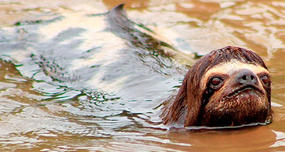
Beavers can swim half a mile underwater on one gulp of air.
Beavers Swim Half a Mile Underwater on One Breath
Next time you're holding your breath in the pool, remember this: while you're struggling to make it across to the other side, a beaver could be casually swimming half a mile underwater without coming up for air. That's roughly eight football fields, all on a single gulp of oxygen.
These furry engineers can hold their breath for up to 15 minutes, though they typically surface after 5-6 minutes during normal activity. Compare that to most humans, who max out around 2 minutes with training. So what's their secret?
Built-in Scuba Gear
Beavers didn't evolve to be nature's most impressive dam builders by accident. Their bodies are precision-engineered for aquatic life. First up: massive lungs. Relative to their body size, beavers have some of the largest lung capacity in the mammal world. More air storage means more time underwater.
But lung size is only part of the equation. Beaver muscles contain 10 times more myoglobin than human muscles. Myoglobin is the protein that stores oxygen in muscle tissue—think of it as a backup oxygen tank built right into their bodies. When they dive, they're not just relying on the air in their lungs; they're tapping into oxygen reserves throughout their entire muscular system.
The Slowdown Effect
Here's where it gets really clever. When a beaver dives, its heart rate automatically drops—a phenomenon called bradycardia. By slowing down their heart, beavers reduce how quickly their body burns through oxygen. It's like switching from highway driving to idle mode, making that single breath last exponentially longer.
This isn't a conscious decision. The moment a beaver's face hits the water, its autonomic nervous system triggers the response. Instant efficiency mode, activated.
These adaptations serve multiple survival functions:
- Foraging for aquatic plants and tree bark without constant surfacing
- Building and maintaining underwater dam structures
- Escaping predators by disappearing beneath the surface
- Accessing underwater lodge entrances in winter when the surface is frozen
The Half-Mile Club
So yes, beavers really can swim over half a mile while completely submerged—roughly 800 meters in a single dive. At their cruising speed of 6 mph, they can cover serious distance before needing to breathe. That's faster than many humans can run on land, happening entirely underwater.
This capability makes beavers incredibly elusive when threatened. By the time a predator realizes where the beaver went, it could be emerging from the water on the complete opposite side of a lake.
The next time you see a beaver pond, remember: beneath that calm surface might be a furry submarine, cruising along on a breath of air that would have run out on you seven minutes ago. Nature's engineers don't just reshape landscapes—they've reshaped what's possible for a mammal in water.
Frequently Asked Questions
How long can beavers hold their breath underwater?
How far can a beaver swim without coming up for air?
What allows beavers to stay underwater so long?
How fast can beavers swim underwater?
Why do beavers need to hold their breath so long?
Verified Fact
This fact has been reviewed and verified against original sources.
Show verification details
Beavers can hold their breath for up to 15 minutes and swim over half a mile (approximately 800 meters) while submerged.
Related Topics
More from Animals
View all Animals →