
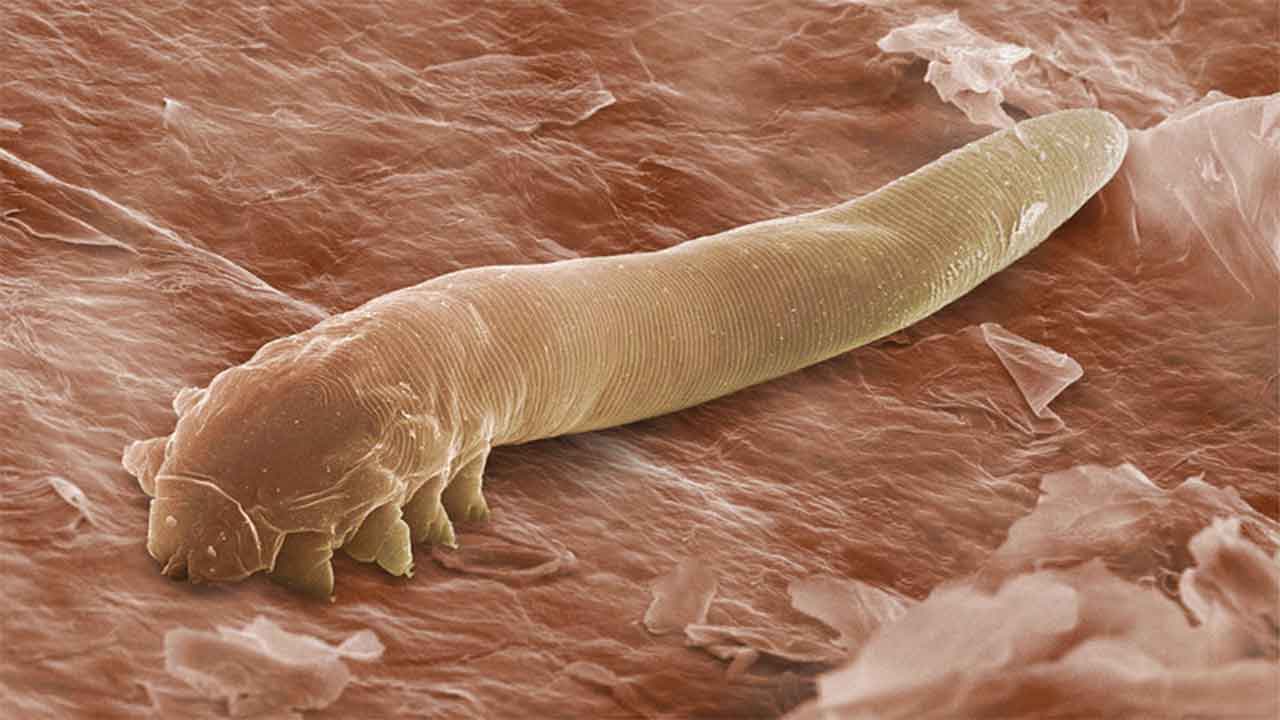
Demodex are microscopic arachnids living in nearly everyone's facial pores. Scientists believed for decades that they had no anus and burst when they died, releasing accumulated waste. A 2022 genome study proved this wrong—they do have anuses and excrete normally.
Face Mites Don't Explode When They Die (Anymore)
Right now, hundreds of microscopic eight-legged creatures are crawling across your face. Demodex folliculorum and Demodex brevis—tiny arachnids about 0.3mm long—live in nearly everyone's hair follicles and oil glands, most densely around the nose, eyebrows, and eyelashes.
For decades, dermatology textbooks taught that these face mites had a bizarre anatomical quirk: they supposedly lacked an anus entirely. According to this theory, the mites' digestive system was so efficient that waste just accumulated inside their bodies throughout their two-week lifespan. When they finally died, they would essentially burst, releasing all that stored fecal matter directly into your pores.
The Exploding Mite Theory
This "no anus" hypothesis wasn't just scientific trivia—it had real medical implications. Researchers believed that when Demodex mites died and released their accumulated waste, it triggered inflammation and immune responses. This was thought to explain conditions like rosacea, where faces become red and inflamed, particularly in areas with high mite populations.
The theory seemed to make sense. Patients with rosacea often have higher numbers of Demodex mites, and the inflammation pattern matched the "waste explosion" hypothesis. Medical literature repeated the claim for years, and it became one of those "fun facts" about the gross things living on your body.
Then Came the Genome
In 2022, researchers at the University of Reading in the UK decided to sequence the complete genome of Demodex folliculorum. Using high-powered electron microscopy and genetic analysis, they made a discovery that upended decades of dermatological assumptions: Demodex mites do have anuses.
The research team found genes responsible for anal development and function, and microscopy confirmed the actual anatomical structure at the mite's posterior end. They don't explode when they die. They just... poop. Like normal animals.
Why Did We Get It Wrong?
The mites are incredibly tiny—about the width of a human hair—making detailed anatomical studies difficult without modern imaging technology. Early researchers using less sophisticated microscopes simply couldn't see the anus, so they assumed it didn't exist. The hypothesis became accepted fact, repeated in papers and textbooks without re-verification.
This is a perfect example of how scientific "knowledge" can calcify around incomplete observations. It took genetic sequencing—a technology that didn't exist when the original hypothesis was formed—to finally set the record straight.
What About Rosacea?
The updated understanding of Demodex biology doesn't mean they're harmless. High mite populations are still associated with skin conditions, but the mechanism is different than previously thought. Rather than exploding corpses, inflammation likely comes from:
- The mites' continuous excretion (they poop while alive, not just when dead)
- Bacterial infections the mites may carry in their digestive systems
- Physical irritation from crawling through hair follicles
- Immune responses to mite proteins
So your face mites are still gross—they're just gross in a more conventional way than we thought.
Frequently Asked Questions
Do Demodex face mites have anuses?
What happens when face mites die?
Are Demodex mites arachnids?
Does everyone have face mites?
Do face mites cause rosacea?
Verified Fact
This fact has been reviewed and verified against original sources.
Show verification details
Original claim outdated - 2022 genome studies confirmed Demodex DO have anuses. Rewrote to focus on the fascinating myth-busting story, which is more interesting than the false claim.