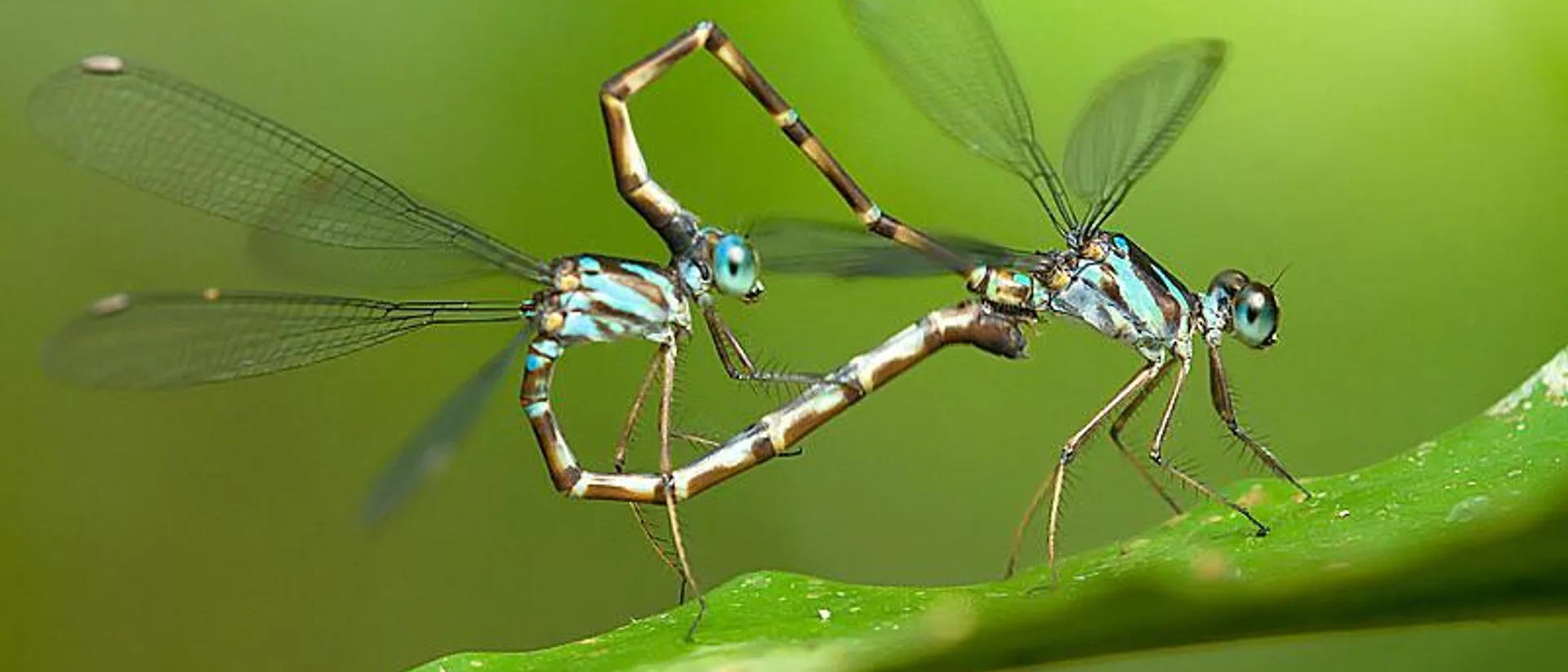
Dragonflies Form Heart Shapes When They Mate
If you've ever spotted two dragonflies connected in mid-air forming what looks like a floating heart, you weren't imagining things. This distinctive shape is real, and it's one of nature's most photogenic mating rituals.
The heart-shaped position—scientists call it a "mating wheel"—happens because of the unique way dragonflies and damselflies reproduce. Unlike most insects, male dragonflies have two sets of genitalia. The primary opening is near the tip of the abdomen, but the functional reproductive organs are located near the base, on segments 2-3.
The Acrobatic Process
Before approaching a female, the male dragonfly performs a peculiar bit of preparation. He curls his abdomen forward to transfer sperm from his primary genital opening to his secondary genitalia near the front of his body. Think of it as loading the equipment before use.
Once ready, he flies up to a female and grasps her behind the head using claspers at the tip of his tail. She's now stuck—literally. The male's grip is strong enough that he can carry her in flight.
Here's where the heart appears: the female curves her abdomen downward and forward, connecting with the male's secondary genitalia to receive the sperm. Their two bodies form a loop that, especially in the more flexible damselflies, looks remarkably like a Valentine's heart.
Romance or Strategy?
While the heart shape seems romantic to human observers, the behavior is actually driven by intense reproductive competition. Male dragonflies have evolved specialized anatomy to remove sperm from previous mates before depositing their own. The elaborate positioning ensures successful fertilization.
The duration varies wildly by species. Some dragonflies complete mating in seconds—a quick aerial hookup. Damselflies, on the other hand, might remain connected for hours, drifting together over ponds and streams in their heart-shaped embrace.
After mating, many males don't simply fly away. They'll guard the female while she lays eggs, either by maintaining their grip (staying in the wheel position) or by hovering nearby to chase off rival males. Some species even stay connected during egg-laying, the female dipping her abdomen into water while the male holds her steady above.
Best Time to Spot Them
You're most likely to see mating wheels during late spring and summer near freshwater habitats. Look for them:
- Hovering over calm ponds and slow streams
- Resting on vegetation near water
- In tandem flight, the heart shape wobbling through the air
- During warm, sunny days when dragonflies are most active
Next time you're near water on a summer day, keep your eyes open for these aerial hearts. What looks like nature's valentine is actually an intricate evolutionary dance that's been perfected over millions of years. The dragonflies aren't being romantic—but they're certainly giving us something beautiful to watch.
Frequently Asked Questions
Do all dragonflies make a heart shape when mating?
How long do dragonflies stay in the heart position?
Why do dragonflies have such an unusual mating position?
Where can I see dragonflies mating in a heart shape?
What's the difference between dragonfly and damselfly mating?
Verified Fact
This fact has been reviewed and verified against original sources.
Show verification details
The fact is accurate. During mating, dragonflies and damselflies form a distinctive heart or wheel-shaped position.