
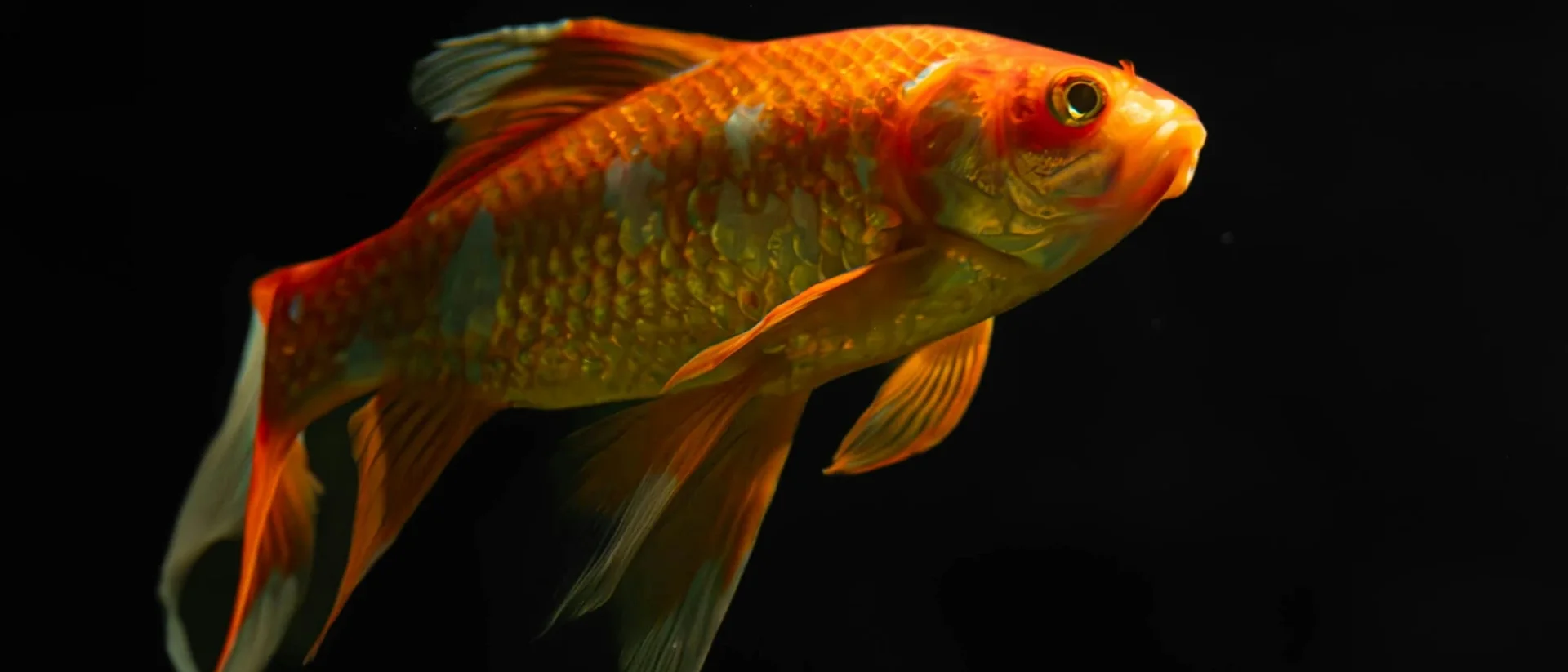
Why Goldfish Turn White in the Dark (It's Not Magic)
Here's something you might not expect: your vibrant orange goldfish isn't permanently that color. Keep it in darkness long enough, and it'll fade to white—or at least a ghostly pale version of its former self. This isn't some weird goldfish magic; it's pure biology, and it reveals something fascinating about how these fish actually work.
The secret lies in specialized cells called chromatophores, which are basically tiny pigment factories embedded in the goldfish's skin. Think of them as biological paint buckets, each containing different colors. The ones responsible for that classic goldfish orange are loaded with carotenoids, while darker colors come from melanophores packed with melanin—the same pigment that colors human skin and hair.
Light: The Pigment Switch
Here's where it gets interesting: these chromatophores don't operate on autopilot. They respond to light—specifically, UV light acts as a biological switch that tells melanophores to produce melanin. When goldfish live in well-lit environments, their bodies get the signal to maintain vibrant pigmentation. Remove the light, and that signal disappears.
Research on goldfish pigmentation reveals that melanin-concentrating hormone (MCH) and α-melanophore-stimulating hormone (α-MSH) work as opposing forces. MCH makes fish pale by aggregating pigments, while α-MSH darkens them by dispersing pigments. In darkness, the balance shifts toward paling.
The Slow Fade
This transformation doesn't happen overnight. Depending on the fish and conditions, noticeable fading typically occurs over weeks to months of consistent darkness. Early scientific observations noted that melanin-producing cells of goldfish kept in "utter darkness" became contracted, with pigment eventually reduced significantly.
But goldfish aren't unique in this ability. Many fish species use chromatophores for rapid color changes—background matching, thermoregulation, even communication. What makes goldfish special is how dramatically they demonstrate the connection between environment and appearance.
Not Just About Light
Before you go testing this at home (please don't—it's stressful for the fish), know that darkness isn't the only color thief. Other factors can drain a goldfish's vibrancy:
- Poor nutrition—Goldfish can't produce carotenoids themselves, so they need them in their diet
- Water quality issues—High ammonia, nitrites, or nitrates cause stress and color loss
- Genetics—Some goldfish naturally fade as they age
- Illness or stress—General poor health manifests visually
The darkness phenomenon specifically targets melanin production through light-sensitive pathways. A study on chromatic lights and goldfish found that fish exposed to fluorescent light on white backgrounds appeared paler than those on black backgrounds, and that ocular light reception—what the fish actually sees—plays a major role in body color regulation.
Why This Matters
This isn't just a party trick. Understanding how goldfish pigmentation works reveals fundamental principles of biology: how organisms respond to environmental cues, how hormones regulate physical traits, and how evolution has shaped adaptability. Wild goldfish (actually Carassius auratus, related to carp) evolved these mechanisms for survival—camouflage, temperature regulation, social signaling.
The pet goldfish in your bowl? It's still running that ancient software, even if it no longer needs to hide from predators. Keep it in darkness, and its body dutifully follows genetic programming: no light detected, pigmentation unnecessary, conserve resources. The result: one very pale fish wondering where the sun went.
Frequently Asked Questions
How long does it take for a goldfish to turn white in the dark?
Will a goldfish turn back to orange if returned to light?
What causes goldfish to change color?
Do all goldfish turn white in the dark?
Is it harmful to keep goldfish in darkness?
Verified Fact
This fact has been reviewed and verified against original sources.
Source: View sourceShow verification details
Scientific research confirms that goldfish pigmentation is regulated by light exposure through chromatophores and melanin-concentrating hormones. Studies show goldfish kept in darkness experience reduced melanin production, leading to pale/white coloration. While Snopes rates this as 'unproven' due to limited controlled studies on complete darkness, peer-reviewed research on light/pigmentation mechanisms supports the underlying biological process.