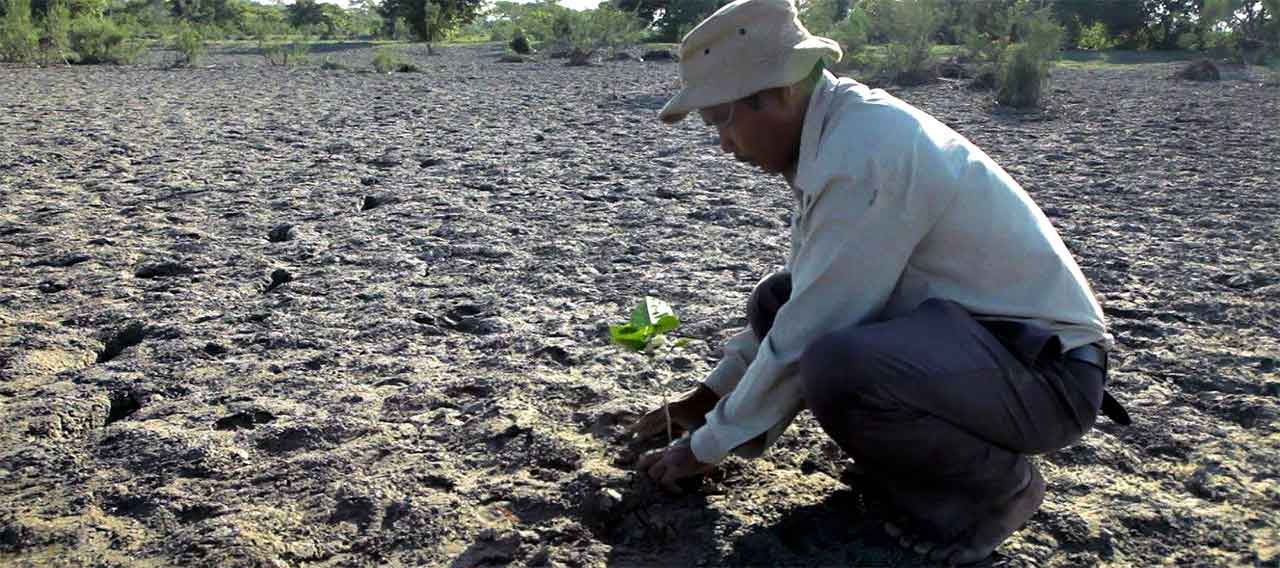
At 17 years old, an Indian man named Jadav Payeng started planting trees on a barren sandbar. At age 47, he lives in his own 1360 acre forest which now houses rhinos, tigers, deer, apes and elephants.
The Forest Man Who Planted an Entire Jungle by Hand
In 1979, a 16-year-old boy named Jadav Payeng stumbled upon dozens of dead snakes on a barren sandbar near his village in Assam, India. They'd died from heat exposure—there were no trees to provide shade. Most teenagers would've felt sad and moved on. Jadav decided to plant a forest.
One tree at a time. By himself. For the next four decades.
The Barren Sandbar That Became a Jungle
The Brahmaputra River had deposited a massive sandbar near Jadav's village, but nothing grew there. The soil was poor, the conditions harsh. The local forestry department told him nothing would survive.
Jadav didn't listen. He started with bamboo—20 seedlings. Then he began planting other species, carefully selecting trees that could survive the floods and droughts. He dug channels to irrigate the land. He built platforms above the saplings to protect them from the brutal sun.
Every single day, he returned to plant more and tend to what he'd already grown.
Welcome to Molai Forest
Today, the Molai Forest (named after Jadav's nickname) spans roughly 1,360 acres—larger than Central Park in New York City. It's not just trees, either. The forest now has a complete ecosystem with multiple layers of vegetation.
And then came the animals:
- Bengal tigers have been spotted multiple times (at least 5 confirmed sightings)
- A herd of around 100 wild elephants visits annually and has even started birthing calves there
- Indian one-horned rhinoceros—an endangered species—have made it their home
- Deer, buffalo, apes, reptiles, and hundreds of bird species thrive in the forest
What was once a dead zone became one of the most biodiverse areas in the region.
The Man Behind the Forest
Jadav never sought recognition. For decades, nobody outside his village knew what he'd done. He lived simply in a small hut on the edge of the forest, making money by selling milk from his buffalo and cows.
It wasn't until 2008—nearly 30 years after he started—that a nature photographer stumbled upon the forest while following a herd of elephants. The discovery led to a journalist investigating who planted it. That's when the world learned about the Forest Man of India.
Awards followed: the Padma Shri (India's fourth-highest civilian honor), recognition from the United Nations, and a documentary about his life. But Jadav keeps planting. "I will continue to plant until my last breath," he's said.
One Person Can Change Everything
What makes Jadav's story so remarkable isn't just the scale—it's the stubbornness. When experts said it was impossible, he proved them wrong. When floods destroyed his early work, he replanted. When people questioned why one man would waste his time, he ignored them.
The Molai Forest stands as proof that individual action matters. Climate change, deforestation, extinction—these problems feel overwhelming. But Jadav Payeng planted 1,360 acres of forest one tree at a time.
If that's not a reason for hope, what is?
Frequently Asked Questions
How did Jadav Payeng plant an entire forest by himself?
What animals live in the Molai Forest?
How big is the forest Jadav Payeng planted?
When did people discover Jadav Payeng's forest?
Why is Jadav Payeng called the Forest Man of India?
Verified Fact
This fact has been reviewed and verified against original sources.
Show verification details
Jadav 'Molai' Payeng is a well-documented environmental activist from Assam, India. He began planting trees in 1979 at age 16 on a barren sandbar in the Brahmaputra River. The Molai Forest is confirmed to be approximately 1,360 acres and does house diverse wildlife including Bengal tigers, Indian rhinoceros, deer, and elephants. Minor age discrepancy: he was 16, not 17, when he started.
Related Topics
More from Animals
View all Animals →