
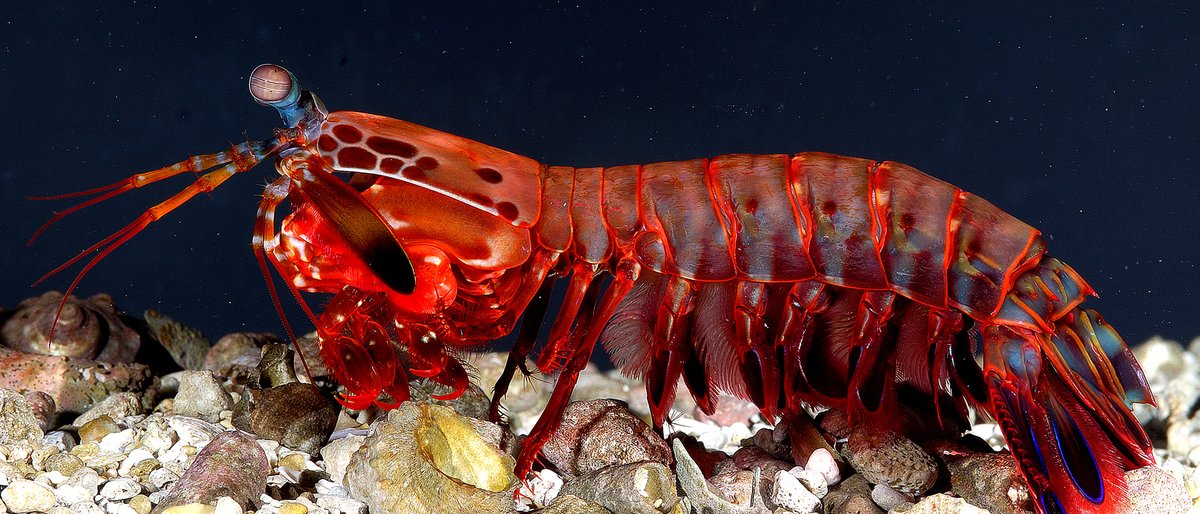
The mantis shrimp has 16 types of color receptors compared to humans' 3, but despite this they're actually terrible at distinguishing between similar shades. Scientists believe they use colors more like a barcode scanner than a camera.
The Mantis Shrimp's Vision Paradox: 16 Color Receptors, Worse Color Vision Than You
When you imagine a creature with 16 different types of color receptors—compared to our measly 3—you'd expect it to see the world in shades and hues we couldn't even fathom. You'd be wrong. The mantis shrimp, despite its spectacular visual hardware, is surprisingly bad at telling colors apart.
Scientists discovered this paradox when they started testing these tiny marine boxers on their actual color discrimination abilities. The results were embarrassing: mantis shrimp performed worse than many animals with far simpler eyes.
The Hardware Doesn't Match the Software
Here's what makes this so bizarre. Humans have three types of color receptors (red, green, and blue cones) and our brains compare the signals from these to create millions of distinguishable colors. It's computational, sophisticated, and it works beautifully.
The mantis shrimp? They've got 16 types of photoreceptors stacked in the middle band of their compound eyes. By all rights, they should see a rainbow that makes our color perception look like a cheap flip phone display.
But when researchers from the University of Queensland tested them on color discrimination tasks in 2014, the shrimp needed colors to be separated by wavelengths of 12-25 nanometers to tell them apart. Humans can distinguish colors just 1-4 nanometers apart. We beat them by a factor of ten.
The Barcode Scanner Theory
So what's going on? Scientists now believe mantis shrimp don't process color the way we do at all. Instead of comparing signals between different receptors, they appear to use each receptor type as a dedicated channel for a specific color—like a barcode scanner reading distinct bands rather than a camera analyzing a full spectrum.
This system is faster but far less precise. When a mantis shrimp sees something, it's likely getting an instant "color code" rather than a nuanced perception of hue. It's the difference between reading a price tag and admiring a sunset.
The evolutionary payoff? Speed. Mantis shrimp are ambush predators with infamously powerful strikes—their club-like appendages can accelerate at the same speed as a .22 caliber bullet. When you're that fast, you need visual processing that can keep up. They traded color sophistication for split-second identification, and in their world of coral reefs and camouflaged prey, that's the winning strategy.
Frequently Asked Questions
Can mantis shrimp see more colors than humans?
How does mantis shrimp vision work?
What other special vision abilities do mantis shrimp have?
Why would evolution give mantis shrimp so many color receptors if they don't see more colors?
How fast can mantis shrimp strike?
Verified Fact
This fact has been reviewed and verified against original sources.
Source: View sourceShow verification details
Research from University of Queensland (Thoen et al., 2014) confirmed mantis shrimp have poor color discrimination despite 12-16 photoreceptor types.