Old Abe was a real bald eagle who fought in the Civil War. He rode into more than 30 battles with the 8th Wisconsin Infantry. He perched on a custom shield and screamed over the gunfire. Confederate soldiers were ordered to shoot him down. He made it through every battle and went home to Wisconsin. Today his profile rides on the shoulder of every 101st Airborne soldier.
The Screaming Eagle Patch Is Based on a Real Bird
Every soldier in the 101st Airborne Division wears a bald eagle's profile on his shoulder. Most assume it is a generic symbol of American might. It is not. The bird on the patch had a name, a rank of sorts, and a service record that ran through some of the bloodiest campaigns of the Civil War.
A Bushel of Corn and a Wartime Bargain
In the spring of 1861, a member of the Lac du Flambeau Band of Lake Superior Ojibwe took a young bald eagle from its nest near the Flambeau River in Wisconsin. He traded the eaglet to a farmer named Daniel McCann for a bushel of corn. That summer, as President Lincoln called for volunteers, a company of recruits from Eau Claire pooled $2.50 to buy the bird before marching off to join the 8th Wisconsin Volunteer Infantry. Their captain, John E. Perkins, named the eagle Old Abe, after the president.
Riding Into Battle on a Shield
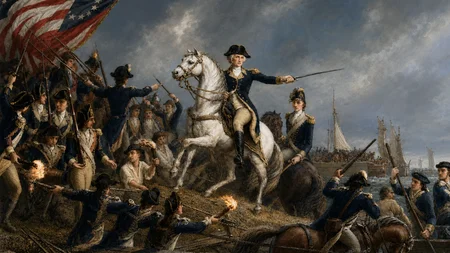
The regiment's quartermaster built a special perch shaped like a shield, mounted on a pole, so Old Abe could be carried into action beside the national colors. Soldiers took turns as his designated bearer through campaigns at Island Number Ten, Corinth, Vicksburg, and the Red River. Eyewitnesses said that whenever the fighting started, Old Abe spread his wings and screamed over the noise of the guns rather than trying to fly away.
The Yankee Buzzard
Confederate soldiers came to know the bird well enough to nickname him the "Yankee Buzzard," and accounts describe marksmen being ordered to bring him down, since a live symbol of Union morale mattered more than another captured flag. Old Abe had close calls. At the Second Battle of Corinth, a bullet is said to have severed the cord tethering him to his perch and clipped a few of his flight feathers. At Vicksburg, another shot reportedly grazed his wing. Neither injury kept him from finishing the war. He came through more than 30 engagements and marched home to Wisconsin with the 8th Infantry when its three-year enlistment ended in 1864.
A Capitol Celebrity
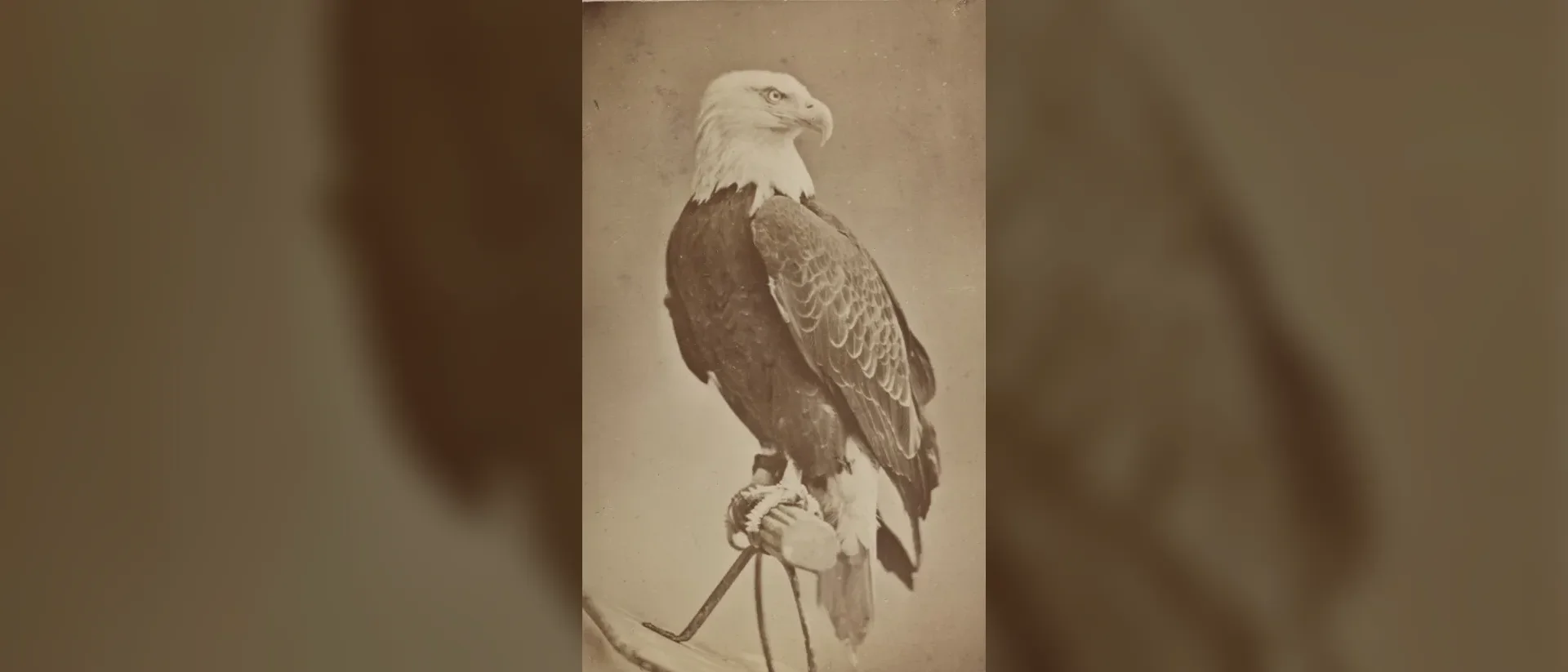
The regiment presented Old Abe to the state of Wisconsin, which built him a custom apartment in the basement of the Capitol in Madison. He became a fixture at postwar reunions, fairs, and political rallies, and photographers lined up to capture him on his old shield perch. Several of those images survive today in the Library of Congress, giving us a rare thing for a Civil War story: real photographs of the actual animal, not just an illustration.
Why He Is Still on Every Shoulder
When the Army organized the 101st Airborne Division in 1921, it looked to Wisconsin's Civil War heritage and chose Old Abe's profile as the unit's insignia. That same eagle's image is why the paratroopers became known as the "Screaming Eagles," a nickname they carried into Normandy, Bastogne, and every conflict since. The patch on a modern soldier's shoulder is not an abstract emblem. It is the likeness of a bird that actually rode into battle a century and a half earlier.
Frequently Asked Questions
Was Old Abe the eagle a real bird?
How did the 8th Wisconsin Infantry get the eagle?
Why did Confederate soldiers call him the Yankee Buzzard?
Why is there an eagle on the 101st Airborne patch?
What happened to Old Abe after the Civil War?
Verified Fact
Verified Jul 28, 2026
Source: Wisconsin Veterans MuseumShow verification details
Verified 2026-07-28 (revised after second pass). Sources: Wisconsin Veterans Museum (source_url, wisvetsmuseum.com/old-abe-the-war-eagle), Wikipedia "Old Abe", military.com "The 101st Airborne's Screaming Eagle Has a Name and a Civil War History", militarytimes.com Dec 2025 retrospective, Airborne and Special Operations Museum (asomf.org) "Three/Five Facts About the 101st Airborne Division", ww2depot.com "The Story of the Screaming Eagle," army.mil article 91178 (403, not readable, corroborated via search snippet), wi101.wisc.edu / warhistoryonline.com (Gen. Sterling Price "dozen battle flags" quote). Claims checked: (1) Real bald eagle, 8th Wisconsin mascot, shield-shaped perch, Confederate targeting/"Yankee Buzzard" nickname, $2.50 purchase by Eau Claire recruits, Second Corinth cord-severed/feather-clip near-miss, Vicksburg wing-graze near-miss -- ALL CONFIRMED verbatim in Wikipedia and wisvetsmuseum.com. (2) "Never wounded" myth correctly AVOIDED -- creator used "made it through every battle"/"never brought down," accurate per near-misses documented in article body. (3) Battle count "more than 30" used consistently everywhere; no field states a hard 36/37 (army.mil/Wikipedia say 37, wisvetsmuseum says "over 30" -- correctly used the number every source supports). (4) 1881 Capitol-fire death does not appear anywhere, including FAQs (only bare year "1881" in two FAQ answers) -- exceeds brand-tone requirement. (5) source_url (wisvetsmuseum.com) verified via WebFetch to support mascot status, Confederate shooting attempts, $2.50 purchase, "over 30 battles," and 1921 insignia adoption -- citation fidelity PASSES; military.com independently and more firmly corroborates the 1921 causal link ("In a nod to the state's military history, the Army put Old Abe on the unit's insignia"). (6) topic_id=animals confirmed, so social_link_comment's /animals/ URL is correct, not a 404. (7) The "valuable as capturing a Union flag" / "another captured flag" framing in FAQ and article is a conservative UNDERSTATEMENT of the actual legend (Gen. Sterling Price reportedly said he'd rather capture Old Abe than "a whole brigade or a dozen battle flags," per wi101.wisc.edu and warhistoryonline.com) -- not an inflation, left as is. DISCREPANCIES FOUND AND CORRECTED: (a) Article closer and one FAQ answer originally asserted "Old Abe's battlefield scream is the reason the division became known as the Screaming Eagles" -- a specific causal claim not affirmed by any source read. The Airborne and Special Operations Museum (asomf.org) states verbatim "The 101st Airborne Division's 'Screaming Eagles' nickname originates from their insignia -- a bald eagle on a black shield" and its page contains no mention of the eagle's scream/screech/vocalization at all -- i.e. no source ties the nickname to the real bird's sound. My first-pass correction replaced this with an equally unsourced claim that the insignia depicts him "mid-scream" -- also uncorroborated (patch descriptions found via search describe an open beak/red tongue/"fierce expression" but no source explicitly frames this as a scream, and one source (ww2depot.com) attributes the "Screaming Eagles" name instead to a distinct "Screaming Eagles of Kentucky" Civil War-era nickname, an unrelated etymology). Given genuinely contested/unconfirmed etymology, both the article and FAQ now state only the well-supported facts: 1921 insignia adoption honoring Wisconsin heritage, and that Old Abe's image is why the paratroopers carry the "Screaming Eagles" name -- with no specific causal mechanism asserted. (b) FAQ question tense fixed: "Why do Confederate soldiers call" -> "Why did Confederate soldiers call" (historical, not present-tense). (c) Article said marksmen were "encouraged" to bring him down while text/social_text/caption/Wikipedia all say "ordered" -- aligned article to "ordered" for consistency (Wikipedia: "Under orders from their officers, Confederate troops made numerous attempts to kill or capture the eagle"). No other field (text/social_text/social_caption/social_engagement_comment/social_link_comment) contained the scream-nickname causal claim, so no further cascade correction needed. No scheduled_posts existed and no images were set (pre-imaging stage), so no cancellation/image-null cascade required. Grading confirmed: engine=1 (emotional-animal/awe, real war-mascot photographic proof, not personal fame) correct. mainstream_novelty=2 correct -- most FB viewers do not know the 101st patch depicts a real animal. affinity_pool=1 (large-niche/regional: military/veteran/history audience) correct. proof_photo_strength was NULL at creation despite the handoff calling for 2 (LOC holds multiple public-domain 1860s-70s photos of the living eagle on his shield perch) -- set to 2. beat_freshness was also NULL (would have corrupted the passes_vetoes composite per the known null-beat_freshness bug) -- confirmed no other fact uses sub_beat=animal-war-icon-photo-proof, set to 2. No cross-model tool available (gemini CLI dead); performed manual sentence-by-sentence trace against Wikipedia/wisvetsmuseum/military.com/militarytimes/asomf source text, re-verifying exact quotes on a second pass after the first pass mis-cited an asomf.org gloss as a direct quote -- corrected in this note.