
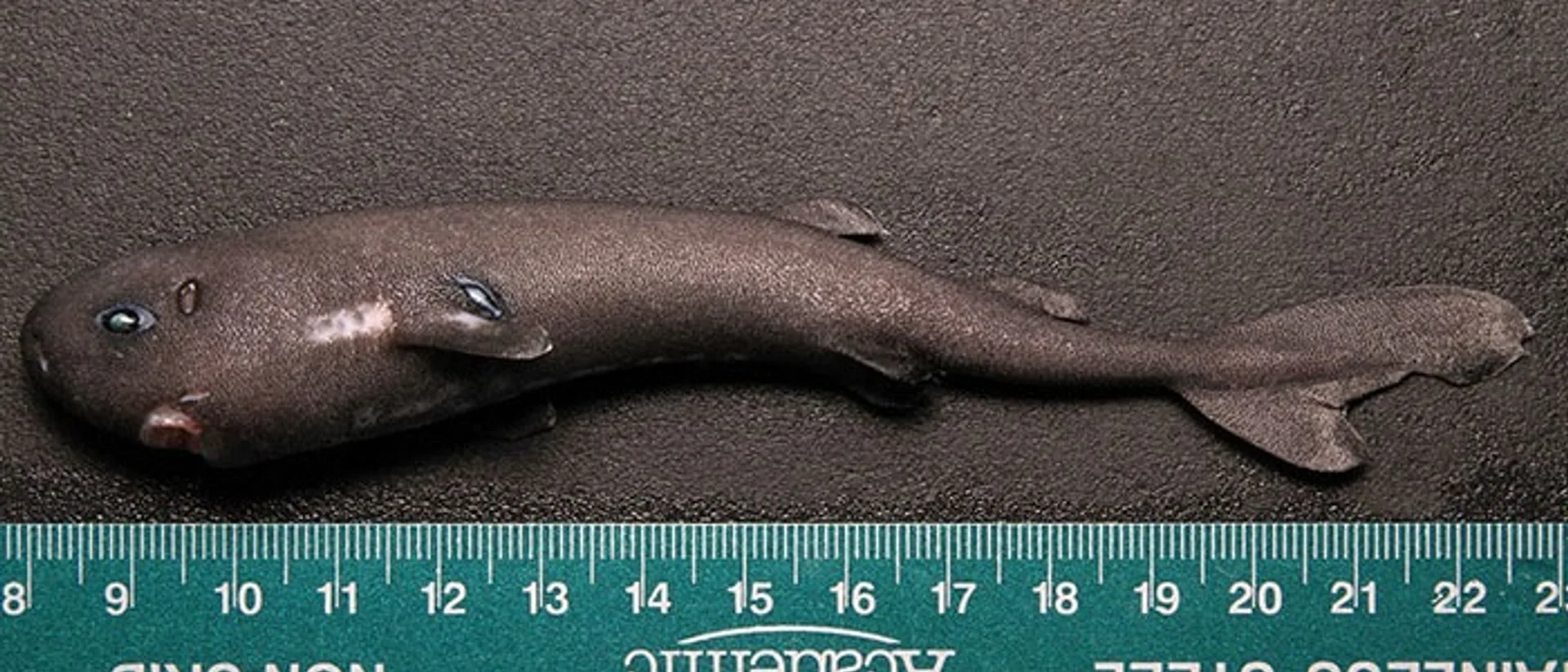
The rarest shark in the Gulf of Mexico is 5 inches long, glows in the dark, and shoots clouds of luminous fluid from tiny pockets near its fins — basically a living flashbang grenade.
The Pocket Shark: Gulf of Mexico's Tiny Glow-in-the-Dark Predator
In 2010, a NOAA research vessel trawling the deep waters of the Gulf of Mexico pulled up something extraordinary in its nets — a tiny, pudgy shark barely longer than a ballpoint pen. It would take nearly a decade before scientists fully understood just how remarkable this creature was.
Discovery and Identification
The specimen was collected during a 2010 survey studying sperm whale feeding ecology in the Gulf of Mexico. Among the hundreds of fish pulled from depths of around 300 meters, researchers noticed something unusual: a small, dark shark unlike anything in their reference guides.
The specimen sat in a museum collection at Tulane University's Biodiversity Research Institute until researcher Mark Doosey took a closer look. In 2015, a team led by Doosey and NOAA fishery biologist Michael Grace identified it as a new species: Mollisquama mississippiensis, the American pocket shark.
It was only the second pocket shark ever found. The first — a different species, Mollisquama parini — had been caught in the Pacific Ocean in 1979, and no one had seen another one since.
What Makes It Special
The American pocket shark measures just 5.5 inches (14.2 cm) long. But what it lacks in size, it more than makes up for in biological weaponry. The shark possesses two remarkable features that make it nearly unique among all known fish:
Bioluminescent pockets: Two small openings near its pectoral fins — the "pockets" that give the shark its name — contain glands that secrete a glowing fluid. Scientists believe the shark can release clouds of this luminous substance, possibly to attract prey, confuse predators, or both. Think of it as a biological flashbang: a burst of light in the pitch-black deep ocean.
Photophores across its body: In addition to the pocket glands, the shark's entire body is covered in tiny light-producing organs called photophores. These give it a faint, ethereal glow — a common adaptation among deep-sea creatures that helps with camouflage by eliminating the shadow their body casts when lit from above (a technique called counter-illumination).
A Family of Two
The genus Mollisquama now contains exactly two known species. The original pocket shark (M. parini) was a 40-cm adult female found in the Pacific. The American pocket shark (M. mississippiensis) is a 14.2-cm juvenile male from the Gulf of Mexico. Despite being related, the two species differ in their number of vertebrae, tooth counts, and the arrangement of their light-producing organs.
The extreme rarity of pocket sharks — just two specimens found in over 40 years of deep-sea research — suggests they inhabit depths and environments that human trawling rarely reaches. How many are out there, living their bioluminescent lives in the deep Gulf? Nobody knows.
Why It Matters
The pocket shark is a reminder that the deep ocean remains one of Earth's least explored frontiers. As Tulane University ichthyologist Henry Bart noted when the discovery was announced: "The fact that only one other specimen of a pocket shark has ever been reported from the Gulf of Mexico, and that was of a different species, underscores how little we know about the Gulf — let alone the ocean as a whole."
For a creature smaller than a smartphone to carry biological flashbang grenades and a full-body glow suit, the pocket shark packs more wonder per inch than almost any animal on Earth.
Frequently Asked Questions
How big is the pocket shark?
Why is it called a pocket shark?
Where was the pocket shark found?
How does the pocket shark glow in the dark?
How many pocket sharks have been found?
Verified Fact
Verified via Tulane University press release
Source: Zootaxa / Tulane UniversityShow verification details
Verified via Tulane University press release (2019), NOAA Fisheries, and the original Zootaxa paper (Grace et al., 2019). Species: Mollisquama mississippiensis. Specimen collected 2010, described 2015 (preliminary) and 2019 (full description with photophore analysis). Only second pocket shark ever found.