
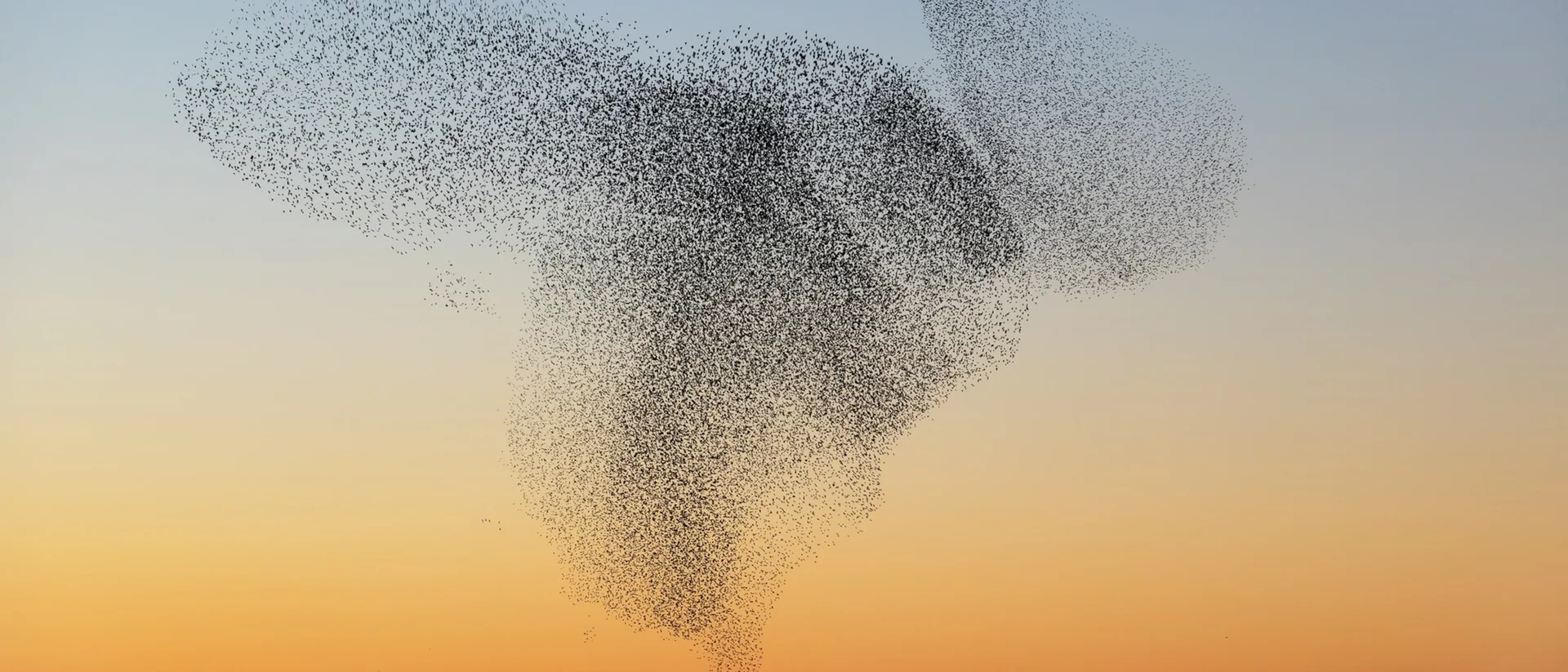
A murmuration of starlings - sometimes hundreds of thousands of birds - swirls as one shape-shifting cloud with no leader and no plan. Each bird follows just three rules: stay close, match speed, avoid collisions. Scientists discovered each bird tracks only its six or seven nearest neighbors. When a peregrine falcon strikes, a wave of evasion sweeps the whole flock at once.
No Leader. No Plan. Just Seven Neighbors.
Every winter evening over wetlands and city rooftops, a sight unfolds that stops people in their tracks: thousands of starlings moving as a single breathing shape in the sky. Scientists call it a murmuration, and for a long time nobody could explain how it worked without a conductor.
Six or Seven Neighbors. That's It.
In 2008, physicists Andrea Cavagna and Irene Giardina led the STARFLAG project in Rome, filming murmurations of up to 4,000 birds using pairs of cameras and then reconstructing every bird's exact 3D position. What they found was remarkable: each starling does not track the flock as a whole. It pays attention only to its six or seven nearest neighbors. Three simple rules govern everything: stay close, match your neighbors' speed, avoid collisions. No leader. No choreography. No plan.
The key discovery was that starlings use topological distance rather than physical distance - meaning each bird tracks a fixed number of neighbors (six or seven) rather than every bird within a fixed radius. This makes the system extraordinarily robust: even when a flock compresses or expands, the information network stays intact.
How the Wave Moves
Because each bird is continuously updating its position relative to seven others, a turning decision propagates through the flock almost instantly - faster than any single bird could react alone. Researcher Irene Giardina described it as "like a game of telephone where information always arrives at the end, uncorrupted." The result is what physicists call scale-free correlation: a change at one edge of a flock of 500 reaches the other side just as fast as a change in a flock of 50,000.
The Falcon Triggers the Show
Murmurations peak at dusk from October to March, just before the birds drop into their communal roosts. But the most dramatic displays are driven by predators. When a peregrine falcon attacks, the flock does not scatter randomly. Instead, a precisely coordinated response called flash expansion ripples outward from the point of attack. Waves of evasive movement travel through the group faster than the predator can track any individual bird. Research published in Behavioral Ecology and Sociobiology confirmed a strong correlation between these wave events and reduced predation success - the falcon is hunting a moving target that becomes a different shape every fraction of a second.
No Mind Needed
What makes murmurations so disorienting to watch is that the collective behavior looks intelligent - purposeful, even beautiful - yet it emerges entirely from simple local rules followed by each individual. No bird knows the shape the flock is making. No bird is in charge. The murmuration is an accident of physics and evolution, and it is one of the most spectacular sights in the natural world.
Frequently Asked Questions
How do starlings in a murmuration know what to do?
Why do starlings form murmurations?
How many starlings can be in a murmuration?
Why do starlings track exactly seven neighbors?
When and where can you see a murmuration?
Verified Fact
Verified Jun 17, 2026 · 4 sources checked
Source: Behavioral Ecology and Sociobiology (via PubMed)Show verification details
Claims checked
- Starlings follow three rules, with no leader
- Each bird tracks six or seven nearest neighbors (not a fixed seven)
- Peregrine falcon attacks trigger a wave of evasion across the flock
- Flock responses do not slow down in larger groups
Sources: PNAS, Behavioral Ecology and Sociobiology, National Geographic