⚠️This fact has been debunked
Our fact-checkers found this claim to be inaccurate. See the article below for details.
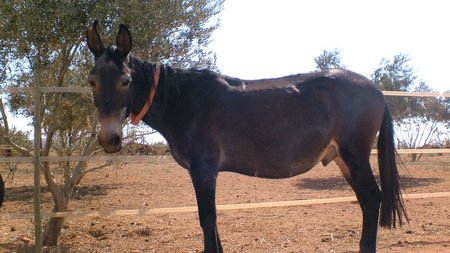
The placement of a donkey's eyes in its' heads enables it to see all four feet at all times.
Can Donkeys Really See All Four Feet at Once?
You've probably heard this one before: donkeys have such perfectly positioned eyes that they can see all four of their feet at the same time. It sounds plausible—after all, their eyes are on the sides of their head, giving them that wide-angle view. But here's the truth: it's anatomically impossible.
Donkeys, like their horse cousins, have remarkable peripheral vision that spans roughly 350 degrees. That's nearly a complete circle of vision! But "nearly" is the key word here.
The Blind Spots Nobody Talks About
Despite their impressive field of view, donkeys have two critical blind spots. The first is directly in front of their face, extending from just under their head to about 3-4 feet forward in a cone shape. The second is directly behind them.
Here's what this means: a donkey can't see the grass it's eating, the treat you're holding under its nose, or its own front hooves. It relies on smell, touch, and whiskers to navigate these zones. Similarly, it can't see directly behind its rear end, which is why approaching a donkey from behind without warning can startle it—and possibly earn you a defensive kick.
So Where Did This Myth Come From?
The confusion likely stems from the fact that donkeys are incredibly sure-footed animals. They navigate rocky terrain, mountain trails, and tricky footing with remarkable confidence. This ability isn't because they're watching all four feet like security cameras—it's because their wide peripheral vision lets them scan and monitor their surroundings constantly, piecing together spatial awareness through head movement and memory.
Think of it like driving a car with excellent side mirrors. You can't see every blind spot simultaneously, but you develop a mental map by checking different angles. Donkeys do the same thing, just naturally.
What Donkeys Actually See
Here's what makes donkey vision genuinely impressive:
- Monocular vision: Each eye operates independently, covering different zones
- Motion detection: Their peripheral vision excels at spotting movement—a survival adaptation from their days as prey animals
- Low-light capability: Donkeys see better than humans in dim conditions
- Limited depth perception: Only about 60-70 degrees directly in front offers binocular (3D) vision
So while a donkey can't literally eyeball all four hooves at once, it doesn't need to. Its brain has evolved to build a constantly updating 3D map of its body position and surroundings—blind spots and all. That's the real superpower, not some anatomical impossibility about seeing its own feet.