The wombat is the only animal on Earth that poops in cubes - 80 to 100 neat, flat-sided blocks every night. For years nobody knew how; everyone assumed a square exit. There isn't one. Engineer Patricia Yang mapped a wombat's intestines and found two stretchy groove regions where the gut wall flexes unevenly, moulding the waste into cubes. The wombat then stacks them to mark territory - and cubes don't roll away.
Wombats Are the Only Animal That Poops in Cubes
Most animals have no choice about the shape of what they leave behind. Wombats do. They are the only known animal on Earth that produces cube-shaped droppings - and for years, scientists had no idea how.
The Only Cube-Maker in the Animal Kingdom
The common wombat (Vombatus ursinus) is a stocky, burrowing marsupial native to Australia. It shares the continent with kangaroos and koalas, but it holds a distinction none of them can claim: its digestive system moulds waste into tidy, flat-sided cubes - between 80 and 100 of them every night. No other vertebrate does this. Snakes coil. Rabbits round. Wombats cube.
The Science Inside the Gut
For a long time, researchers assumed a cube-shaped exit point must be responsible. It is not. Mechanical engineer Patricia Yang at the Georgia Institute of Technology solved the puzzle by inflating the intestines of wombats with thin balloons and mapping how the walls stretch. She found two groove-like regions where the intestinal wall is far more elastic than the tissue around them. Stiffer sections contract faster; the softer grooves squeeze more slowly. Over roughly 40,000 muscle contractions as food travels down the wombat's 33-foot gut, those alternating zones press edges into the drying waste. By the time it reaches the final half-metre before exit, the corners are sharp and the shape is set. The study was published in the journal Soft Matter in 2021.
Dry, Firm, and Built to Last
The wombat's digestive tract takes 14 to 18 days to process a meal - roughly four times longer than the human gut. That slow journey strips out almost all the moisture, leaving each cube extremely dry and firm. That dryness matters: a moist dropping would slump back into a rounded shape. The dehydrated cube holds its corners even after leaving the body.
The Perfect Territory Marker
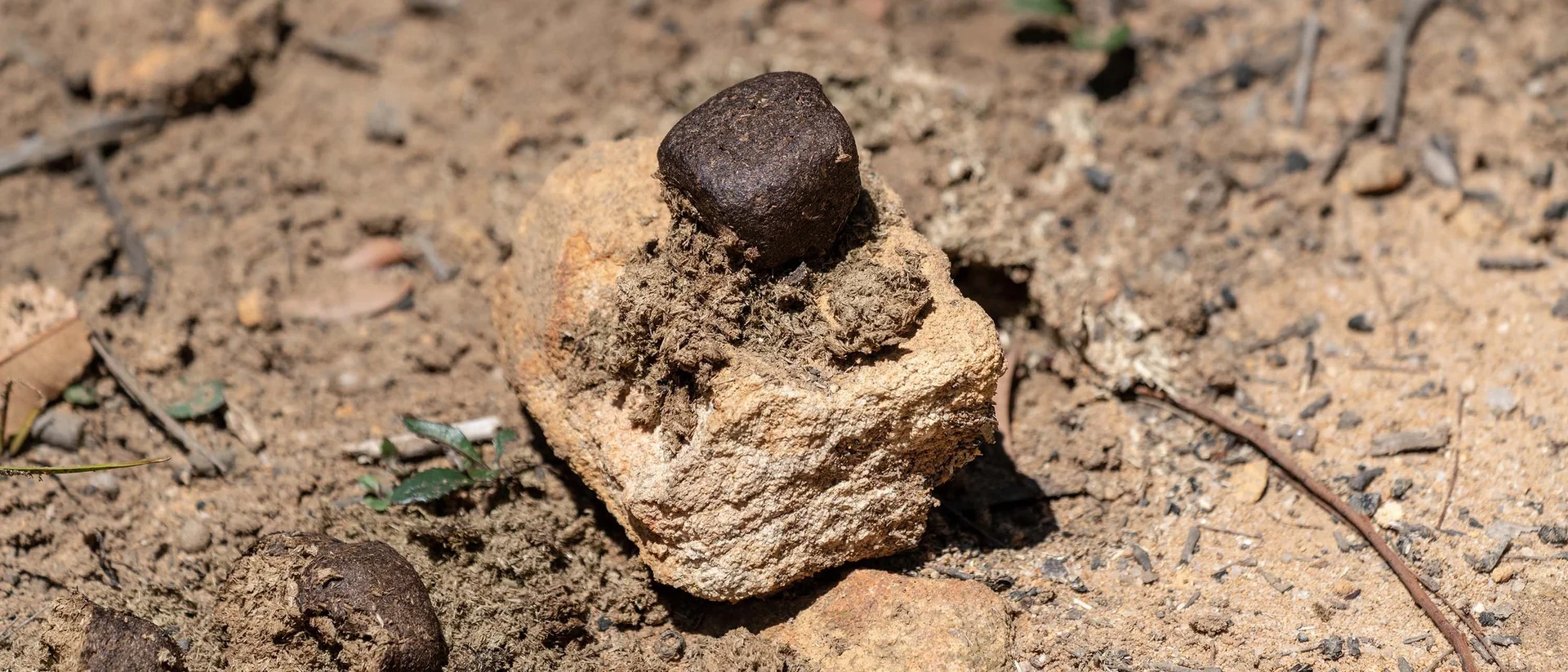
Wombats are territorial animals. They leave droppings on raised spots - the tops of rocks and logs near their burrows - where the scent carries furthest. A round pellet dropped on a rock rolls off. A cube stays put. Research on wombat territorial behaviour has confirmed that wombats choose elevated landmarks specifically for scat placement, and the flat faces of a cube grip a surface far better than a sphere. Other wombats detect these markers and judge whether an area is already occupied, reducing the need for direct confrontation.
An Ig Nobel Prize Winner
The cube-poop research earned Patricia Yang and David Hu the 2019 Ig Nobel Prize in Physics - awarded annually for science that first makes people laugh, then makes them think. The team has since used the wombat's intestinal trick as inspiration for studying new ways to manufacture soft cube shapes in engineering, since no mechanical process had previously achieved it from the inside out.
Frequently Asked Questions
Why do wombats poop cubes?
How many cube-shaped droppings does a wombat produce each night?
Are wombats the only animals that poop cubes?
How do wombats use their droppings to mark territory?
What did scientists discover about how wombat intestines work?
Verified Fact
Verified Jun 15, 2026 · 5 sources checked
Source: View sourceShow verification details
Claims checked
- Only animal known to produce cube-shaped droppings
- Cube shape forms in the gut, not at the exit
- Roughly 80 to 100 droppings per night, four to eight at a time
- Digestion takes 14 to 18 days (some sources say 8-14)
- 2019 Ig Nobel Prize in Physics for the research
Sources: Smithsonian Magazine, The Conversation, WorldAtlas, improbable.com, Georgia Tech