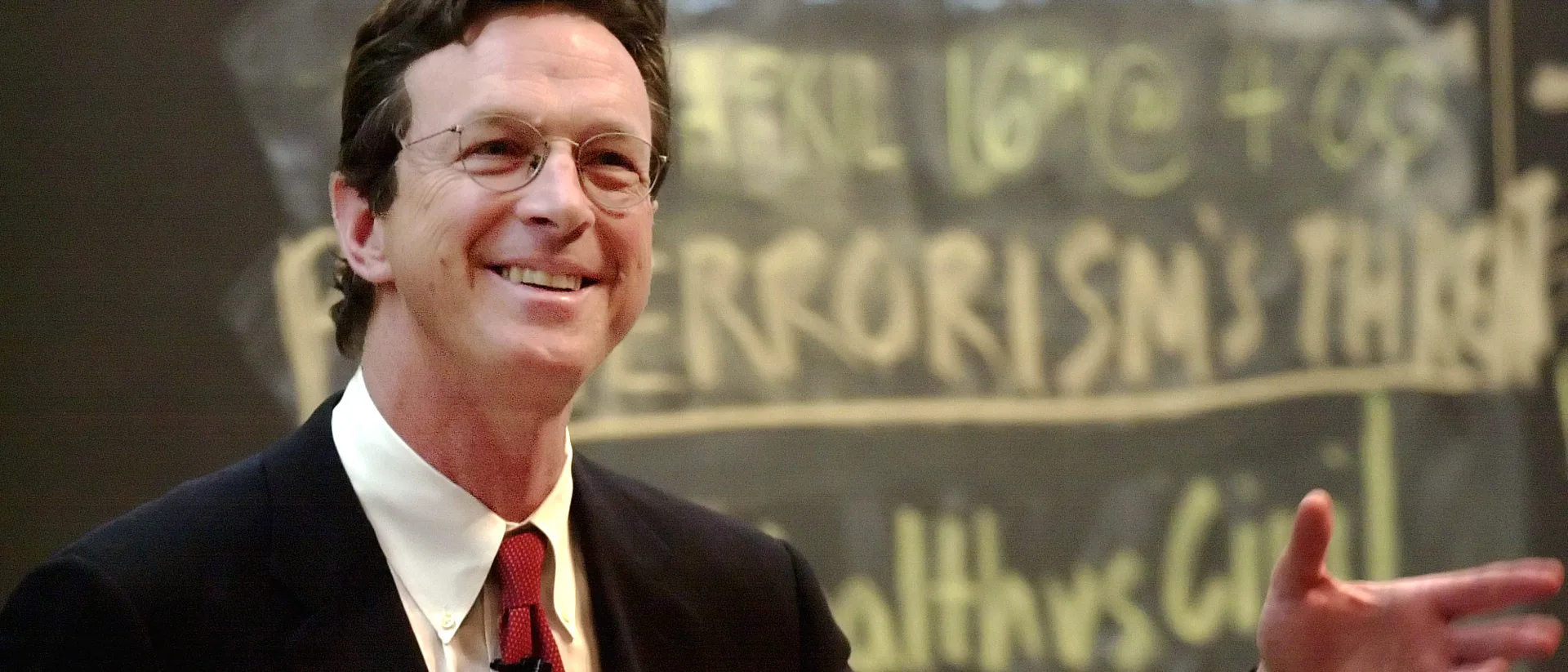
Michael Crichton, author of Jurassic Park, felt his literature professor at Harvard was giving him unfair grades. To prove it, he turned in a paper by George Orwell and received a B-.
How George Orwell Got a B- at Harvard (Decades After Death)
Picture this: You're an undergraduate at Harvard in the early 1960s, and you're convinced your literature professor has it out for you. Most students would just complain to their roommates. Michael Crichton decided to commit academic fraud to prove a point.
The future bestselling author—who would go on to write Jurassic Park, The Andromeda Strain, and create ER—was getting mediocre grades in his English class despite his obvious talent. Fed up with what he saw as unfair marking, Crichton hatched a plan that was equal parts genius and completely bonkers.
The Great Grade Experiment
Crichton lifted an essay by George Orwell—you know, one of the most celebrated English writers of the 20th century—and submitted it as his own work. Not a inspired-by piece. Not a heavily referenced homage. The actual essay, verbatim, with Crichton's name slapped on top.
The grade he received? B-minus.
What This Actually Proved
Crichton later detailed this incident in his 1988 memoir Travels, framing it as evidence of his professor's inability to recognize quality writing. But here's where it gets interesting—this stunt actually revealed several things:
- Either the professor never read Orwell (unlikely at Harvard)
- Or didn't recognize one of the most famous essayists in English literature (embarrassing)
- Or the essay genuinely didn't fit the assignment criteria (possible)
- Or Crichton picked an obscure enough Orwell piece to slip through (clever)
The B-minus became proof of something, though what exactly remains debatable decades later.
The Aftermath: Medical School as Revenge
This experience soured Crichton on pursuing English literature at Harvard. His solution? Switch to medicine—a field where grading was more objective and professors couldn't inject personal bias into evaluating whether your diagnosis of strep throat was properly written.
He graduated from Harvard Medical School in 1969 but never practiced medicine. Instead, he'd already started writing bestselling thrillers under pseudonyms while still in med school. Turns out that literature professor might have accidentally done the world a favor by pushing Crichton toward the career that gave us dinosaur theme parks and techno-thrillers.
Why This Story Matters
Crichton's academic rebellion captures something universal: that moment when you're absolutely certain the system is rigged against you. Most of us don't have the audacity—or access to famous essays—to prove it quite so dramatically.
It also raises questions about subjective grading in the humanities. Was Crichton right that his professor was biased? Or was he a talented but unpolished writer who couldn't accept that talent alone doesn't guarantee top grades? The B-minus on Orwell's work suggests the former, but we'll never know what the assignment actually asked for.
Either way, Crichton got the last laugh. His books have sold over 200 million copies worldwide, been translated into 40 languages, and spawned some of the biggest film franchises in history. That literature professor is remembered solely for not recognizing George Orwell's writing.
Moral of the story: Sometimes a B-minus is just the motivation you need to become one of the bestselling authors of all time.
Frequently Asked Questions
Did Michael Crichton submit George Orwell's paper to prove his professor was unfair?
What was Michael Crichton's experiment with his Harvard professor?
Why did Michael Crichton challenge his Harvard professor?
How did Michael Crichton prove his Harvard professor was biased?
Did George Orwell's essay get a better grade when submitted by Michael Crichton?
Verified Fact
This fact has been reviewed and verified against original sources.
Show verification details
Confirmed through Crichton's memoir 'Travels' (1988) and multiple credible sources. The incident occurred in the early 1960s when Crichton was an undergraduate at Harvard.