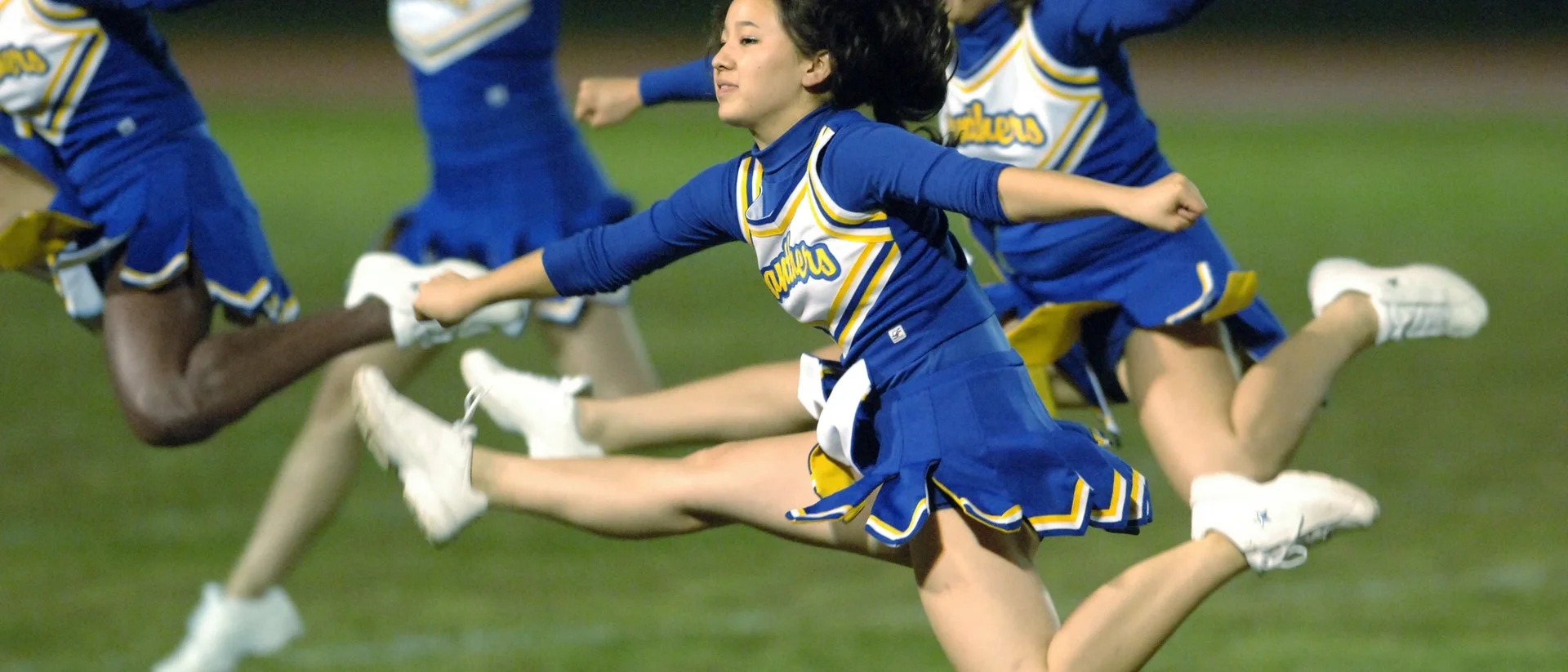
The Herkie is the cheer jump: one leg kicked straight out, the other bent back. It started as a flub. Dallas teenager Lawrence Herkimer went up for a clean split jump and missed. "It was just a poor split jump," he said later. "I don't like to tell people that." The jump took his name anyway. Squads still throw it every Friday night.
The Most Copied Cheer Jump Was a Mistake
Go to a high school football game this autumn and you will see it within a quarter: one leg kicked straight out to the side, the other tucked back under, one arm punched at the sky. It is the most copied jump in American cheerleading, and the man who threw it first was not trying to throw it at all.
The Jump He Meant to Do
Lawrence Russell Herkimer grew up in Dallas and cheered at North Dallas High School in the early 1940s. What he wanted was a clean split jump, both legs out straight, the kind that looks like a scissor snapping open in midair.
He never got there. The jump came out lopsided, one leg straight and the other folded back in a hurdler's crouch, and that shape became his signature anyway.
He perfected the bent version at Southern Methodist University, where he was head cheerleader during the Doak Walker era and graduated in 1948.
Decades later he was still a little embarrassed about it. "It was just a poor split jump," he told The New York Times in 2009. "I don't like to tell people that."
Cheer coaches now teach it as a precise position: one arm straight up, the other hand on the hip, one leg extended, the other bent back. The flaw became the technique.
Fifty-Two Girls and One Boy
In 1948 Herkimer borrowed $600 and booked a summer clinic at Sam Houston State Teachers College in Huntsville, Texas. It was the first cheerleading camp anyone had run.
Fifty-two girls and one boy turned up.
The next summer, 350 came.
He incorporated the National Cheerleaders Association in 1961. He sold the business in 1986. The camps had spread across the country and into several others, and the NCA still runs them every summer on college campuses nationwide.
The Spirit Stick and the Hidden Handle
The spirit stick came out of a camp in 1954. One squad was not the sharpest on the field but kept cheering for every other team there, so Herkimer cut a branch off a tree, painted it, and handed it to them in front of the whole camp.
It is still awarded for attitude rather than skill.
The pompon took longer. In 1971 the patent office granted Herkimer patent number 3,560,313 for an updated design: flameproof Mylar strands around a handle hidden inside the fringe, so the whole thing could be shaken hard without coming apart in a cheerleader's fist.
"Whenever I see them, all the pompoms waving around, I say, 'There my pompoms are,'" he told the Times.
Still on the Sideline
Herkimer died in Dallas in 2015 at 89. The jump did not go anywhere.
Squads throw Herkies on sidelines, on gym floors and on competition mats across the country, and every cheerleader who has ever worn a uniform can name it from across a field.
A teenager missed a split jump in Dallas more than eighty years ago, and squads have been copying the miss ever since.
Frequently Asked Questions
Who invented the Herkie jump?
How do you do a Herkie jump?
What is the difference between a Herkie and a side hurdler?
When was the first cheerleading camp?
Who created the spirit stick?
Verified Fact
Verified Sep 11, 2026 · 4 sources checked
Source: SMUShow verification details
Claims checked
- The Herkie began as a split jump Lawrence Herkimer failed to complete
- His own words, "It was just a poor split jump"
- He first threw it as a Dallas high school cheerleader in the early 1940s
- His first cheerleading camp, in 1948, drew 52 girls and one boy, then 350 the next summer
- Camp reach scoped to nationwide after sources disagreed on all 50 states
- The 1971 patent covered an updated pompon design, not the first pompon
Sources: SMU, The New York Times, NPR, Omni Cheer
Related Topics
More from History & Culture
View all History & Culture →