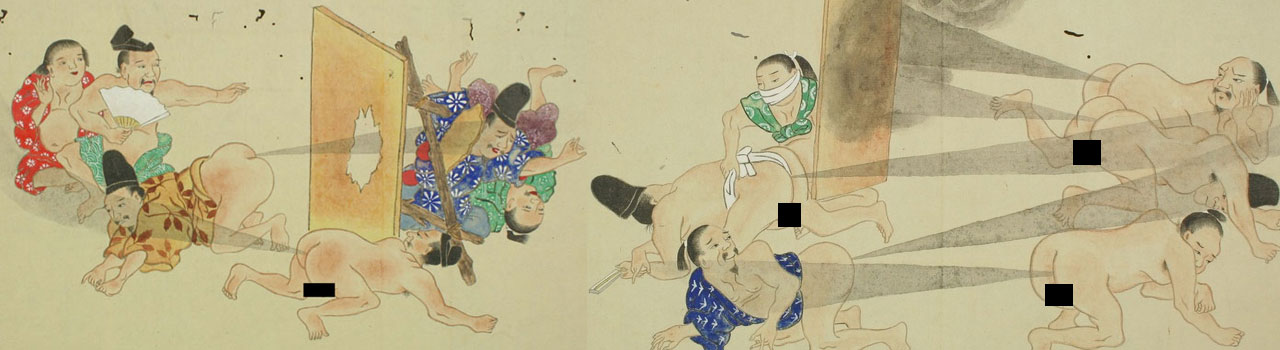
There are scrolls from the Edo period of Japan that suggest fart battles took place. The drawings show men blasting farts at other men, women, and even a cat.
Edo Japan's Epic 'Fart Battle' Scrolls
Imagine a battlefield where the weapon of choice isn't a sword or a spear, but a powerful gust of wind from one's rear. This might sound like a fantastical tale, but evidence from Japan's Edo period suggests such humorous skirmishes were immortalized in art.
The scrolls in question are known as He-Gassen (屁合戦), which literally translates to "fart battles." These captivating artworks, predominantly from the Edo period (1603–1868), depict people engaged in hilariously exaggerated flatulence competitions. It's a vivid, often chaotic, portrayal of bodily humor.
The Art of Flatulence
These unique Japanese scrolls are far from subtle. They show men, women, and sometimes even animals, deploying farts with an almost supernatural force. The illustrations frequently feature individuals being blown off their feet, sent soaring into the air, or having their clothes and belongings scattered by these invisible, yet potent, attacks.
It wasn't just human-on-human combat. Some scenes depict farts powerful enough to dislodge cats, topple over carts, or even send entire groups scattering in disarray. The sheer inventiveness and scale of these depicted "fart attacks" speak volumes about the humor of the era.
A Glimpse into Edo Society
While undoubtedly comical, the He-Gassen scrolls offer more than just a laugh. They provide a fascinating window into the cultural landscape of Edo Japan. Humor, even crude humor, has always been a way for societies to cope with stress, challenge norms, or simply entertain.
Scholars have proposed various interpretations for the scrolls' existence:
- Pure Comedy: The simplest explanation is that farts are universally funny, and the scrolls were created purely for their entertainment value.
- Social Commentary: Some suggest the scrolls might have carried deeper meanings. As Japan began to emerge from its isolationist policies, the imagery could have subtly expressed anti-foreigner sentiments, with the "farts" representing a symbolic rejection or repulsion.
- Satire: They might have also satirized certain aspects of society, power structures, or human folly.
Regardless of the underlying message, the scrolls demonstrate a playful and uninhibited side of historical Japanese art that often goes unappreciated.
Who Created These Masterpieces?
The artists behind many He-Gassen scrolls remain anonymous, a common practice for humorous and sometimes risqué artworks of the time. However, their artistic skill is undeniable, capturing dynamic movement and comical expressions with great detail.
One well-known example, held by Waseda University Library, is an 1846 copy of a 1680 original, attributed to a painter named Airan, who in turn copied the work of the renowned Hishikawa Moronobu. These works were often part of the Ukiyo-e tradition, a genre of Japanese art known for its woodblock prints and paintings depicting everyday life and popular culture.
Today, these scrolls are preserved not just as historical curiosities, but as valuable cultural artifacts. They remind us that humor transcends time and borders, and that sometimes, the most unexpected subjects can inspire truly remarkable art.
The next time you consider the solemnity of historical documents, remember the Edo period and its legendary fart battles – a testament to the enduring human capacity for playful irreverence.
Frequently Asked Questions
What are 'He-Gassen' scrolls?
When were these scrolls created?
What do the 'fart battles' depict?
What is the historical significance of He-Gassen scrolls?
Can I see these scrolls today?
Verified Fact
This fact has been reviewed and verified against original sources.
Related Topics
More from History & Culture
View all History & Culture →