
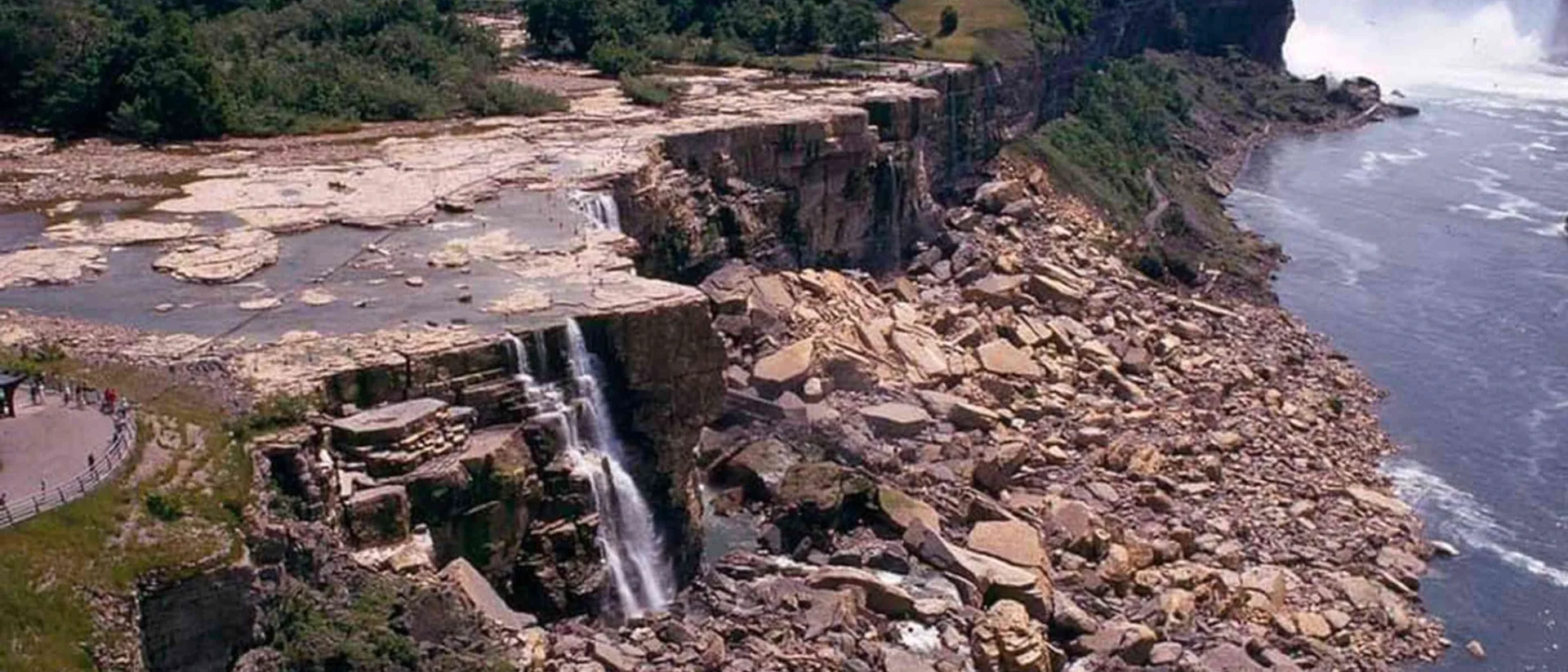
They turned Niagara Falls off. In 1969, the U.S. Army Corps of Engineers dumped 28,000 tons of rock into the Niagara River, stopping the American Falls completely for five months. Tourists walked the dry riverbed and found millions of coins - and engineers discovered the fallen boulders below were holding the falls up.
They Turned Niagara Falls Off in 1969
In the summer of 1969, one of the most recognizable waterfalls on Earth went silent. The American side of Niagara Falls - which had roared continuously for roughly 12,000 years - was turned off. Not by accident. On purpose.
Why Engineers Needed the Water Gone
By the 1960s, a massive pile of fallen rock called talus had accumulated at the base of the American Falls, effectively halving the waterfall's visible height. The International Joint Commission - a binational U.S.-Canada body overseeing shared waterways - wanted to know whether the talus could be removed to restore the falls to their full dramatic drop. To study the rock properly, the water had to go.
Building the Dam
Starting June 9, 1969, the Albert Elia Construction Company, directed by the U.S. Army Corps of Engineers, Buffalo District, put more than 1,200 trucks to work dumping 28,000 tons of rock across a 600-foot stretch of the Niagara River between the mainland and Goat Island. Three days later, on June 12, the American Falls stopped flowing - for the first time since the end of the last Ice Age, roughly 12,000 years earlier. The Canadian Horseshoe Falls kept running throughout.
What the Dry Riverbed Revealed
The exposed cliff drew 100,000 visitors in the first week alone. Tourists walked where the waterfall had thundered minutes before. Geologists drilled into the riverbed, mapping faults and measuring erosion rates. Workers found two unidentified bodies in the dry rock - along with millions of coins thrown in by hopeful visitors over decades. Engineers installed steel bolts and cables to stabilize fragile sections including Luna Island.
The Counterintuitive Discovery
After months of analysis, the geologists delivered a surprise verdict: the talus pile was likely holding up the waterfall face. The debris was acting as structural support. Remove it and the cliff above could catastrophically collapse. The International Joint Commission rejected removal - citing both the structural risk and the estimated $26 million cost. Instead, engineers quietly reinforced the rock with bolts and anchors, and left the talus exactly as they found it.
Turning It Back On
On November 25, 1969, in front of 2,650 spectators, the temporary cofferdam was dynamited. The Niagara River reclaimed its course. The American Falls roared back to life, looking almost exactly as they had before. Five months of engineering work had produced one recommendation: leave it alone.
Enjoyed this? Get a new fact every morning.
A fascinating fact in your inbox every morning. Free. Unsubscribe anytime.
Frequently Asked Questions
Why did engineers turn off Niagara Falls in 1969?
How did they stop the American Falls at Niagara in 1969?
What was discovered when Niagara Falls was drained in 1969?
When did Niagara Falls start flowing again after the 1969 dewatering?
Did engineers remove the rock pile at the base of Niagara's American Falls?
Verified Fact
Verified via HISTORY
Source: HISTORYShow verification details
com, Slate (2019), Abandoned Spaces, Rare Historical Photos. June 9 1969 cofferdam construction start confirmed (Albert Elia Construction Co., US Army Corps of Engineers Buffalo District). June 12 1969 American Falls stopped flowing.