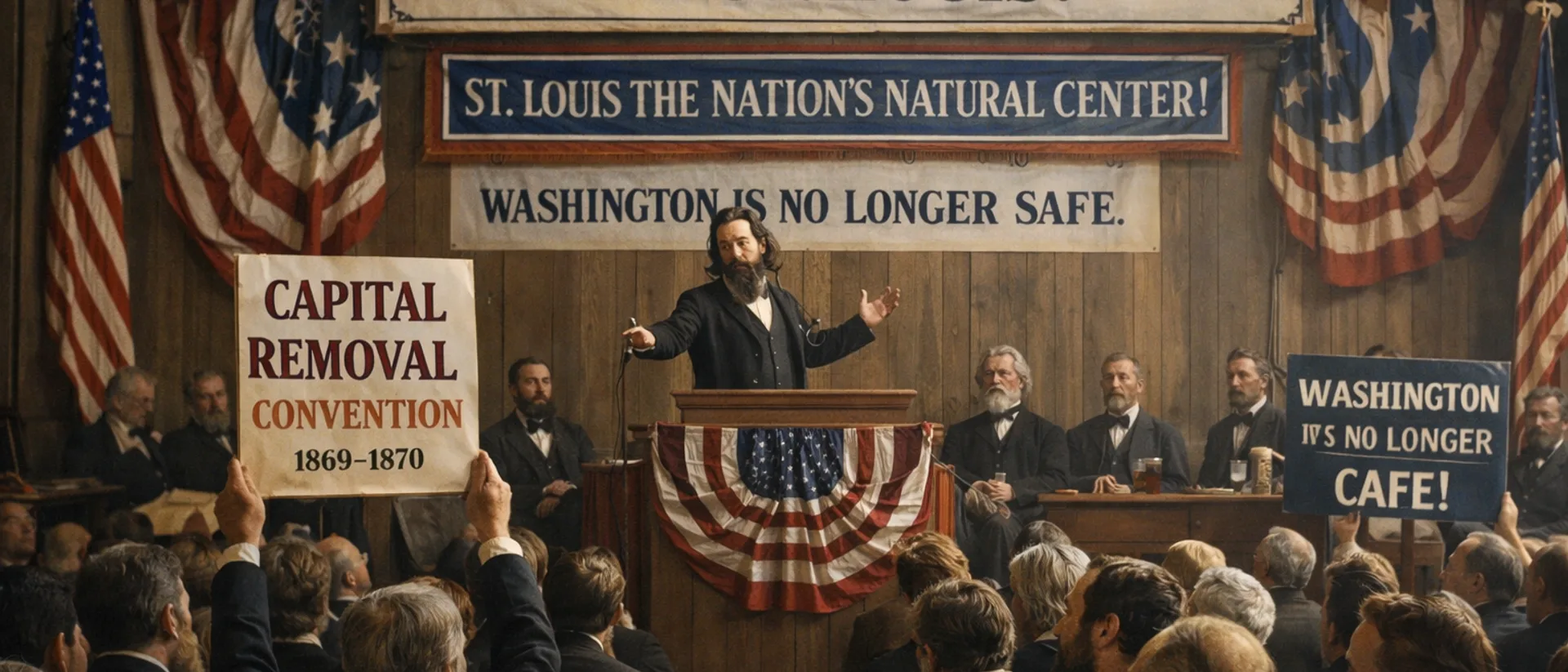
In 1869–1870, boosters called Washington vulnerable and pitched St. Louis as the nation’s natural center, even hosting a Capital Removal convention.
When St. Louis Tried to Become the U.S. Capital
After the Civil War, the United States expanded rapidly westward, and many Midwesterners began to question whether Washington, D.C., still made sense as the nation’s seat of government. To them, the capital sat on the edge of a country that now stretched to the Pacific. By the late 1860s and early 1870s, the idea of “capital removal” had become a real political movement, and St. Louis boosters argued their city was the place where a more secure, more central capital should rise.
A Capital That Matched a Growing Nation
Supporters of removal pointed to population shifts and the growth of rail and river commerce in the Mississippi Valley. They argued that a national capital should be near the geographic and economic center of the country, not tucked against the Atlantic coast. As historian accounts note, the push was framed as practical and strategic: a central capital would be easier to reach, better connected to the expanding West, and less vulnerable in the event of conflict.
St. Louis Makes Its Pitch
St. Louis publisher Logan U. Reavis became the movement’s loudest voice, joined by wealthy supporters such as Henry T. Blow. The city’s boosters claimed St. Louis was the “natural” hub of the nation and promoted it as the logical capital of a continent‑spanning republic. The campaign attracted enough attention that organizers issued a nationwide call to governors and civic leaders to attend a formal meeting devoted to “Capital Removal.”
The 1869 Capital Removal Convention
In October 1869, a National Capital Removal Convention met in St. Louis. Histories of the movement note that delegates came from numerous states and territories and debated resolutions that described the Mississippi Valley as the convenient, natural, and inevitable place for the capital, where the nation’s population and wealth were gravitating and where the government would be safer from foreign threats or sectional turmoil. The gathering did not settle on a concrete plan, but it amplified the idea nationwide and inspired a follow‑up convention in Cincinnati the next year.
Why the Movement Faded
Despite its burst of energy, capital removal struggled to gain lasting traction in Congress. As President Ulysses S. Grant pushed for improvements to Washington and lawmakers invested in the city, the urgency waned. By the early 1870s, the movement largely collapsed, leaving behind a fascinating “what if” episode when St. Louis briefly made a serious case to become the capital of the United States.
Frequently Asked Questions
What was the Capital Removal movement?
Why did supporters favor St. Louis?
Was there a convention about moving the capital?
Did the capital ever move?
Verified Fact
Verified Aug 26, 2026 · 4 sources checked
Source: White House Historical AssociationShow verification details
Claims checked
- 1869 St. Louis hosted a National Capital Removal Convention
- Boosters pushed to move the US capital to St. Louis
- Washington, D.C. was called impractical or vulnerable
Sources: White House Historical Association, HistoryNet, Missouri Secretary of State, State Historical Society of Missouri