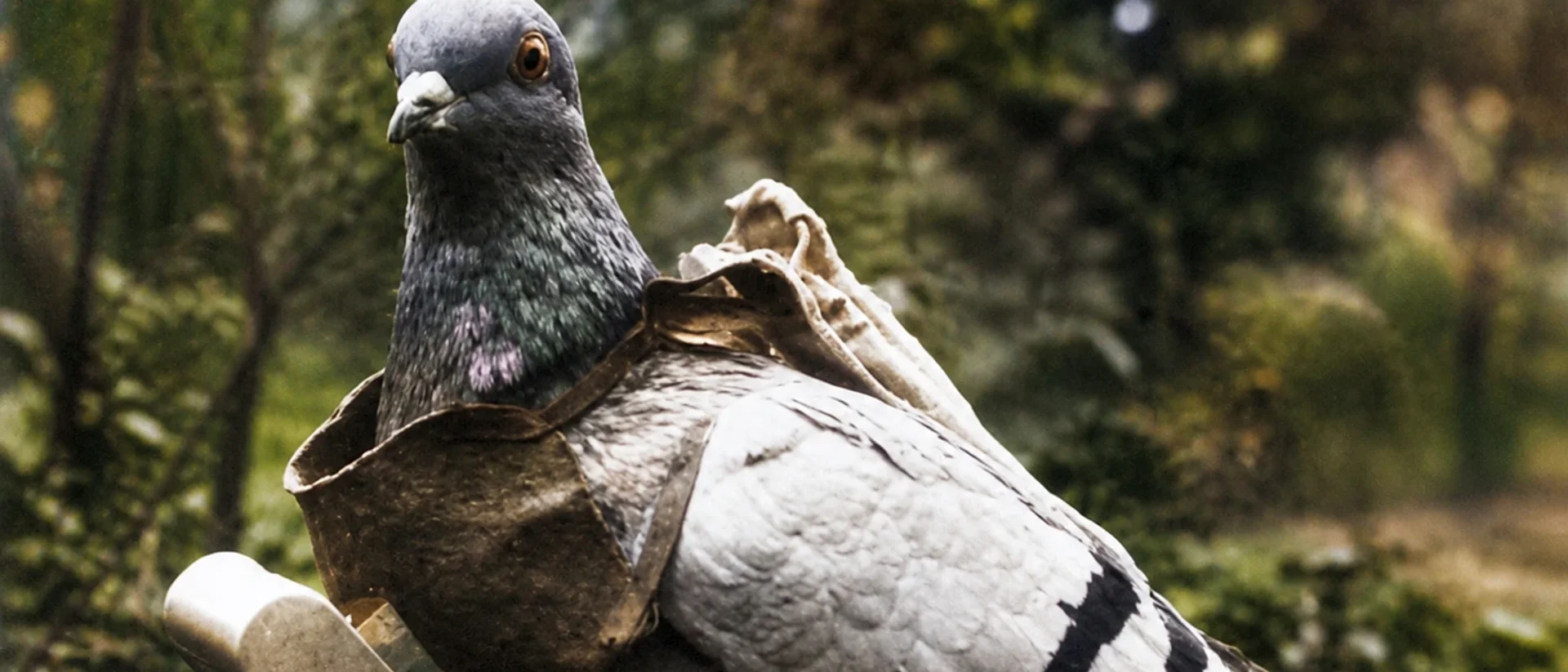
A homing pigeon shot through the breast with one leg hanging by a tendon flew 25 miles to save 194 men trapped behind enemy lines. The survivors carved him a wooden leg. He still stands at the Smithsonian today.
The Pigeon Who Flew Through Gunfire and Saved 194 Men
On the morning of October 4, 1918, a small canister was tied to the leg of the last working pigeon in Major Charles Whittlesey's command. The message inside read: "We are along the road parallel to 276.4. Our own artillery is dropping a barrage directly on us. For heaven's sake, stop it." The pigeon's name was Cher Ami - French for "dear friend." What happened next became one of the most improbable rescue stories of World War I.
The Trapped Battalion
The Meuse-Argonne Offensive had pushed deep into German-held France, and Whittlesey's unit - part of the 77th Infantry Division - had advanced further than the troops on their flanks. Now they were cut off. Roughly 500 men were surrounded in the Argonne Forest, hemmed in by German forces and running out of food and ammunition. Making the situation worse: American artillery, unaware of how far forward the battalion had pushed, was dropping shells directly on their position. Earlier birds sent with messages had been shot down before reaching headquarters.
The Final Pigeon
Cher Ami had already completed 12 successful missions over the Western Front - a remarkable record among Signal Corps pigeons. He was one of roughly 600 English-bred homing pigeons donated to the U.S. Army Signal Corps by the British Home Forces Pigeon Service in May 1918. On October 4, he was the last pigeon Whittlesey had left. The major attached the desperate plea to the bird's capsule and released him into the sky above the forest.
25 Miles Through Gunfire
The Germans knew what a pigeon leaving the American lines meant, and they opened fire. Cher Ami was hit. A bullet or shrapnel tore through his breast, nearly severed his right leg, and blinded him in one eye. By any logic, the bird should have fallen. Instead, he kept flying. He covered 25 miles in roughly 25 minutes - arriving at division headquarters with the message capsule still dangling from the tendons of his nearly-severed leg. Medics rushed to treat the bird. The message reached commanders. The artillery barrage stopped.
194 men walked out of the Argonne Forest on October 8th as survivors of what became known as the Lost Battalion. Army medics saved Cher Ami's life but could not save his leg - so members of the Lost Battalion carved him a small wooden one.
After the Guns Stopped
France awarded Cher Ami the Croix de Guerre with Palm - the same decoration bestowed on human soldiers for gallantry under fire. He was also later inducted into the Racing Pigeon Hall of Fame in 1931 and received the Animals in War and Peace Medal of Bravery in 2019. Cher Ami died from his wounds on June 13, 1919, at Fort Monmouth, New Jersey. His taxidermied body was presented to the Smithsonian Institution in 1921, where it remains on display at the National Museum of American History in Washington D.C. - wooden leg and all.
The 2021 DNA Mystery
For over a century, there was a quiet dispute about Cher Ami's sex. Wartime Signal Corps records had listed the pigeon as a hen. The Smithsonian had always classified Cher Ami as male. In 2021, to mark the centennial of the bird's arrival at the museum, the Smithsonian collaborated with its National Zoo and Conservation Biology Institute to conduct DNA analysis. The result confirmed what the Smithsonian had long maintained: Cher Ami was male - a cock bird, not a hen. A century-old mystery, settled at last by a feather and a laboratory.
Enjoyed this? Get a new fact every morning.
A fascinating fact in your inbox every morning. Free. Unsubscribe anytime.
Frequently Asked Questions
How many soldiers did Cher Ami save?
How far and fast did Cher Ami fly?
Where is Cher Ami today?
Was Cher Ami male or female?
What award did Cher Ami receive?
Where did Cher Ami come from?
Verified Fact
Verified Aug 26, 2026 · 6 sources checked
Source: Military.comShow verification details
Claims checked
- 194 soldiers saved by the pigeon
- Flew 25 miles in about 25 minutes
- Date corrected to Oct 4, 1918; pigeon was male per 2021 DNA test (earlier version said female/2019)
- Wooden leg carved by survivors
- Croix de Guerre with Palm awarded
Sources: Military.com, Britannica, National Museum of the US Army, World War I Centennial Commission, Army.mil, Smithsonian
Related Topics
More from History & Culture
View all History & Culture →