
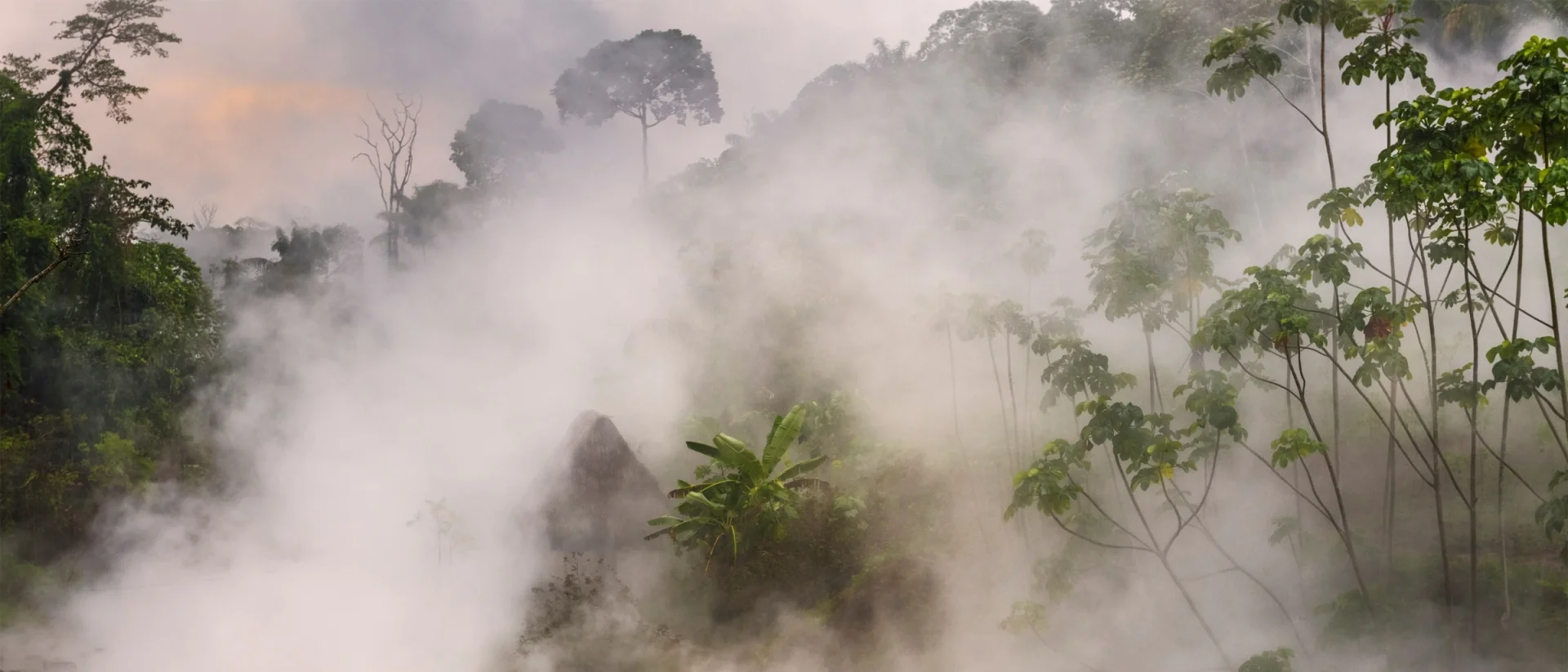
Scientists told him this river was a myth. In the Peruvian Amazon, it stretches nearly 4 miles and reaches close to 95C - hot enough to cook animals alive. Andres Ruzo went to find it anyway. It was real.
The River Scientists Said Couldn't Exist
When geoscientist Andres Ruzo was a boy growing up in Peru, his grandfather told him about a river deep in the Amazon that boils. When Ruzo later mentioned it to professors in grad school, they were direct: a river that hot could not exist without a volcano nearby. There was no such volcano. The story had to be a legend. Ruzo went looking for it anyway.
A River That Should Not Exist
The Shanay-timpishka - a name meaning "boiled by the heat of the sun" - flows through the Peruvian Amazon in the Huanuco region, feeding into the Pachitea and then the Ucayali River. The entire river system spans about 9 km (5.6 miles), but only the lower 6.3 km (roughly 4 miles) is thermal. At its headwaters, it behaves like any jungle stream - around 27C (81F). Then it crosses a series of geological fault zones, and everything changes.
The hottest average temperature recorded in the river is nearly 95C (203F). At certain hot spring sections it has reached 99.1C (210F) - a fraction of a degree below boiling. The river is up to 30 meters (98 feet) wide and 4.5 meters (15 feet) deep in places. Animals that fall in do not survive. Ruzo observed the deaths himself: the eyes go first - they cook faster than flesh.
No Volcano. That Is the Part Nobody Expected.
What makes the Shanay-timpishka scientifically remarkable is not just its temperature - it is how it stays that hot. Geothermal rivers at this scale are almost always powered by nearby volcanic activity. The nearest known volcanic center is more than 700 km (435 miles) away. By the rules geology normally operates under, a near-boiling river of this size here simply should not exist.
The leading scientific explanation is a non-volcanic geothermal mechanism: rainwater seeps into deep fault systems, travels toward the Earth's mantle, absorbs geothermal heat, then surfaces through fault-fed hot springs that discharge into the river along its thermal stretch. It is one of the largest documented non-volcanic geothermal systems on Earth.
Sacred Ground, Studied for the First Time
The river has been known to local people for far longer than any scientist studied it. The Mayantuyacu healing center sits on its banks, and local shamans regard the river as the domain of Yacumama, a giant serpent spirit known as "the Mother of the Waters." Ruzo became the first scientist formally granted permission to study the river - around 2011, after locating it through family contacts. He has since founded the Boiling River Project, a non-profit working to protect and study the site.
What the Legend Got Right
The story Ruzo's grandfather told came from Peruvian legend: tales of the Spanish conquistadors venturing into the Amazon and returning with accounts of rivers that boiled. Historians had dismissed these as exaggeration. Geologists had dismissed the possibility as physically impossible. What the legend described - a sacred, near-boiling river running through the deep Amazon - turned out to be real. Ruzo's TED Talk on the discovery has been viewed more than 2.4 million times.
Enjoyed this? Get a new fact every morning.
A fascinating fact in your inbox every morning. Free. Unsubscribe anytime.
Frequently Asked Questions
Where exactly is the Boiling River of the Amazon?
How hot does the Boiling River get?
Why does the Boiling River get so hot without a volcano?
Who was Andres Ruzo and how did he find the Boiling River?
Is the Boiling River sacred to local communities?
Verified Fact
Verified Aug 26, 2026 · 5 sources checked
Source: National GeographicShow verification details
Claims checked
- River stretches nearly 4 miles in the Peruvian Amazon
- Water reaches close to 95C, with a peak of 99.1C
- Scientists told Ruzo the river was a myth, but it is real
- Ruzo was first scientist with permission to study it, not the discoverer
Sources: National Geographic, Wikipedia, IFLScience, TED, TED YouTube