
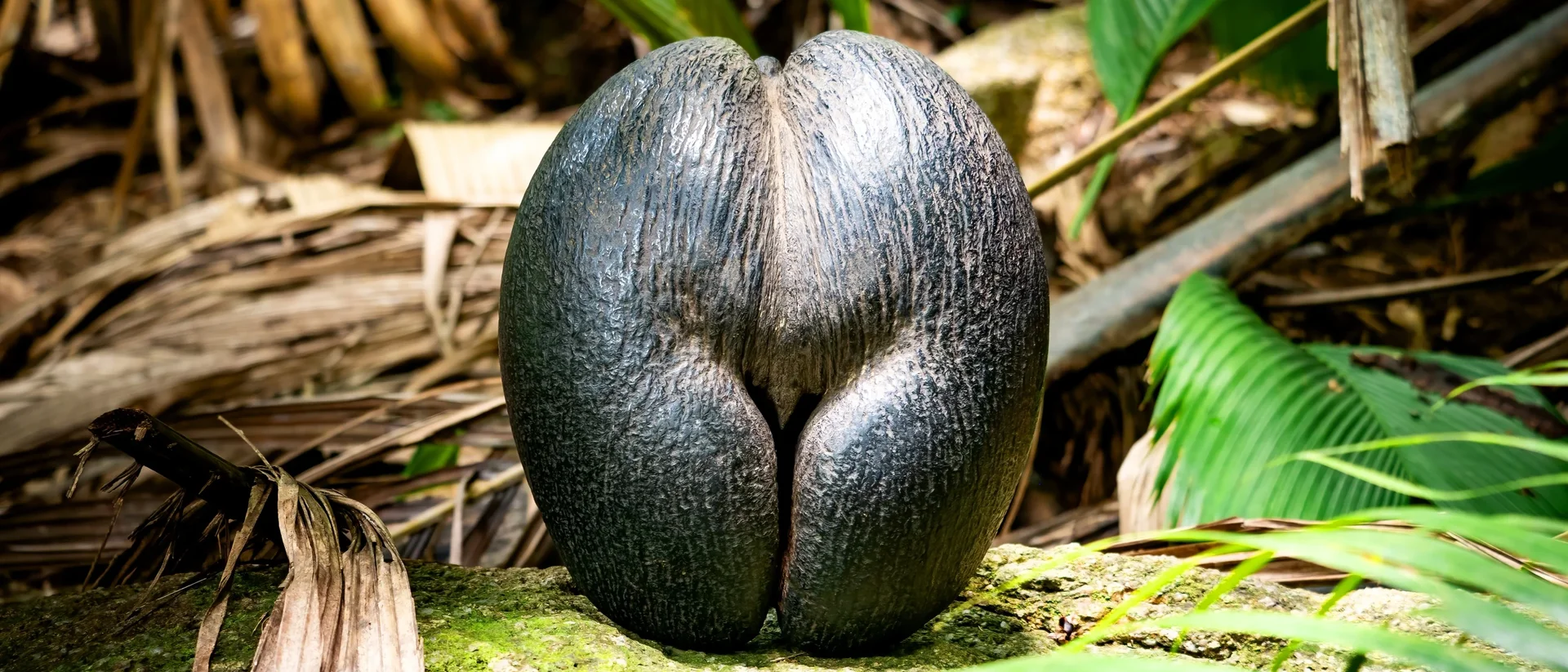
The Coco de Mer grows the world's largest seed - up to 25 kg and half a metre long. For centuries sailors found the giant nuts drifting in the Indian Ocean with no tree in sight, so they decided it must grow on a tree on the seafloor. The palm grows wild on just two islands on Earth, and every nut now needs a government permit to leave.
The Coco de Mer: The Seed Sailors Thought Grew Underwater
Somewhere on the remote islands of Praslin and Curieuse in the Seychelles, a palm tree is quietly growing the world's largest seed. It takes six to seven years to mature on the tree. When it finally falls, it weighs up to 25 kilograms - heavier than a car tyre - and stretches nearly half a metre long. It also looks unmistakably like a human pelvis and buttocks.
A Shape That Made Scientists Blush
The Coco de Mer (Lodoicea maldivica) earned its original scientific name from that silhouette. Botanists once called it Lodoicea callipyge - a Latin-Greek hybrid meaning "beautiful buttocks." In Seychellois Creole it goes by coco fesse, which translates, without much subtlety, to "bum coconut." The shape is not a loose interpretation. The two-lobed, bilobed form mirrors the human lower body in a way that startled European explorers, inspired fertility legends, and remains the single most distinctive thing about the plant.
Found on Only Two Islands on Earth
The wild Coco de Mer palm grows naturally on just two islands in the world: Praslin and Curieuse, both in the Seychelles archipelago in the Indian Ocean. Roughly 8,000 mature wild trees remain. The Vallee de Mai forest on Praslin - where dense stands grow almost exactly as they did before humans arrived - is a UNESCO World Heritage Site.
The Nut That Was Royalty
Before the Seychelles was discovered by Europeans in 1768, the enormous husks occasionally washed ashore in the Maldives and along Indian Ocean coastlines. Nobody knew where they came from - the prevailing theory was a mythical tree at the bottom of the sea. Holy Roman Emperor Rudolf II offered a fortune for one. Middle Eastern princes paid enormous sums for a nut they could not identify. When sailors finally found the source, the government immediately declared the trees crown property.
Strictly Controlled Today
The Coco de Mer is now classified as Endangered by the IUCN. Taking a wild nut is a serious offence - poachers face fines of thousands of dollars and possible imprisonment. Legal nuts are heavily regulated: each must be polished or hollowed and accompanied by a numbered government permit. A single legally purchased nut can cost £500 to £2,000 depending on size. Whole viable seeds cannot be exported at all - only hollowed shells are permitted to leave the Seychelles.
Frequently Asked Questions
How heavy is the Coco de Mer seed?
Where does the Coco de Mer grow?
Why is the Coco de Mer called coco fesse or the love nut?
Can you buy or export a Coco de Mer seed?
How long does a Coco de Mer take to grow?
Verified Fact
This fact has been reviewed and verified against original sources.
Source: Kew GardensShow verification details
Weight "up to 25 kg" sourced from Kew Gardens (kew.org). Wikipedia/scientific sources confirm 6-7 years maturation + 2 years germination; Britannica cites "about 10 years" and Cal Academy gives "6-10 years" - the 6-7 figure is not...