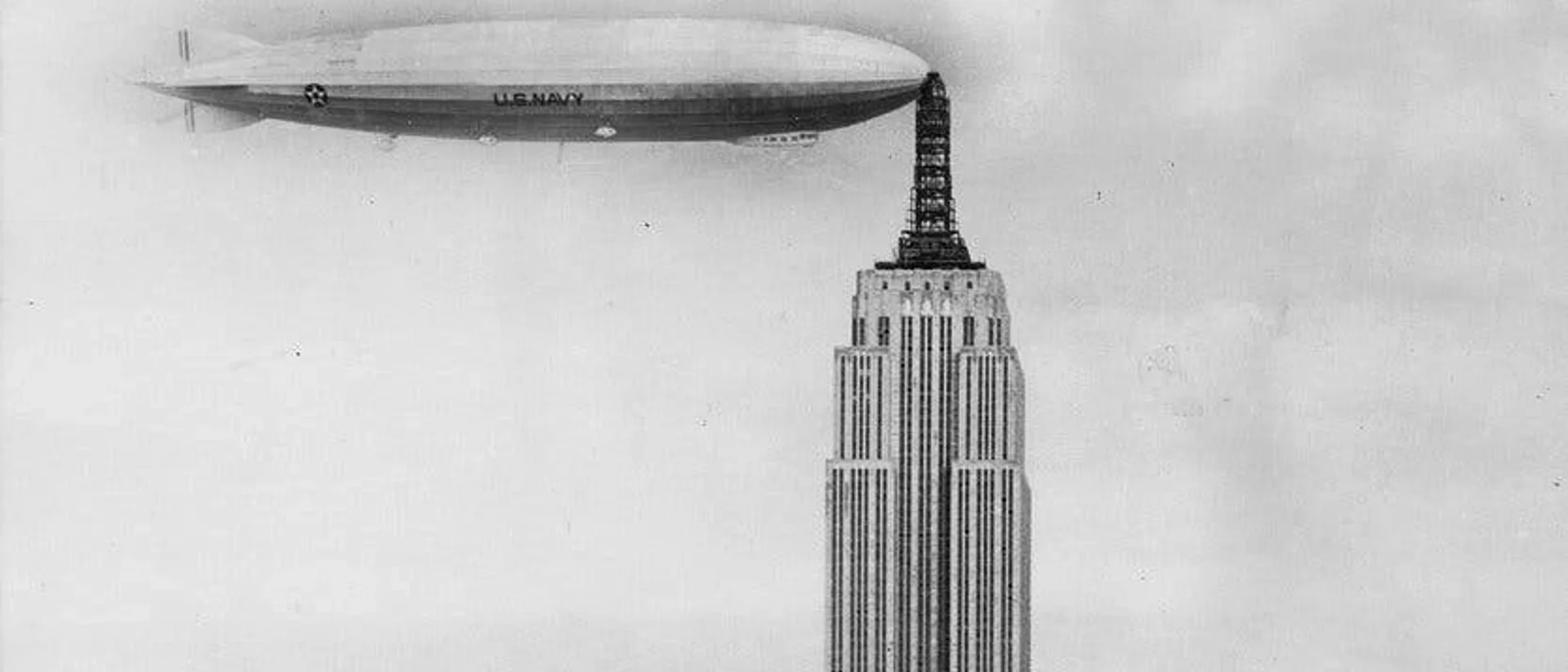
The Empire State Building's spire was designed as a boarding dock for airships. Passengers would cross an open gangplank 1,250 feet above the street, then ride an elevator down. In September 1931, a small airship docked there for three minutes in 40 mph winds. Two weeks later, a blimp lowered newspapers to the tower on a 100 foot rope. Updrafts made the mast unusable. No airship ever truly docked there.
The Empire State Building Was Built as an Airship Dock
Tourists riding the elevator to the Empire State Building's observation deck are standing inside what was once meant to be a boarding gate for transatlantic airships. The plan sounds like science fiction. It was real, and city officials approved it.
A Race to Be Tallest, With a Twist
In late 1929, as the Empire State Building's investors raced to beat the nearby Chrysler Building for the title of world's tallest, they announced the tower would grow another 200 feet. The official reason was not vanity. Al Smith, the former New York governor leading the project, said the extra height would house a mooring mast for airships, the giant hydrogen and helium dirigibles many assumed would soon carry passengers across the Atlantic the way ocean liners did.
An Open Gangplank at 1,250 Feet
The design called for airships to tie their nose cone to the mast near the top of the building. Passengers would then cross an open gangplank stretched over the street, more than 1,250 feet in the air, before riding a private elevator down to the 86th floor and out onto Fifth Avenue in about seven minutes.
Three Minutes of Actual Docking
Only one attempt came close to working. In September 1931, a small privately owned airship maneuvered close enough to hook onto the mast and held the connection for about three minutes in winds gusting near 40 miles an hour. Traffic on the streets below stopped as crowds watched the airship pitch and strain against the building.
A Newspaper Delivery, By Rope
Two weeks later, the Goodyear blimp Columbia flew past the tower and lowered a stack of that day's Evening Journal newspapers down to a man waiting on the mast, using a 100 foot rope. It worked, but it was a stunt, not a transportation system. A separate attempt by the same blimp to collect mail bags from the mast failed when the rope was torn from the hands of the man waiting at the top.
The Photo That Fooled Everyone
A famous photograph appears to show the Navy airship USS Los Angeles moored to the building's spire. It circulated in newspapers for decades and is now held by the Metropolitan Museum of Art, which displays it as an example of early photo manipulation. It is a composite. No airship of that size ever docked there.
Grounded for Good
Engineers and airship pilots, including Graf Zeppelin commander Hugo Eckener, warned that the wind currents swirling around Manhattan's skyscrapers made tethering an airship for any real length of time far too dangerous. There was also no practical way to secure the tail of a ship that long while it hung over a crowded city street. The mooring mast idea was quietly dropped. Decades later, the spire found a new job as a television and radio transmitter, the role it still serves today.
Frequently Asked Questions
Why was the Empire State Building's spire built?
Did an airship ever actually dock at the Empire State Building?
Is the famous photo of a blimp docked at the Empire State Building real?
What happened to the mooring mast on the Empire State Building?
How tall is the Empire State Building's spire above the street?
Verified Fact
Verified Jul 3, 2026 · 6 sources checked
Source: Smithsonian MagazineShow verification details
Claims checked
- Mooring mast designed as airship passenger terminal with gangplank
- September 1931 docking, 3 minutes, 40 mph winds, private airship
- Two weeks later, blimp lowered newspapers on 100-foot rope
- Mail-bag attempt was a pickup from the mast, not delivery
- No large airship ever truly docked; Met museum photo is fake
Sources: Smithsonian Magazine, Wikipedia, Library of Congress, Met Museum, Airship Heritage Trust, MCNY Blog