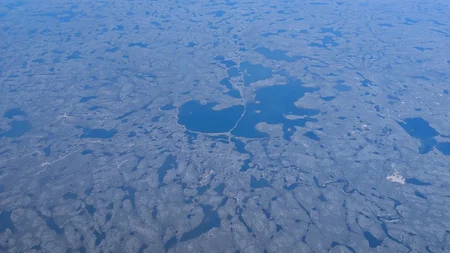
It takes a drop of ocean water approximately 1,000 years to complete a full circuit through the global ocean circulation system.
The 1,000-Year Journey of a Single Water Drop
Somewhere in the North Atlantic right now, a drop of water is beginning an epic journey. It won't see sunlight again for a millennium.
This isn't science fiction—it's the thermohaline circulation, often called the global ocean conveyor belt. And it operates on a timescale that makes human lifetimes seem like the blink of an eye.
The Deep Dive
The journey begins when surface water in the North Atlantic becomes cold and salty enough to sink. Near Greenland and Iceland, winter chills the water while evaporation and ice formation concentrate its salt content. This dense water plunges to the ocean floor—sometimes more than 4,000 meters down.
Once at the bottom, our water drop begins its slow crawl southward. It creeps along the Atlantic seafloor, passes the equator without noticing, and eventually reaches Antarctica. The pace? About 1-2 centimeters per second. A snail would lap it.
Around the World in 1,000 Years
From Antarctica, the deep water splits. Some flows into the Indian Ocean. Some enters the Pacific. The journey through the Pacific alone takes centuries—it's the largest and deepest ocean basin on Earth.
Eventually, in the tropical Pacific and Indian Oceans, the water slowly rises. Warming and mixing bring it back toward the surface over hundreds of years. Surface currents then carry it back toward the Atlantic, completing the circuit.
The full loop covers roughly 40,000 kilometers—the circumference of Earth. But unlike air travel, this trip has no express lane.
Why It Matters
This isn't just an oceanographic curiosity. The conveyor belt moves an almost incomprehensible amount of water:
- About 20 million cubic meters per second flows through the system
- That's 100 times the flow of the Amazon River
- It transports heat equivalent to 1 petawatt—a million billion watts
This heat transport keeps Western Europe significantly warmer than it should be at its latitude. London sits as far north as Calgary, Canada, but enjoys far milder winters thanks to this oceanic heating system.
A Climate Time Machine
Scientists study the conveyor belt to understand both past and future climate. Water sinking today in the North Atlantic carries a chemical signature of our current atmosphere—including dissolved CO₂ and temperature data.
When that water resurfaces in the year 3000, future oceanographers could read it like a message in a bottle from our era.
Climate change threatens to disrupt this ancient system. Melting Greenland ice adds fresh water to the North Atlantic, potentially slowing or altering the circulation. Some models suggest the conveyor belt could weaken by 25-50% this century.
The drop of water beginning its journey today will complete it in a world we can barely imagine. But the journey itself—patient, persistent, planetary in scale—will continue as it has for millions of years.
Frequently Asked Questions
How long does it take for ocean water to circulate around the world?
What is the global ocean conveyor belt?
Why does ocean water sink in the North Atlantic?
How does ocean circulation affect climate?
Could climate change stop ocean circulation?
Verified Fact
This fact has been reviewed and verified against original sources.
Show verification details
The claim is broadly accurate but the timeframe varies significantly. Deep ocean circulation (thermohaline circulation) takes approximately 1,000 years for a complete cycle, though some estimates range from 500-2,000 years depending on the...
Related Topics
More from Places & Culture
View all Places & Culture →