📅This fact may be outdated
The information in this fact was accurate when published but may have changed since then.
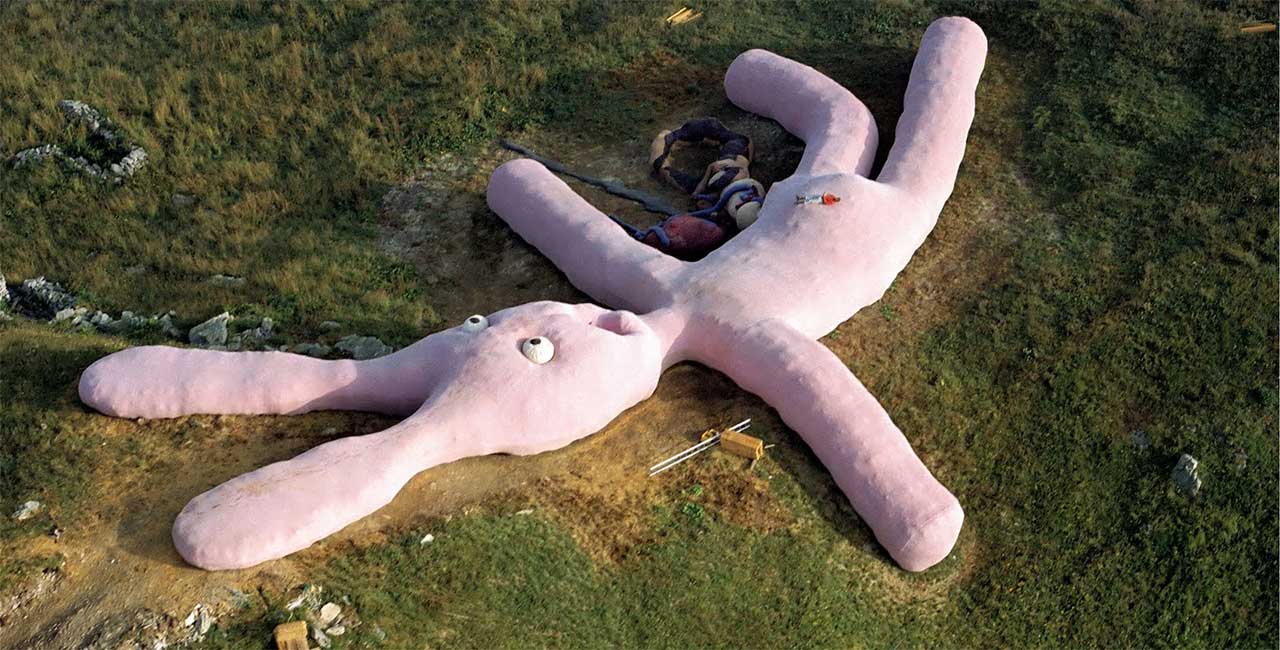
On a hill in Italy, there's a 200 foot stuffed pink bunny with its entrails spilling out.
The Giant Pink Bunny That Decomposed on an Italian Mountain
Picture this: You're hiking through the Piedmont Alps in northern Italy, and suddenly you crest a hill to find a 200-foot-long pink bunny sprawled across the mountainside, its stuffed guts spilling out like some fever dream version of Watership Down. This wasn't a hallucination—it was real, and it was spectacular.
In 2005, the Viennese art collective Gelitin spent five years hand-knitting this massive rabbit, hauling it up to Colletto Fava near the ski village of Artesina, and leaving it there for hikers to discover. The installation stood 20 feet tall and stretched longer than half a football field.
A Bunny Built for Giants (Or Lilliputians)
The artists didn't just want you to look at it—they wanted you to climb on it. The entire concept was inspired by Gulliver's Travels, designed to make visitors feel like tiny Lilliputians crawling over a giant's corpse. Gelitin explicitly encouraged people to jump on it, nap on it, or just marvel at the absurdity of a massive pink rabbit carcass on a remote Italian hillside.
The bunny was knitted from soft, waterproof wool and stuffed with straw. Its entrails were deliberately positioned to spill out dramatically, because if you're going to build a giant dead rabbit, you might as well commit to the aesthetic.
Nature Had Other Plans
Here's where the story takes a turn. Gelitin designed their rabbit to slowly decompose over time, expecting it to last until 2025—a full 20 years. But Mother Nature had different ideas. By 2016, barely a decade after installation, the bunny had almost completely decomposed. The Italian weather, UV exposure, and wildlife turned the surreal sculpture into little more than a pink outline visible from satellite imagery.
The rapid decay actually became part of the art itself—a commentary on impermanence that the artists probably didn't plan but couldn't have scripted better. Photos from Google Earth show its gradual disappearance, transforming from a shocking pink landmark into a ghost of its former self.
The Legacy of Hase
Though the physical bunny is gone, "Hase" (German for "hare") lives on in countless photos, travel blogs, and the memories of the thousands who made the pilgrimage. The installation achieved what great public art should: it surprised people, made them question reality for a moment, and gave them a story they'd tell for years.
Today, if you hike up to Colletto Fava, you'll find only faint traces of pink fabric and the flattened grass where it once lay. But for over a decade, an Italian mountain hosted one of the world's most bizarre and wonderful art installations—a 200-foot stuffed rabbit that literally returned to the earth that held it.
Frequently Asked Questions
Is the giant pink bunny in Italy still there?
Why did artists build a giant pink bunny in Italy?
Where was the giant pink bunny located in Italy?
How big was the giant pink bunny art installation?
What happened to the pink bunny on the Italian mountain?
Related Topics
More from Places & Culture
View all Places & Culture →