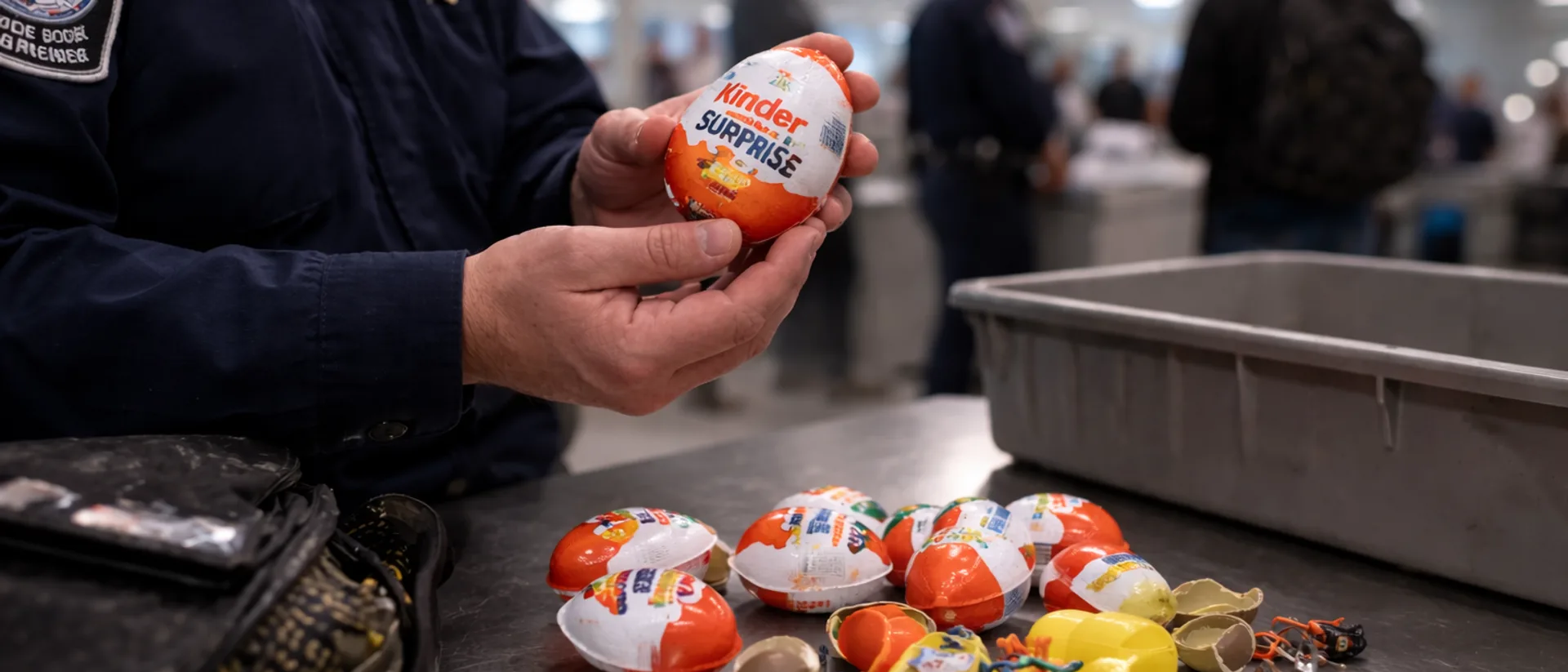
They're sold in over 170 countries. But bring a Kinder Surprise egg into the United States and customs will seize it. A toy inside a chocolate egg violates a 1938 federal law. Border agents confiscated over 60,000 in one year. The original Kinder Surprise remains contraband.
Kinder Surprise Eggs Are Contraband in the United States
In most of the world, Kinder Surprise eggs are a childhood staple - a hollow chocolate egg with a small toy capsule inside. They're sold in over 170 countries. But in the United States, they're contraband.
The 1938 Law
The ban stems from the Federal Food, Drug, and Cosmetic Act of 1938, specifically Section 402(d), which deems confectionery "adulterated" if it contains a non-nutritive object partially or completely embedded within it. The law was designed to prevent choking hazards in candy - and a plastic capsule inside a chocolate shell is exactly what it prohibits.
The law does include an exception for objects that serve a "practical functional value" and don't pose a health risk - think a stick in a lollipop. But the Consumer Product Safety Commission has never granted Kinder Surprise eggs that exception.
60,000 Seized in a Single Year
US Customs and Border Protection actively enforces the ban at the border. In 2011, CBP seized more than 60,000 Kinder Surprise eggs from travellers entering the United States. The eggs are treated as prohibited food items and confiscated on the spot.
Travellers have been stopped and detained at border crossings for carrying them. In one documented 2012 incident in Seattle, two men were held for two and a half hours over Kinder eggs in their luggage.
The real-world consequences are confiscation and, at worst, a fine for failing to declare food items - but the image of customs agents solemnly confiscating chocolate eggs from bewildered tourists has made the ban a source of international amusement.
Kinder's American Workaround
In 2017, Ferrero (Kinder's parent company) launched Kinder Joy in the United States. It's a completely redesigned product: a plastic egg split into two sealed halves. One side contains cream and wafer pieces with a small spoon. The other contains the toy. The toy is never embedded inside food, so it complies with the law.
Kinder Joy has been a commercial success in the US. But the original Kinder Surprise - the hollow chocolate egg with the toy rattling around inside - remains illegal. It's one of the most popular confectionery products on the planet and one of the few consumer goods that Americans cannot legally buy.
Frequently Asked Questions
Why are Kinder Surprise eggs banned in the US?
Can you buy Kinder eggs in the US?
What happens if you bring Kinder Surprise eggs into the US?
Verified Fact
Verified via CBP press releases
Source: US Customs and Border ProtectionShow verification details
Verified via CBP press releases (60,000+ seized in 2011), 21 U.S.C. § 342(d)(1) (Federal Food, Drug, and Cosmetic Act), CNN, NPR, CBC News. Ban confirmed. Kinder Joy (separate compartment) launched in US in 2017. Chile also bans them. The widely circulated "$2,500 per egg fine" is NOT confirmed — actual fine is $400 for undeclared food items. Nobody has been prosecuted; eggs are confiscated.