
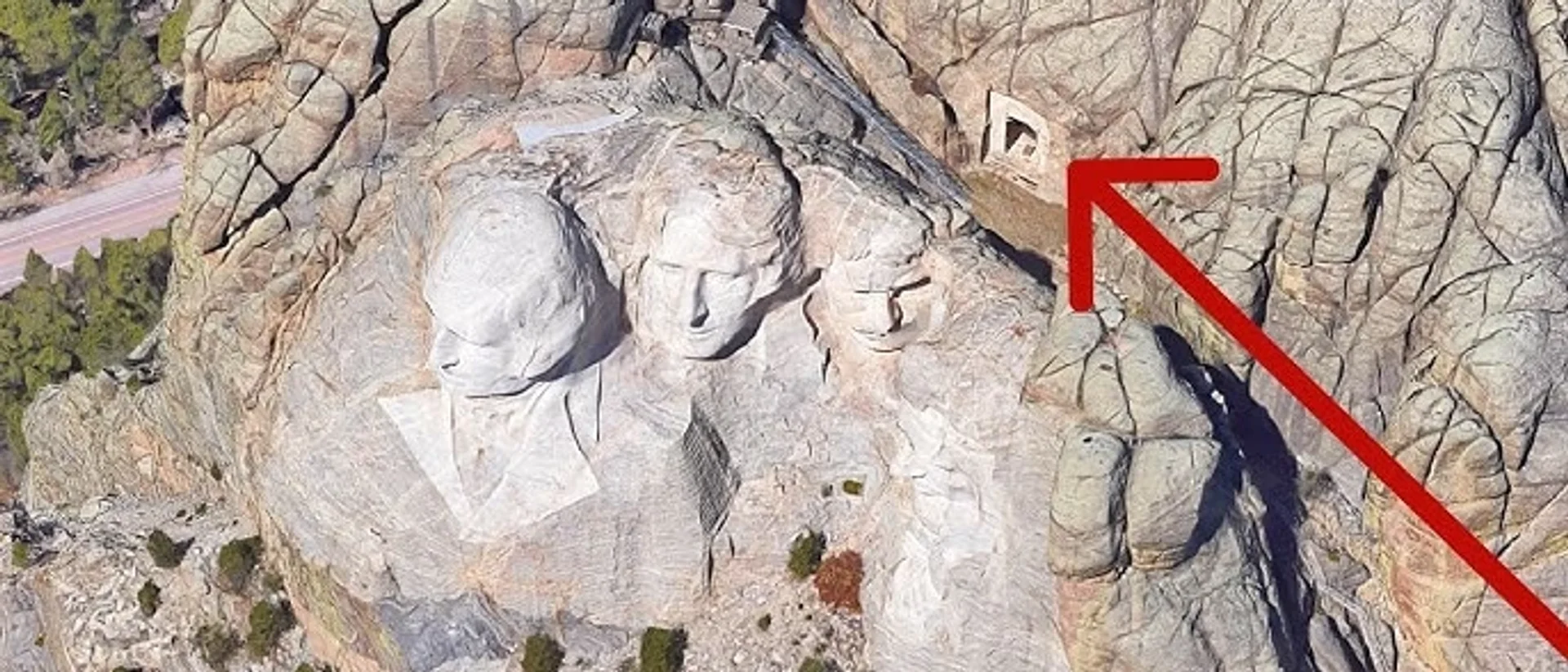
Mount Rushmore has a secret: a 70-foot granite tunnel cut directly behind the faces. Sculptor Gutzon Borglum began drilling it in 1938 to house America's founding documents for future civilizations. Congress shut the project down in 1939 and Borglum died in 1941. In 1998, his family lowered 16 porcelain panels into a titanium vault and sealed it under a 1,200-pound granite capstone. Nobody can go inside.
The Secret Vault Sealed Inside Mount Rushmore
Millions of tourists photograph the four presidents carved into Mount Rushmore each year. Almost none of them know there is a sealed vault cut directly into the mountain behind those faces - placed there not for us, but for people living thousands of years from now.
Borglum's Original Plan
Sculptor Gutzon Borglum began work on Mount Rushmore in 1927, but his ambitions went far beyond four enormous stone faces. He wanted to build what he called the Hall of Records - an 80-by-100-foot chamber carved into the north canyon wall directly behind the presidential heads. An 800-foot granite staircase would lead visitors up to the entrance, framed by cast-glass doors beneath a bronze eagle with a 38-foot wingspan. Inside, brass and glass cabinets would hold the Declaration of Independence, the Constitution, and busts of great Americans from Benjamin Franklin to the Wright Brothers.
Borglum believed that future civilizations might encounter the monument and have no idea what it meant. He wrote that "civilizations are ghouls" - each one forgets everything that came before it. He wanted Mount Rushmore to be both the sculpture and its own explanation.
The 70-Foot Tunnel
In July 1938, workers began blasting the Hall of Records into the granite. After roughly a year of drilling, they had created a 70-foot-long tunnel in the canyon wall behind Lincoln's head. Then Congress ordered Borglum to stop. Federal funding was tied to the faces, not the hall, and the government wanted the presidential portraits finished first. The Hall of Records was set aside - then Borglum died in March 1941, and the project died with him.
For nearly six decades, the unfinished tunnel sat empty: a 70-foot hole in the mountain that most visitors never saw and nobody talked about.
The 1998 Sealing
On August 9, 1998, Borglum's family gathered inside the unfinished chamber to honor what he had started. They lowered sixteen porcelain enamel panels into the floor of the tunnel. The panels were inscribed with the full text of the Declaration of Independence, the U.S. Constitution, the Bill of Rights, biographies of each of the four presidents, a biography of Borglum himself, and a history of the memorial's construction. The panels went into a teakwood box, which was sealed inside a titanium vault, which was then covered by a 1,200-pound black granite capstone.
Borglum's daughter, Mary Ellis, attended the ceremony and watched the capstone lowered into place. She said: "It's the end of the creation of Mount Rushmore as my father saw it."
The Vault Nobody Visits
The Hall of Records remains closed to the public and is not included on any visitor tour. The National Park Service maintains it as a permanent repository - not for people alive today, but for whoever encounters the mountain thousands of years from now and wonders who built it and why. The tunnel is there right now, behind the presidents, sealed under granite, holding the story of the country that carved them.
Frequently Asked Questions
What is the Hall of Records at Mount Rushmore?
What is inside the Mount Rushmore vault?
Can visitors go inside the Mount Rushmore Hall of Records?
Why did Gutzon Borglum want to build the Hall of Records?
When was the Mount Rushmore vault sealed?
Verified Fact
Verified Jun 15, 2026 · 5 sources checked
Source: National Park ServiceShow verification details
Claims checked
- 70-foot tunnel cut behind Lincoln's head
- Work began July 1938, Congress halted it in 1939
- Borglum died in March 1941
- In 1998, 16 porcelain panels in a titanium vault were sealed under a 1,200-pound granite capstone
- Vault is not publicly accessible
Sources: National Park Service, History.com, Black Hills Visitor, historyfacts.com, Fox News