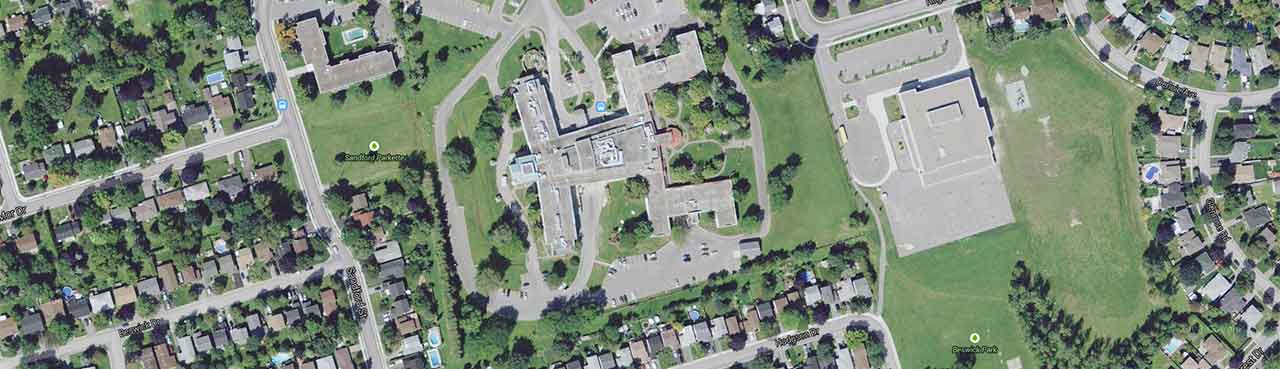
There's a man-shaped health center in Newmarket, Ontario, Canada, that from above looks like a spread-eagled naked man—complete with detailed arms, legs with kneecaps, and unmistakable male anatomy between the legs.
Ontario Health Centre Looks Like a Naked Man
Sometimes architecture tells a story the designers never intended. Such is the case with the Newmarket Health Centre in Ontario, Canada, where an aerial view reveals something that would make even the most seasoned urban planner do a double-take.
From above, the building looks exactly like a naked man lying on his back with arms and legs spread wide. And we do mean exactly.
Anatomically Correct Architecture
The four-winged structure features:
- Two western wings that extend like outstretched arms
- Two eastern wings resembling legs—complete with what appear to be kneecaps and feet
- A rectangular section at the top that looks like a head
- And between those architectural "legs"... well, you can probably guess
The building went viral in 2015 when people discovered it on Google Maps, sparking headlines from the Daily Mail to Playboy magazine. Twitter user Voxtar spoke for many when they wrote: "I applaud the architect who built Newmarket's Health Centre with a phallic entrance."
How Did This Happen?
The original structure was built in 1951 as a facility for patients, seniors, and veterans needing long-term care. Over the decades, various wings and extensions were added—apparently without anyone checking what the building looked like from a satellite's perspective.
Today it houses 132 long-term care beds with 24-hour nursing staff. The Regional Municipality of York took over ownership in 1991, and presumably had a moment of realization at some point when Google Earth became publicly available.
The Town's Response
Local residents have taken the discovery with good humor. "Having part of it look like a man's penis is particularly amusing," noted resident Peter Kaufman with admirable understatement.
Kaufman also pointed out that Newmarket is the birthplace of both Jim Carrey and John Candy—two of Canada's greatest comedians. "I'm sure Jim Carrey and John Candy will find it funny," he said, as if the universe had planned this cosmic joke all along.
While some might find the shape embarrassing, the health centre continues serving its community with dignity—132 beds, round-the-clock care, therapeutic gardens, and an on-site hair salon. It just happens to do all this while looking like an anatomical diagram from 30,000 feet.
Next time you're browsing Google Maps, zoom in on Newmarket, Ontario. The address is 194 Eagle Street—though honestly, you won't need directions. Just look for the building that looks like it's very happy to see you.
Frequently Asked Questions
Where is the man-shaped building in Canada?
Is the Newmarket Health Centre shaped like a man on purpose?
What is the Newmarket Health Centre used for?
When did people discover the Newmarket Health Centre looks like a man?
Is there really an STI clinic in the man-shaped building?
Verified Fact
This fact has been reviewed and verified against original sources.
Show verification details
Corrected the claim about the STI clinic. The building IS man-shaped, but it's a long-term care home for seniors - there is no STI clinic there. The 'STI clinic' claim originated from a joke Daily Mail headline that went viral as fact.
Related Topics
More from Places & Culture
View all Places & Culture →