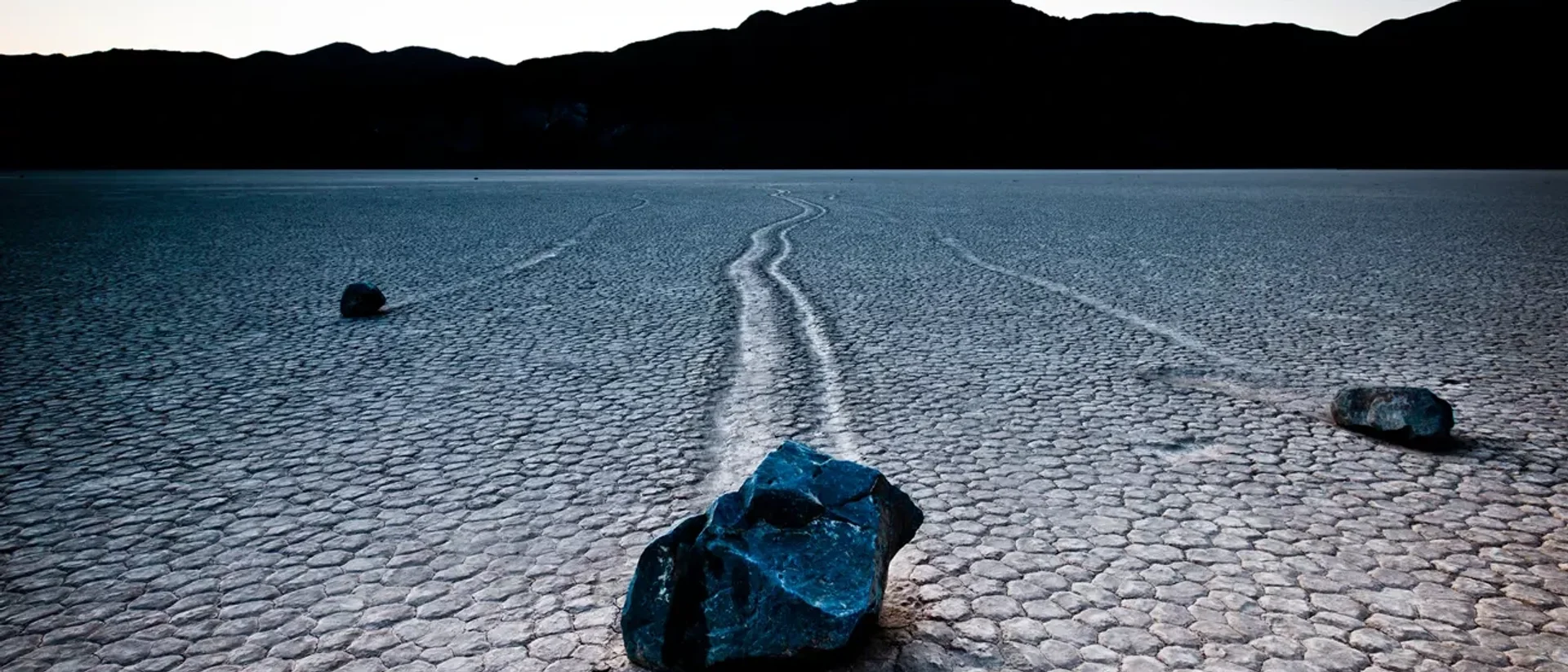
At Racetrack Playa in Death Valley, rocks weighing up to 700 lbs slide across cracked mud on their own - leaving trails hundreds of feet long. Nobody caught them moving for nearly 100 years. Scientists finally solved it in 2014: rare winter ice forms overnight, cracks into floating panels at sunrise, and a light breeze pushes the panels against the rocks, skating them silently across the playa.
Death Valley Rocks That Move by Themselves
At Racetrack Playa, deep in California's Death Valley National Park, there are rocks that move. Big ones - some weighing up to 700 pounds. They creep across the cracked mud and leave long, unmistakable trails behind them. Nobody was ever there to see it happen. For nearly 100 years, geologists and curious visitors stared at those trails and had no explanation.
A Mystery That Baffled Everyone
The first documented sighting came in 1915, when prospector Joseph Crook visited the dry lakebed and could not explain the trails he found. Formal scientific study began in the 1940s, and over the following decades researchers proposed magnetic fields, dust devils, algae-slicked mud, and windstorms as possible causes. None of them held up. The rocks were too heavy to be shifted by wind alone - and no one, in any season, in any decade, ever witnessed one actually moving.
The GPS Experiment
In 2011, paleobiologist Richard Norris of Scripps Institution of Oceanography and his cousin Jim Norris devised a plan: tag 15 rocks with custom motion-activated GPS units, install a high-resolution weather station, and wait. They waited two years. Then, in December 2013, the sensors fired. The time-lapse cameras had caught it all.
Windowpane Ice - The Answer Nobody Expected
The mechanism turned out to be beautifully mundane. On rare winter nights, rain floods the playa with a shallow pond just an inch or two deep. Overnight temperatures drop below freezing, and by morning the pond is covered by a thin sheet of ice - only 3 to 6 millimetres thick, like a pane of glass. As the sun rises, the ice melts and breaks into large floating panels tens of metres across. A light breeze - just 3 to 5 metres per second - drives those ice sheets across the slick mud. When the panels hit a rock, the rock slides. Slowly - just 2 to 5 metres per minute - but it slides. On December 20, 2013 alone, more than 60 rocks moved simultaneously, with some covering 224 metres (245 yards) over that single winter season.
Why Nobody Ever Saw It
Movement requires a precise sequence: rain, then overnight freeze, then a gentle morning breeze. That combination is rare - it may happen only a handful of times per year, or not at all. The playa is also remote, reachable only by a rough unpaved road. Those factors together meant the odds of a human observer being present at the right moment were vanishingly small. The rocks had been moving for millennia; it took nearly 100 years of documented scientific curiosity - and two years of patient GPS monitoring - to finally catch them in the act. The study was published in PLOS ONE in August 2014.
Frequently Asked Questions
What are the sailing stones of Death Valley?
How do the sailing stones move?
Who solved the mystery of the sailing stones?
How long was the sailing stones mystery unsolved?
Where is Racetrack Playa located?
Verified Fact
Verified against: Scripps Institution of Oceanography press release
Source: Scripps Institution of OceanographyShow verification details
Key claims verified against: Scripps Institution of Oceanography press release (scripps.ucsd.edu); PLOS ONE paper doi:10.1371/journal.pone.0105948 (Norris et al., Aug 27 2014); ScienceDaily release (2014/08/140828141902); Wikipedia sailing stones; historicmysteries.com and sickhistory.com for 1915 Joseph Crook first documentation. Rock weight up to 320kg/700lbs confirmed (PLOS ONE). Trails of hundreds of meters confirmed. December 2013 GPS observation confirmed. Ice mechanism: 3-6mm windowpane ice, 3-5 m/s wind, 2-5 m/min movement, 224m max single season (PLOS ONE). More than 60 rocks moved December 20 2013 (ScienceDaily/Scripps). 1915 first documented prospector account confirmed across sickhistory.com, historicmysteries.com. Wrong theories (magnetism, wind alone, algae, dust devils) confirmed as previously proposed. is_child_friendly=true.