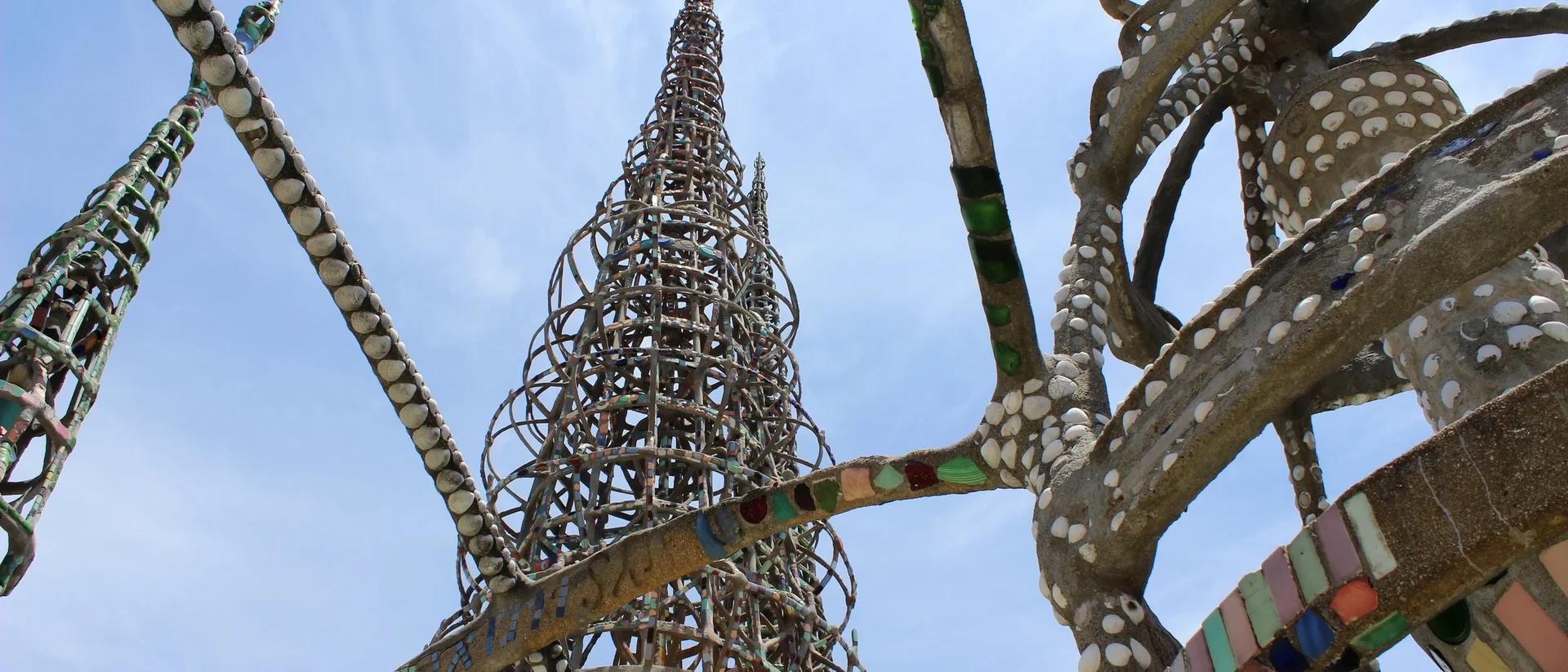
Simon Rodia, an Italian immigrant tile mason, spent 33 years building the Watts Towers in Los Angeles entirely by hand - no machines, no scaffolding, no bolts, no welds, no blueprints. His only tools were pipe-fitter pliers and a window-washer belt. The tallest spire reaches 99 feet. When he finished in 1954, he deeded the land to a neighbor, boarded a bus, and never came back.
One Man Built a 99-Foot Tower for 33 Years, Then Just Walked Away
In the backyard of a small house in the Watts neighborhood of Los Angeles, one man spent more than three decades building something engineers still struggle to explain. No permits, no blueprints, no crew - just an Italian immigrant with a window-washer belt and a bucket of hand tools, working alone until the towers were nearly a hundred feet tall.
The Man Behind the Spires
Sabato Rodia - known as Simon or Sam - emigrated from Italy and settled in Watts around 1920, working as a tile mason and construction worker. He had no formal training as an artist or architect. In 1921, at around 42 years old, he began working on the triangular backyard of his home at 1761 107th Street, bending steel rebar into the first of what would become seventeen interconnected towers. He called the whole site Nuestro Pueblo - "Our Town."
No Machines, No Plans, No Help
For 33 years, Rodia worked entirely alone. He used no machine equipment, no scaffolding, no bolts, no rivets, no welds, and no architectural drawings. His primary tools were pipe-fitter pliers and a window-washer belt and buckle, which served as his only safety line while working at heights of nearly 100 feet. He assembled structural elements on the ground, carried them up in buckets, and packed mortar by hand over a skeleton of steel rebar and wire mesh. Into that mortar he pressed whatever he could find: broken pottery, ceramic tiles, seashells, colored glass, and bottle fragments from 7-Up and Canada Dry. Many of the decorative tiles came from the Malibu Potteries and the California Clay Products Company.
The Tallest Spire: 99 Feet
The site grew to include 17 major sculptures and mosaics within a single enclosure. The tallest tower reaches 99.5 feet - roughly ten stories - and stands today held together without a single bolt or weld. Rodia pioneered a thin-shell concrete technique that structural engineers later found surprisingly robust. In 1959, when the City of Los Angeles condemned the towers as unsafe, officials performed a stress test by pulling on the tallest spire with a crane. The crane buckled before the tower moved. The demolition order was lifted.
He Finished, Gave It Away, and Left
In 1954, after 33 years of work, Rodia stopped. The following year, he deeded the property to his neighbor and boarded a bus to Martinez, California, to live near his sister. He never returned to Watts, never sold his creation, and never visited the towers again. He later said of the project: "I had it in my mind to do something big, and I did." He died in Martinez in 1965.
A National Historic Landmark
The Watts Towers were designated a National Historic Landmark in 1990. They are owned by the City of Los Angeles and managed as a state historic park. The towers Rodia built by hand, alone, over 33 years - then quietly walked away from - still stand today in the neighborhood where he lived.
Frequently Asked Questions
How long did it take to build the Watts Towers?
What tools did Simon Rodia use to build the Watts Towers?
How tall are the Watts Towers?
What happened to Simon Rodia after he finished the Watts Towers?
Are the Watts Towers still standing today?
Verified Fact
Verified Jun 22, 2026 · 7 sources checked
Source: Discover Los AngelesShow verification details
Claims checked
- Built alone by hand over 33 years (1921-1954)
- No machines, scaffolding, bolts, welds, or blueprints
- Tallest spire is 99.5 feet
- Tools were pipe-fitter pliers and a window-washer belt
- Deeded land to neighbor, boarded a bus, and never returned
Sources: Discover Los Angeles, Google Arts & Culture, LACMA Unframed, SPACES Archives, Wikipedia, WhenInYourState, wattstowers.us