A London skyscraper accidentally became a giant curved mirror. Its glass facade focused sunlight into a beam so intense it melted a parked Jaguar, scorched a shop, and let a reporter fry an egg on the pavement. The architect had built the same flaw in Las Vegas years earlier.
The London Skyscraper That Melted a Jaguar
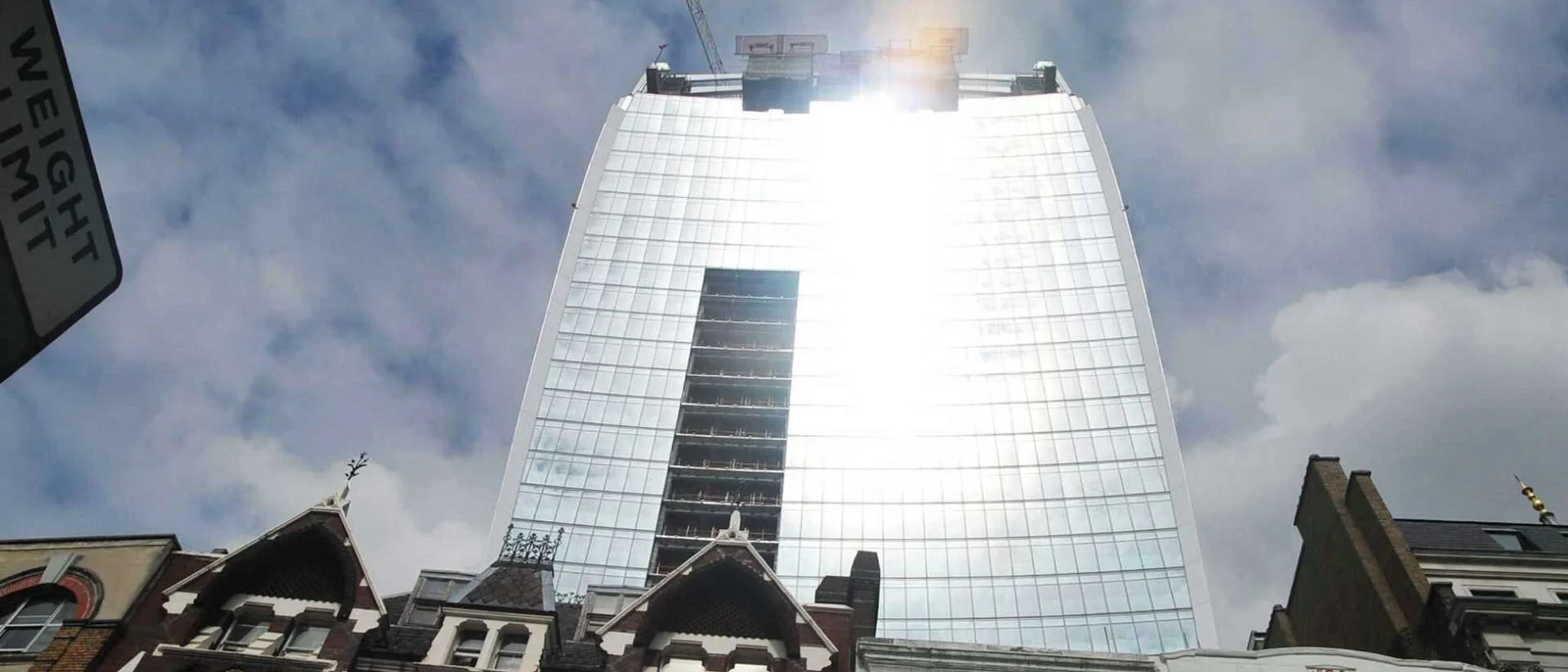
In the summer of 2013, something strange was happening on Eastcheap, a narrow street in the City of London. Parked cars were warping. A barber shop carpet caught fire. Slate tiles shattered on a restaurant doorstep. The culprit was not arson - it was a skyscraper.
The Building That Forgot Physics
The tower at 20 Fenchurch Street - nicknamed "the Walkie-Talkie" for its top-heavy silhouette - was still under construction when its south-facing concave glass facade began acting as a parabolic reflector. Like a giant magnifying glass, it gathered sunlight from a large curved surface and focused it into a concentrated beam at street level. The effect lasted up to two hours each day and was powerful enough to raise street temperatures to 117C (243F). The beam was up to six times brighter than direct sunlight.
The Jaguar That Paid the Price
London businessman Martin Lindsay parked his Jaguar XJ on Eastcheap and returned to find it "absolutely ruined." The wing mirror had melted, the badge had warped, and panels had blistered. Repairs came to £946. Developers Land Securities and Canary Wharf Group apologized and covered the bill. Nearby, a barber shop carpet had caught fire, a restaurant owner found shattered slate tiles on his doorstep, and City A.M. reporter Jim Waterson placed a frying pan on the pavement and cooked an egg in the beam.
The Architect Who Had Done It Before
The building was designed by architect Rafael Vinoly - who had made the exact same mistake three years earlier. His Vdara hotel in Las Vegas (2010) has a similarly curved, south-facing glass facade that created a hot spot by the pool deck intense enough to singe sunbathers' hair and melt plastic bags and drinks cups. Vinoly projected the London beam would reach 36 degrees; it reached 72. When pressed, he blamed "the superabundance of consultants."
The Fix
Developers submitted plans for a permanent brise soleil - horizontal aluminium fins running from the third to the 34th floor, designed by Vinoly's practice alongside solar glare specialists Loisos + Ubbelohde. The fins were installed in 2014 at a cost of less than $10 million. The beam that had fried eggs and melted a Jaguar was gone. The building remains one of the most distinctive - and cautionary - shapes on the London skyline.
Frequently Asked Questions
What is the Walkie-Talkie building in London?
Why did the Walkie-Talkie building melt cars?
Who was affected by the Walkie-Talkie death ray?
What was done to fix the Walkie-Talkie solar reflection problem?
Did the same architect cause a similar problem elsewhere?
Verified Fact
Verified Aug 26, 2026 · 7 sources checked
Source: Wikipedia - 20 Fenchurch StreetShow verification details
Claims checked
- Melted a parked Jaguar and scorched a shop
- Reporter fried an egg on the pavement near the building
- Architect Rafael Vinoly built the same flaw in Las Vegas in 2010
- Fix installed (brise soleil) on floors 3-34 in 2014
- Temperatures on the pavement reached 91-117°C
Sources: Wikipedia, ArchDaily, New Atlas, NBC News, Construction Enquirer, Architectural Record