
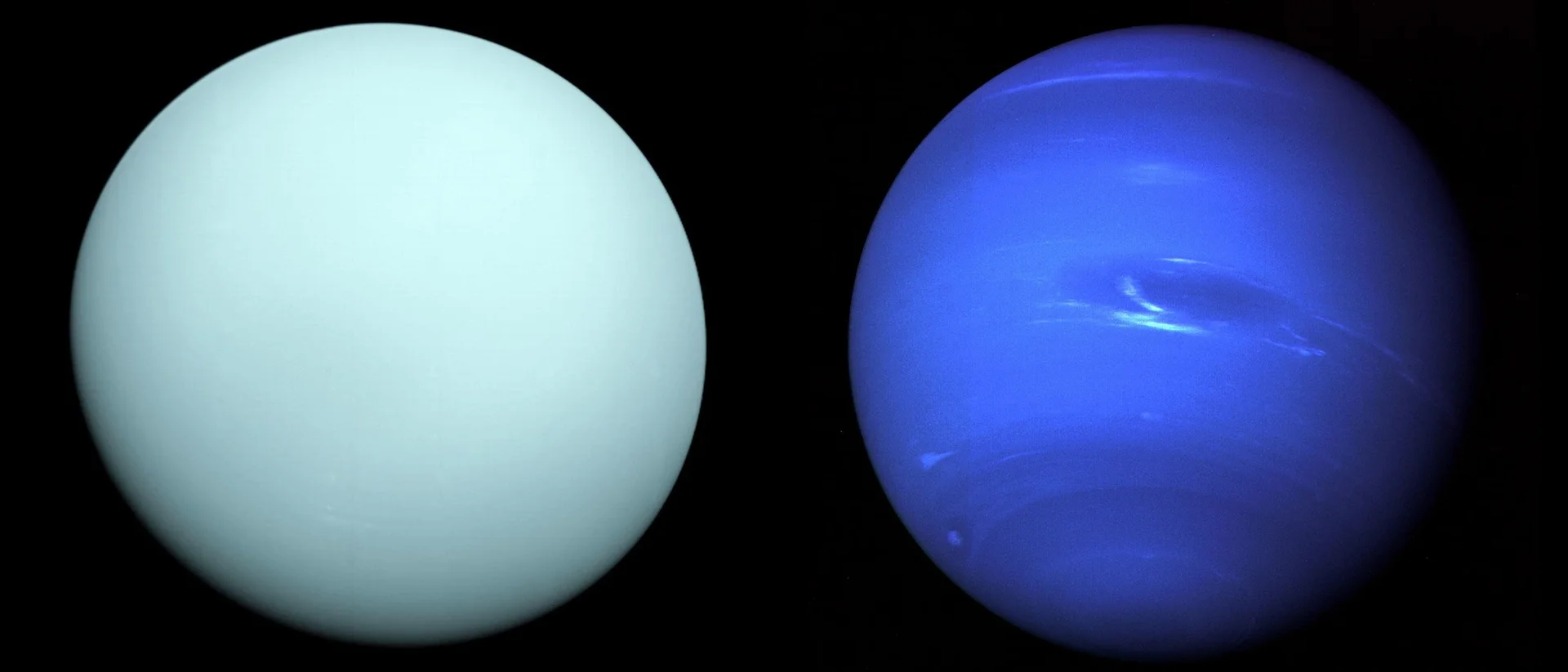
Deep inside Neptune and Uranus, heat and pressure squeeze carbon from methane into diamonds that sink toward the core. In 2017, scientists at SLAC recreated the conditions and watched diamonds form.
It Rains Diamonds on Neptune and Uranus
When astronomers call Neptune and Uranus "ice giants," they leave out the most spectacular ingredient: diamonds. Thousands of miles below the cloud tops, conditions are so extreme that carbon atoms bond together and form solid diamonds - then sink toward the core like gemstone hailstones.
Where the Diamonds Come From
The deep interiors of both planets are rich in methane - a simple molecule made of one carbon atom bonded to four hydrogen atoms. At depths greater than 5,000 miles below the surface, temperatures exceed 9,000 degrees Fahrenheit (around 5,000 degrees Celsius) and pressure reaches millions of times that of Earth's atmosphere. Under those conditions, methane breaks apart. The hydrogen escapes, and the freed carbon atoms are forced together under immense pressure, forming solid diamond crystals. Those crystals are too dense to float, so they sink deeper, settling around the core.
Scientists Recreated It in a Lab
For decades this was a compelling theory with no direct proof. In 2017, physicist Dominik Kraus of Helmholtz-Zentrum Dresden-Rossendorf led a team that used SLAC's Linac Coherent Light Source in California to finally change that. The researchers fired intense laser pulses at a thin sheet of polystyrene - ordinary plastic, made of hydrogen and carbon, the same two elements found in the planets' interiors. The lasers created overlapping shock waves that briefly reproduced the pressure and temperature conditions found deep inside Neptune and Uranus. X-ray pulses, each lasting just 50 femtoseconds, captured the transformation in real time. Nearly every carbon atom in the plastic was converted into diamond. The study was published in Nature Astronomy.
Bigger Than Any Diamond on Earth
The lab-made diamonds were only a few nanometers wide - the experiment lasted a fraction of a second. Inside Neptune and Uranus, the process runs for billions of years. Scientists estimate the diamonds that slowly settle toward the planetary cores could grow to millions of carats in weight, dwarfing any gem ever found on Earth.
The 2024 Discovery: Diamonds and Magnetic Fields
A follow-up study published in Nature Astronomy in January 2024, led by Mungo Frost at SLAC, found that diamond formation happens at lower pressures and temperatures than the 2017 work had suggested. That means diamonds likely form at shallower depths inside both planets. As they sink through layers of electrically conductive ice, they stir the fluid, driving currents that act as a dynamo. The researchers suggest this could help explain something that has puzzled scientists for years: why Neptune and Uranus have magnetic fields so lopsided and irregular compared to Earth or Jupiter. The 2024 study also found that the presence of oxygen - which the planets have in abundance - makes diamond formation easier, raising the possibility that diamond rain occurs on "mini-Neptunes," one of the most common types of planet found beyond our solar system.
A Use Closer to Home
The nanodiamonds produced in the SLAC experiments are not just a curiosity. Researchers believe the same shock-compression technique could offer a new way to manufacture nanodiamonds on Earth, where they are already used in medical sensors, drug delivery systems, and quantum electronics. The alien interior of an ice giant may end up pointing the way to better medical tools.
Frequently Asked Questions
Does it really rain diamonds on Neptune and Uranus?
How big are the diamonds inside Neptune and Uranus?
What experiment proved diamond rain is real?
Why do Neptune and Uranus have such unusual magnetic fields?
Could diamond rain happen on planets beyond our solar system?
Verified Fact
Verified Jun 15, 2026 · 6 sources checked
Source: View sourceShow verification details
Claims checked
- Diamonds form from methane under extreme heat and pressure inside Neptune and Uranus
- Experiment temperature corrected to about 9,000°F (5,000°C)
- Lead scientist Dominik Kraus is at HZDR, not SLAC (work used SLAC's facility)
- 2024 experiment was conducted at European XFEL, not SLAC
- Depth, polystyrene, shock waves, and X-ray pulses confirmed
Sources: SLAC, HZDR, LLNL, ScienceDaily, phys.org, space.com