
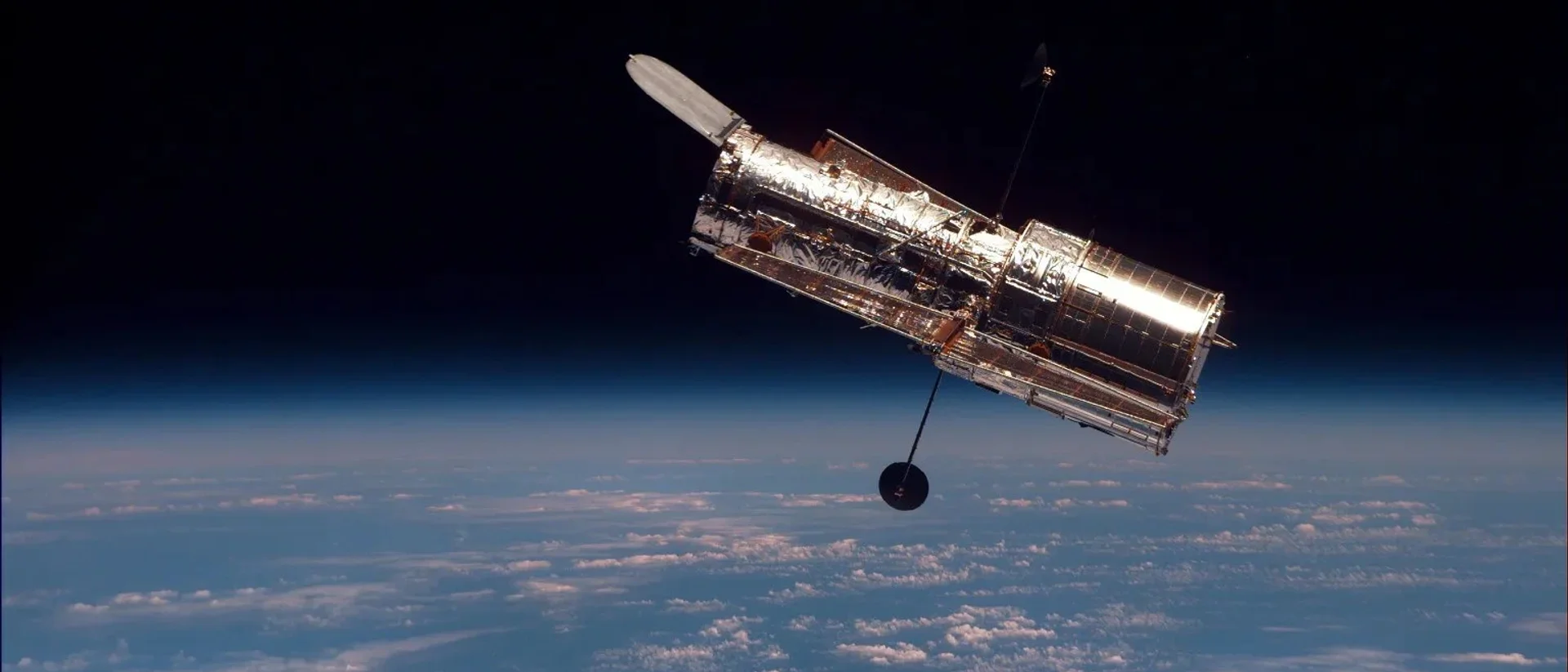
Hubble launched in 1990 with a $1.5 billion price tag - and a mirror ground to the wrong shape. The error was just 2 microns off, about 1/50th the width of a human hair, but enough to leave the telescope nearly blind. NASA became a late-night punchline. In December 1993, astronauts spent 35 hours across five spacewalks installing corrective optics in orbit. The images that came back were perfect.

NASA Launched Hubble Nearly Blind - Then Fixed It in Space

3 viewsPosted 6 days agoUpdated 6 minutes ago

In 1990, NASA sent the most powerful telescope ever built into orbit - and almost immediately discovered it could barely see. Hubble's primary mirror had been ground to the wrong shape, and the world's most anticipated observatory was producing images so blurry it became a national embarrassment.

A Mirror Off by a Fraction

The flaw was almost unimaginably small. Hubble's primary mirror - 2.4 meters across - had been polished to the wrong curve. The outer edge was 2 microns too flat, roughly 1/50th the width of a human hair. But in optics, precision is everything. Instead of focusing 70% of incoming starlight to a single point, Hubble could only manage 10-15%. Every star appeared surrounded by a halo of scattered light. Every galaxy was a soft blur.

The cause was traced to a tool called a null corrector, used during fabrication to test the mirror's shape. A lens inside the device had been spaced off by 1.3 millimeters - a tiny error that had gone undetected for nine years. The result: Hubble had been polished to perfection - but to the wrong specification entirely.

A $1.5 Billion Punchline

The telescope had cost $1.5 billion to build and launch. Within weeks of its first images arriving, NASA found itself fielding congressional hearings and late-night jokes. Senator Barbara Mikulski publicly asked whether NASA was building "techno turkeys." Astronomers who had waited decades for Hubble to fly watched blurry images of galaxies they could barely identify.

Glasses for a Telescope

Engineers developed a solution called COSTAR - the Corrective Optics Space Telescope Axial Replacement. About the size of a large refrigerator, it used 10 small motorized mirrors to intercept light before it reached Hubble's instruments, compensating precisely for the original mirror's error. The concept was conceived by engineer James Crocker while studying the adjustable shower fixtures in a European hotel room.

In December 1993, Space Shuttle Endeavour carried seven astronauts to Hubble on mission STS-61. Over five consecutive spacewalks totaling 35 hours and 28 minutes, two teams worked in orbit to install COSTAR and replace the Wide Field and Planetary Camera. It was among the most complex repair missions NASA had ever attempted.

The Images That Came Back

When the corrected images arrived, Senator Mikulski's reaction was immediate: "My God, it's like putting my glasses on." The before-and-after photographs of galaxy M100 became iconic - a blurry smear transformed into a crisp spiral of stars. Hubble went on to produce discoveries that reshaped modern astronomy: the accelerating expansion of the universe, the age of the cosmos, the atmospheres of planets orbiting other stars. The telescope that launched nearly blind became the most productive observatory in the history of science.

Enjoyed this? Get a new fact every day.

Follow FunFactz for the best ones in your feed.

or get one in your inbox

Frequently Asked Questions

What was wrong with the Hubble Space Telescope when it launched?
Hubble's primary mirror was ground to the wrong shape - its outer edge was 2 microns too flat, about 1/50th the width of a human hair. The error was caused by a faulty testing device called a null corrector that had a 1.3-millimeter lens spacing error. This spherical aberration meant the telescope could not focus properly, producing blurry images.
How was the Hubble Space Telescope repaired?
In December 1993, Space Shuttle Endeavour carried seven astronauts to Hubble on mission STS-61. Over five consecutive spacewalks totaling 35 hours and 28 minutes, they installed a device called COSTAR - corrective optics that used 10 small motorized mirrors to compensate precisely for the mirror's flaw, essentially acting as a pair of glasses for the telescope.
What is COSTAR on the Hubble Space Telescope?
COSTAR stands for Corrective Optics Space Telescope Axial Replacement. About the size of a large refrigerator, it used 10 small motorized mirrors to correct the path of incoming light before it reached Hubble's instruments. The concept was invented by engineer James Crocker, who was inspired by adjustable shower fixtures in a European hotel room.
How much did the Hubble Space Telescope cost?
The Hubble Space Telescope cost approximately $1.5 billion to build and launch. The 1993 servicing mission that repaired the mirror added further costs, including $50 million for the COSTAR corrective optics device alone.
When did the Hubble Space Telescope launch?
Hubble launched on April 24, 1990, aboard Space Shuttle Discovery. The flaw in its primary mirror was discovered within weeks of its first images being received, and the telescope operated in a degraded state until the repair mission in December 1993.

Verified Fact

Verified Jun 22, 2026 · 6 sources checked

Source: NASA Science
Show verification details

Verified 2026-06-22. 6 sources checked independently. Primary sources: (1) NASA SM1 page science.nasa.gov/.../servicing-mission-1/ - mirror 2.2 microns, 5 EVAs totaling 35h28m, Endeavour STS-61 Dec 2-13 1993, 7 crew, COSTAR with five pairs (10 total) of mirrors; (2) NASA mirror-flaw page (source_url) - null corrector 1.3mm spacing error, COSTAR refrigerator-sized; (3) Wikipedia COSTAR - 10 total correction mirrors, James Crocker senior optical engineer Ball Aerospace, hotel showerhead inspiration, $50M cost; (4) ESA Hubble SM1 pages; (5) CBS News/Spaceflight Now - Mikulski quotes; (6) Space Daily - 2.2 microns. Claims checked: Launch Apr 24 1990 on Discovery: CONFIRMED. $1.5 billion cost: CONFIRMED. Mirror spherical aberration: CONFIRMED. Error 2 microns (text) vs 2.2 microns (NASA precise): ACCEPTABLE - ESA FAQ and CBS News use 2 microns rounded; companion 1/50th hair width matches NASA SM1 2.2 micron phrasing. Null corrector 1.3mm error: CONFIRMED. Undetected 9 years (link comment): CONFIRMED (mirror 1981, flaw June 1990). STS-61 December 1993: CONFIRMED. Endeavour: CONFIRMED. 7 crew: CONFIRMED. 5 consecutive spacewalks: CONFIRMED. 35h EVA total (social_text): CONFIRMED (35h28m; shorthand acceptable). 35h28m (article/FAQ): CONFIRMED exactly. COSTAR name/acronym: CONFIRMED. COSTAR refrigerator-sized (matches source_url). COSTAR 10 small motorized mirrors: CONFIRMED (five pairs = 10 total per Wikipedia/NASM). James Crocker engineer shower fixtures: CONFIRMED (Wikipedia - senior optical engineer Ball Aerospace, hotel showerhead on adjustable rod). WFPC2 installed: CONFIRMED. $50M COSTAR (FAQ): CONFIRMED (Wikipedia). Mikulski techno turkey: CONFIRMED. Mikulski glasses quote: CONFIRMED (minor word order variant: sources say putting on my glasses; fact says putting my glasses on - identical meaning). Galaxy M100 before/after: CONFIRMED. Reversed-agency check: N/A. Numeric coherence: no arithmetic chains in social_text/caption; all figures standalone. Citation fidelity: source_url supports flaw half + COSTAR description; repair specifics confirmed via multiple other primaries. Engine=2 CONFIRMED - Hubble is recognizable worldwide and IS the story. proof_photo_strength set 2 - NASA/ESA public-domain imagery outstanding (M100 before/after, STS-61 EVA photos). beat_freshness set 2 - no recent space-telescope-repair beat on page. mainstream_novelty=2 confirmed - blind-launch/glasses angle not a recycled viral classic. Discrepancies: none material. Note: Gemini CLI unavailable (auth error); manual sentence-by-sentence comparison substituted.

Related Topics

More from Science & Space

View all Science & Space