Ice worms live inside glaciers and are so sensitive to temperature that exposure above 40°F causes their body enzymes to break down rapidly, killing them within minutes.
Ice Worms: The Only Animals That Live Inside Glaciers
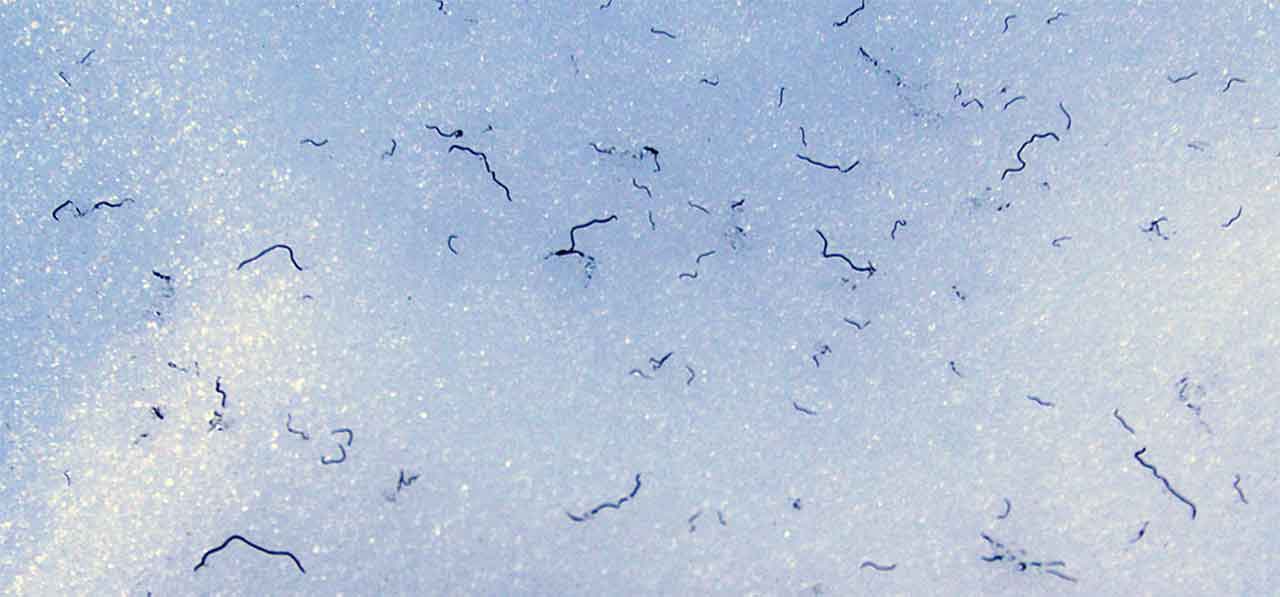
Somewhere in the glaciers of Alaska, Washington, Oregon, and British Columbia, billions of small black worms are threading their way through solid ice right now. They're called ice worms, and they're not a myth, a metaphor, or a joke—they're the only known animals on Earth that spend their entire lives inside glacial ice.
These tiny creatures, typically just an inch or two long, belong to the genus Mesenchytraeus. And they have a problem that sounds like it came from a fairy tale: they're so perfectly adapted to freezing temperatures that warmth is lethal to them.
A Body Built for the Cold
Ice worms thrive at temperatures around 32°F (0°C). Their enzymes, cell membranes, and entire metabolism are calibrated for conditions that would kill almost any other animal. This extreme specialization comes with a fatal trade-off.
When temperatures climb above about 40°F (5°C), the worms don't just become uncomfortable—their cellular machinery falls apart. The enzymes that run their metabolism denature and break down. Within minutes, the worms die and begin to decompose rapidly.
This led to the popular myth that ice worms "melt," which isn't quite accurate. They don't liquefy like ice cubes. But the speed of their death and decomposition in warm conditions is so dramatic that it's easy to see where the legend came from.
What Do They Eat in There?
Life inside a glacier seems impossibly barren, but ice worms have found a niche. They feed on:
- Algae and pollen that blow onto the glacier surface
- Bacteria living in the ice
- Other microscopic organic material trapped in the frozen matrix
During the day, they burrow deeper into the ice to avoid sunlight and warmer surface temperatures. At night, they migrate up to the surface to feed, sometimes in such numbers that the glacier appears to be covered in a writhing black carpet.
Billions of Them
Scientists estimate that some glaciers host populations in the billions. A single square meter of glacier surface can contain hundreds of ice worms during their nighttime feeding hours.
This makes them a significant part of glacier ecosystems—a concept that might seem strange, since we tend to think of glaciers as lifeless. Ice worms are food for snow buntings and other birds that visit glacial environments. Their waste products fertilize the algae and bacteria that colonize ice surfaces.
A Species Living on Borrowed Time
Climate change poses an existential threat to ice worms. As glaciers shrink and temperatures rise, these creatures have nowhere to go. They can't adapt to warmer conditions—their biology simply doesn't allow it.
They also can't migrate to colder glaciers. Ice worms have limited mobility and are found only in coastal glaciers of the Pacific Northwest. As their frozen homes disappear, so will they.
For now, though, they remain one of nature's most improbable success stories: animals that turned ice into a home and warmth into their enemy. The next time you look at a glacier, remember—it's not as empty as it looks.
Frequently Asked Questions
Are ice worms real?
Do ice worms actually melt?
What do ice worms eat?
How many ice worms live in a glacier?
Will ice worms go extinct from climate change?
Verified Fact
This fact has been reviewed and verified against original sources.
Show verification details
Corrected the claim that ice worms 'melt' - they actually die and decompose rapidly due to enzyme breakdown, but don't literally melt like ice. The temperature sensitivity is accurate.