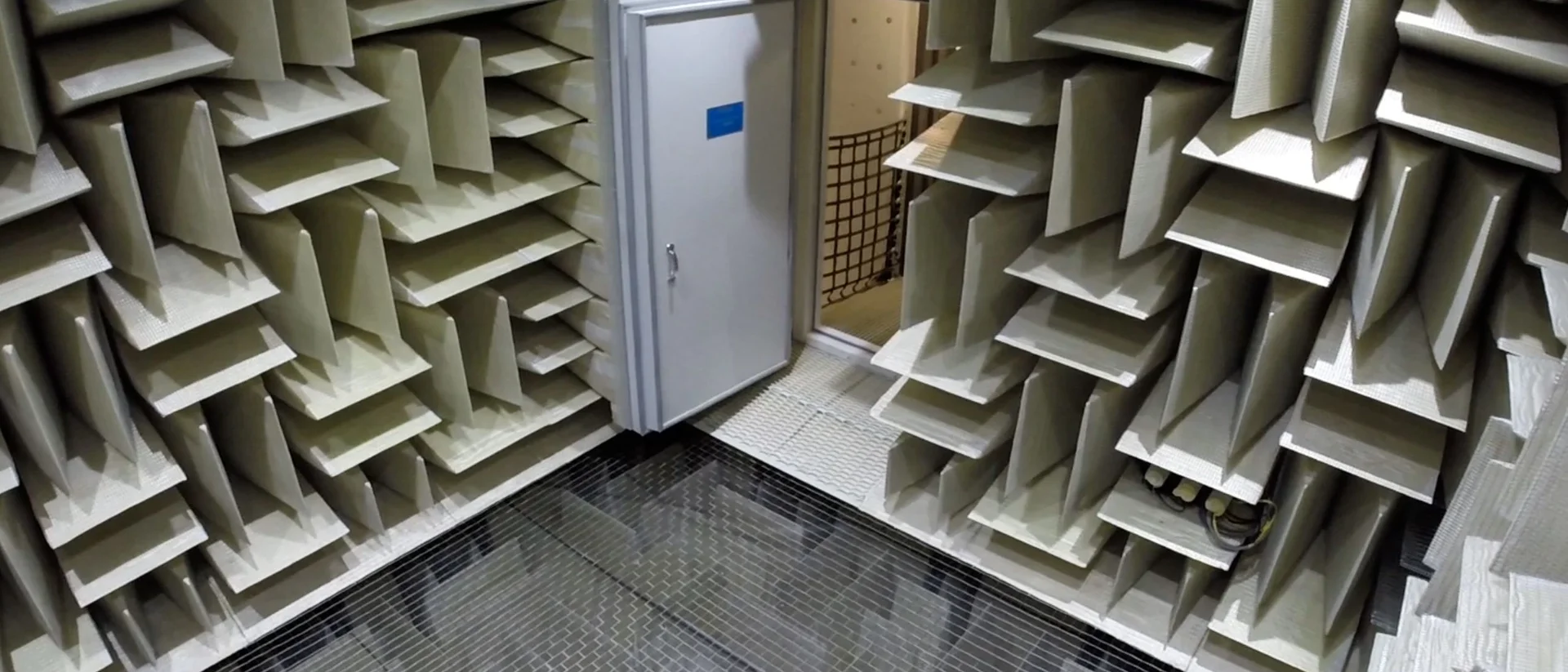
Microsoft built a room so quiet it measures -20.35 dBA - well below the threshold of human hearing. The walls absorb everything. Your body fills the silence: heartbeat, breathing, stomach, the buzz of your own inner ears. Visitors lose their sense of balance. You become the sound.
The Room So Quiet You Can Hear Your Own Blood
There is a room in Redmond, Washington where the silence is so complete it stops feeling like silence at all - and starts feeling like something is wrong.
The Record-Breaking Chamber
Microsoft's Building 87 on its Redmond campus houses an anechoic chamber - literally "without echo" - that held the Guinness World Record for the quietest place on Earth from 2015 to 2021. Measured at -20.35 dBA (an average of two independent tests at -20.6 dBA and -20.1 dBA), the room sits more than 20 decibels below the threshold of human hearing. For comparison, a quiet bedroom typically registers around 30 dBA. This room is quieter than what the human auditory system was designed to detect.
The chamber achieves this by lining every surface with wedge-shaped acoustic foam that absorbs sound rather than reflecting it. The inner room also rests on its own vibration-damping springs, isolating it from the faint tremor of the building around it - and the ground beneath that.
You Become the Sound
Step inside and remove the ambient noise most people never consciously notice - traffic, HVAC hum, the faint creak of a building - and the human body fills the void. Visitors report hearing their own heartbeat thumping, the rise and fall of their breathing, their stomach gurgling, and a faint high-pitched tone from the inner ear itself. Without sound bouncing off walls, the brain also loses the spatial cues it uses to judge position. In the dark, some visitors struggle to stay upright.
Steve Orfield, founder of Orfield Laboratories (whose Minneapolis chamber held the Guinness record before Microsoft's), described the experience plainly: "In the anechoic chamber, you become the sound."
The widely-shared claim that nobody can last 45 minutes and that visitors hallucinate is a myth Orfield himself has debunked. "That was never the case," he said. "That quote was made up." What is documented is that the silence is genuinely disorienting, and most visitors choose to leave well before any time limit becomes relevant.
What It Is Actually For
Microsoft did not build the chamber as an experiment in human endurance. Engineers use it to test devices and audio technology with extreme precision - keyboards, microphones, and software that must handle audio inputs accurately. When every whisper of ambient noise is stripped away, a faint unwanted click or hiss becomes immediately obvious. The chamber is a quality-control tool; public tours are not offered.
A Record That Has Changed Hands
Before Microsoft claimed the Guinness title in 2015, Orfield Laboratories held it - their chamber measured -9.4 dBA in 2004, later improved to -13 dBA. Orfield reclaimed the record in November 2021 with a new measurement of -24.9 dBA. The back-and-forth reflects how specialized acoustic engineering has pushed the boundary of what "quiet" can mean - well into territory the human auditory system was never built to navigate.
Frequently Asked Questions
What is an anechoic chamber?
How quiet is Microsoft's Building 87 anechoic chamber?
Can you really hear your own heartbeat inside an anechoic chamber?
Is it true nobody can last 45 minutes in an anechoic chamber before hallucinating?
Who holds the Guinness World Record for the quietest room in 2026?
Verified Fact
Verified Jun 14, 2026 · 5 sources checked
Source: Guinness World RecordsShow verification details
Claims checked
- Microsoft’s room measured -20.35 dBA, averaging tests of -20.6 and -20.1 dBA
- The record stood from 2015 to 2021, when Orfield reclaimed it at -24.9 dBA
- Visitors hear their own heartbeat, breathing, and inner-ear buzz
- Visitors can lose balance, and some fall over in the dark
- The 45-minute hallucination claim was debunked
Sources: Guinness World Records, Mpls.St.Paul Magazine, Atlas Obscura, Vice
Related Topics
More from Science & Space
View all Science & Space →