
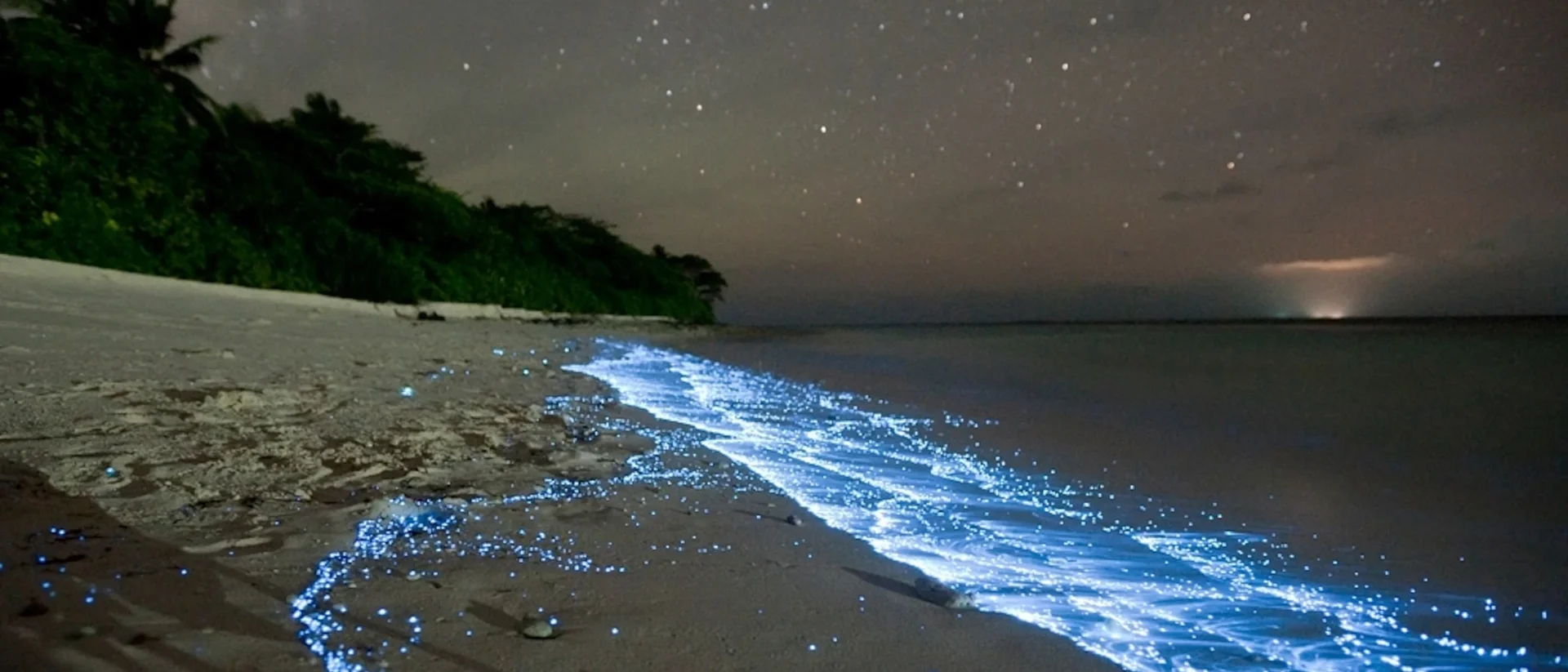
When ocean waves glow electric blue at night, the light comes from millions of living creatures. Dinoflagellates - microscopic plankton - carry a chemical called luciferin that flashes the instant water is disturbed. It is a defense: the burst of light summons predators of whatever is eating them. Mosquito Bay on Vieques, Puerto Rico holds the Guinness World Record for the brightest bioluminescent bay, with 700,000 glowing organisms per gallon.
When Ocean Waves Glow Electric Blue at Night
A swimmer drags a hand through dark water and leaves a trail of cold blue fire. A breaking wave pulses with light. No electricity, no pollution - just billions of single-celled creatures doing what they have done for hundreds of millions of years.
What Is Actually Happening
The glow comes from dinoflagellates, a type of microscopic plankton found in oceans worldwide. These tiny organisms carry a chemical called luciferin, which reacts with an enzyme called luciferase and oxygen the moment the surrounding water is physically disturbed - by a breaking wave, a swimming fish, a paddle stroke, or even a raindrop. The reaction releases energy as light rather than heat, producing a burst of blue-green bioluminescence lasting less than a second per flash. Blue light appears dominant because water absorbs longer wavelengths (red, orange, yellow) and transmits shorter ones, so blue carries farthest through seawater.
Why They Flash
The light is a defense mechanism. When a copepod - a tiny crustacean that grazes on dinoflagellates - brushes against them, the resulting burst of light acts as a "burglar alarm": it attracts the copepod's own predators, turning the attack into an ambush. Experiments with Lingulodinium polyedra have shown that bioluminescent flashing significantly reduces copepod predation rates. The flash can also directly startle copepods, triggering an escape response that leaves the dinoflagellate unharmed.
The Brightest Bay on Earth
Mosquito Bay on Vieques Island, Puerto Rico holds the Guinness World Record as the world's brightest bioluminescent bay, recognised in 2006. The bay contains up to 700,000 dinoflagellates per gallon of water - a concentration made possible by its narrow entrance (which prevents organisms from washing out to sea) and surrounding mangrove forests that supply rich nutrients. The species responsible, Pyrodinium bahamense (meaning "whirling fire"), earns its name. The bay can only be visited by kayak or non-motorised vessel to protect the ecosystem.
The Maldives Sea of Stars
On the other side of the world, Vaadhoo Island in the Maldives is famous for its "Sea of Stars" - a beach where the shoreline glows blue at night. Here the effect is largely driven by Noctiluca scintillans ("sea sparkle"), a larger dinoflagellate that blooms between May and November. The effect is unpredictable and depends on water temperature, nutrient levels, and the absence of light pollution, which is why moonless nights and minimal coastal development make both sites so spectacular.
From Defense to Discovery
Bioluminescence using luciferin and luciferase has evolved independently dozens of times across the tree of life - in deep-sea fish, jellyfish, fungi, and insects. Scientists have developed modified luciferase genes as glowing "reporter" markers, spliced into living cells so researchers can track gene activity under a microscope. What evolved as a survival trick in the open ocean became one of the most useful tools in modern cell biology.
Frequently Asked Questions
Why do ocean waves glow blue at night?
Where is the best place to see bioluminescent water?
Is bioluminescent water safe to swim in?
Why is bioluminescence in the ocean blue?
What is the purpose of bioluminescence in plankton?
Verified Fact
Verified Jun 17, 2026 · 6 sources checked
Source: Guinness World RecordsShow verification details
Claims checked
- Electric blue glow comes from dinoflagellates flashing luciferin when disturbed
- Mosquito Bay holds Guinness record with up to 700,000 glowing organisms per gallon
- Flash is a defense that attracts predators of whatever eats the plankton
- Responsible species is Pyrodinium bahamense
- Bioluminescence evolved independently dozens of times
Sources: Guinness World Records, Phys.org, Functional Ecology, Wikipedia, University of Bristol, Vieques.com