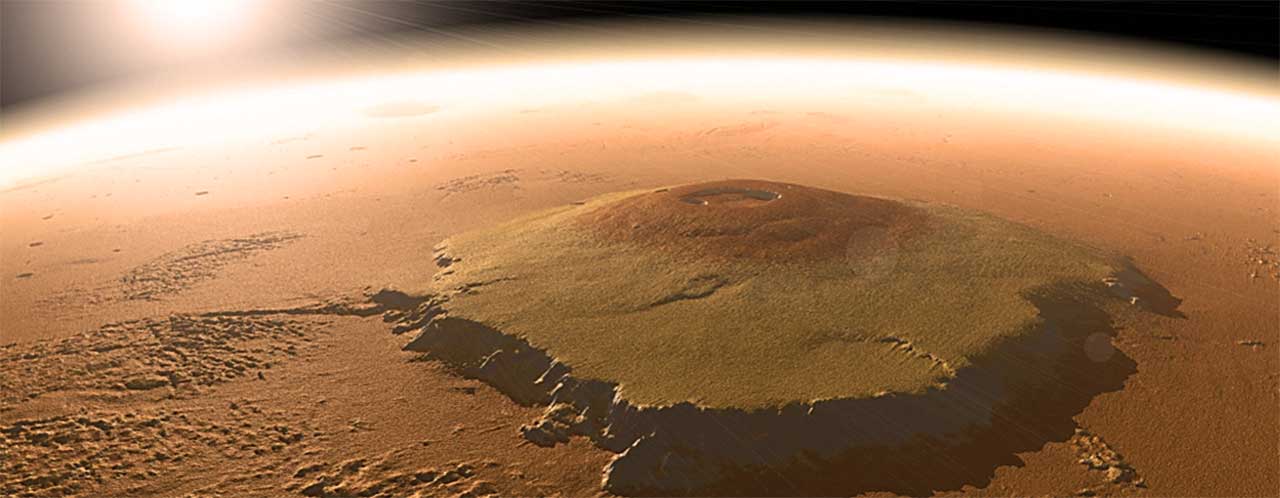
Olympus Mons on Mars is the tallest volcano in the Solar System, standing approximately 13.6 miles (22 km) high. It is nearly 2.5 times the height of Mount Everest.
Mars Has a Volcano That Dwarfs Mount Everest
Somewhere on the rust-red surface of Mars sits a mountain so enormous it defies comprehension. Olympus Mons isn't just the tallest volcano on the Red Planet—it's the tallest in the entire Solar System.
At approximately 13.6 miles (22 kilometers) high, this Martian giant would tower over anything Earth has to offer. Mount Everest, our planet's most impressive peak, reaches a mere 5.5 miles above sea level. Olympus Mons stands nearly 2.5 times taller.
A Mountain the Size of France
Height is only part of the story. Olympus Mons sprawls across an area roughly the size of Arizona—about 374 miles (602 km) in diameter. If you placed it over France, it would cover nearly the entire country.
The volcano's slopes rise so gradually that if you stood at its base, you wouldn't even realize you were on a mountain. The incline averages just 5 degrees. You could walk up it without breaking much of a sweat—if you had an oxygen supply and didn't mind the -80°F temperatures.
Why Mars Grows Giants
Earth has impressive volcanoes too—Hawaii's Mauna Kea, measured from its underwater base, reaches about 6.2 miles. So why can't our planet compete with Mars?
Two factors give Mars the advantage:
- No plate tectonics: Earth's crust constantly shifts, moving volcanoes away from their magma sources. Mars' crust stays put, letting lava pile up in one spot for billions of years.
- Lower gravity: Mars has only 38% of Earth's gravity. Structures can grow much taller before collapsing under their own weight.
Olympus Mons has been building itself for at least 3 billion years. Some evidence suggests it may have erupted as recently as 25 million years ago—practically yesterday in geological terms.
A Caldera You Could Lose Cities In
At the summit sits a massive caldera—a crater formed by volcanic collapse—measuring 50 miles across and nearly 2 miles deep. The entire city of Los Angeles could fit inside it with room to spare.
The caldera actually contains six overlapping collapse craters, each one formed during a different eruptive phase. It's like looking at the rings of a tree, except each ring represents a catastrophic volcanic event.
Could It Erupt Again?
Scientists haven't ruled it out. While Mars appears volcanically quiet today, the geological evidence suggests Olympus Mons may simply be dormant rather than extinct. Some researchers estimate there's a reasonable chance of future eruptions—though "future" in planetary science might mean millions of years from now.
For now, Olympus Mons stands as a monument to what volcanism can achieve when given billions of years and a planet that doesn't shuffle its crust around. It's a reminder that even our most impressive mountains are, on a cosmic scale, relatively modest bumps.
Frequently Asked Questions
How tall is Olympus Mons compared to Mount Everest?
Why is Olympus Mons so much bigger than volcanoes on Earth?
Is Olympus Mons still active?
How wide is Olympus Mons?
What is at the top of Olympus Mons?
Verified Fact
This fact has been reviewed and verified against original sources.
Show verification details
Corrected height from 14 miles to approximately 13.6 miles (22 km) and clarified the Everest comparison to nearly 2.5 times rather than 3 times.
Related Topics
More from Science & Space
View all Science & Space →