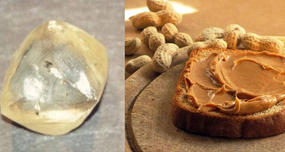
Real diamonds can be made from peanut butter!
Scientists Turn Peanut Butter Into Real Diamonds
When geophysicist Dan Frost told his colleagues he was making diamonds from peanut butter, they probably thought he'd lost his mind. But at the Bayerisches Geoinstitut in Germany, Frost proved that everyone's favorite sandwich spread can become one of Earth's hardest materials—with just a little squeeze. Well, a lot of squeeze.
The Science Is Actually Simple
Diamonds are pure carbon atoms arranged in a crystal lattice. Peanut butter? Also loaded with carbon. The trick is getting those carbon atoms to reorganize from "delicious snack" to "expensive gemstone" configuration.
Frost sandwiches a dollop of peanut butter between two diamonds (the irony is not lost on us) and cranks up the pressure to about 1.3 million times atmospheric pressure. That's roughly what you'd experience 900 miles beneath Earth's surface, if you could somehow survive being there.
At these extreme conditions, the carbon atoms in the peanut butter shift from their casual, layered graphite-like arrangement into diamond's rigid three-dimensional structure. Chemistry students call this allotropic transformation. Normal people call it insane.
Why Anyone Would Do This
Before you start hoarding Skippy for a get-rich-quick scheme, know that this process is wildly impractical. It takes three weeks to produce a 3-millimeter diamond. That's smaller than a pencil eraser. The hydrogen bonded to the carbon makes everything messier than standard synthetic diamond production, and the equipment costs more than a jewelry store's entire inventory.
Frost isn't trying to corner the diamond market—he's studying Earth's mantle. Natural diamonds form 90-120 miles underground under similar extreme conditions. By experimenting with carbon-rich materials like peanut butter, researchers gain insights into how our planet transforms materials in its deep interior.
The research started with a hypothesis: could rocks have pulled carbon dioxide from ancient oceans, with the naked carbon later squeezed into diamonds by heat and pressure? Peanut butter became the perfect test subject because it's carbon-dense, readily available, and apparently no one told Frost he couldn't use it.
Other Weird Diamond Sources
Peanut butter isn't the only bizarre starting material for lab-grown diamonds. Scientists have successfully created diamonds from:
- Human cremation ashes
- Tequila (specifically the vapor from premium brands)
- Hair
- Methane gas
Essentially, any carbon-rich material can theoretically become a diamond if you apply enough pressure and heat. The universe doesn't care about the source—carbon is carbon.
The next time you're making a PB&J, remember: you're holding millions of potential microscopic diamonds. You just need access to equipment that simulates the Earth's mantle and several weeks of patience. Or you could, you know, just eat it. That's significantly easier.
Frequently Asked Questions
Can you really make diamonds from peanut butter?
How long does it take to make a diamond from peanut butter?
Why would scientists make diamonds from peanut butter?
What other weird materials can be turned into diamonds?
Are peanut butter diamonds real diamonds?
Verified Fact
Verified by Dr
Show verification details
Scientifically verified by Dr. Dan Frost at Bayerisches Geoinstitut in Germany. The process uses extreme pressure (1.3 million times atmospheric pressure) to convert the carbon in peanut butter into diamond crystals. While impractical for commercial production, it's legitimate geophysical research.