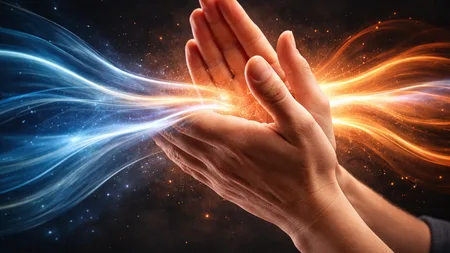
From the nitrogen in our DNA, to the calcium in our teeth, the iron in our blood, to the carbon in our apple pies - all were made in the interiors of collapsing stars; we're all made of stardust.
We're All Made of Stardust (And Science Proves It)
Look at your hand. The calcium hardening your bones, the iron carrying oxygen through your blood, the carbon forming every cell—none of it existed at the beginning of the universe. Every single atom heavier than hydrogen was forged in the nuclear furnace of a dying star.
When the universe began 13.8 billion years ago, the Big Bang created only three elements: hydrogen, helium, and traces of lithium. That's it. No oxygen to breathe, no carbon for life, no iron for blood. The cosmic pantry was nearly empty.
Stars: The Universe's Element Factories
Stars are essentially giant nuclear reactors. In their cores, temperatures reach 15 million degrees Celsius, hot enough to smash hydrogen atoms together into helium. This process—nuclear fusion—releases tremendous energy. It's what makes stars shine.
But here's where it gets wild: when a star runs out of hydrogen, it doesn't die quietly. If it's massive enough, it starts fusing helium into carbon and oxygen. Then carbon into neon and magnesium. The process continues up the periodic table—silicon, sulfur, calcium, iron—each step requiring more pressure and heat than the last.
Eventually, the star's core becomes so heavy it collapses in on itself, triggering a supernova explosion that outshines entire galaxies. This violent death doesn't just destroy the star—it creates elements. Gold, platinum, uranium, and every other heavy element are born in these cataclysmic moments or in the collision of neutron stars.
Your Body's Cosmic Recipe
You are, quite literally, recycled star matter. Consider the chemistry:
- Oxygen (65% of your body): Created when helium atoms fused in stellar cores
- Carbon (18%): The backbone of all organic molecules, forged the same way
- Nitrogen in your DNA: Made when massive stars burned through their fuel
- Calcium in your teeth: Synthesized in supernova explosions
- Iron in your blood: The final element created before a star goes supernova
The atoms in your left hand might have come from a different star than the atoms in your right. Some of the iron in your blood could be 10 billion years old, having drifted through space for eons before becoming part of the dust cloud that formed our solar system.
From Stardust to Consciousness
Carl Sagan popularized this idea in his 1980 series Cosmos with the line: "We are made of star stuff." He meant it literally. The elements scattered by dying stars coalesced into new solar systems, planets, and eventually—on at least one small blue world—into living things capable of understanding their own cosmic origins.
Every time you breathe, you're inhaling oxygen atoms that were inside a star billions of years ago. When you kiss someone, you're pressing together atoms that traveled across the galaxy. You are not just in the universe; the universe is in you.
We are, in the most profound sense, the universe experiencing itself—a temporary arrangement of ancient stardust, awakened and aware, contemplating the very stars that made us possible.
Frequently Asked Questions
Are humans really made of stardust?
What elements in the human body come from stars?
Who said we are made of stardust?
How do stars create elements?
Where does the iron in our blood come from?
Verified Fact
This fact has been reviewed and verified against original sources.
Show verification details
Scientifically accurate. All elements heavier than hydrogen, helium, and lithium were created through stellar nucleosynthesis in the cores of stars and supernova explosions. This includes the nitrogen in DNA, calcium in bones/teeth, iron in blood, and carbon in all organic molecules. This is a paraphrase of Carl Sagan's famous 'star stuff' quote from Cosmos (1980).