
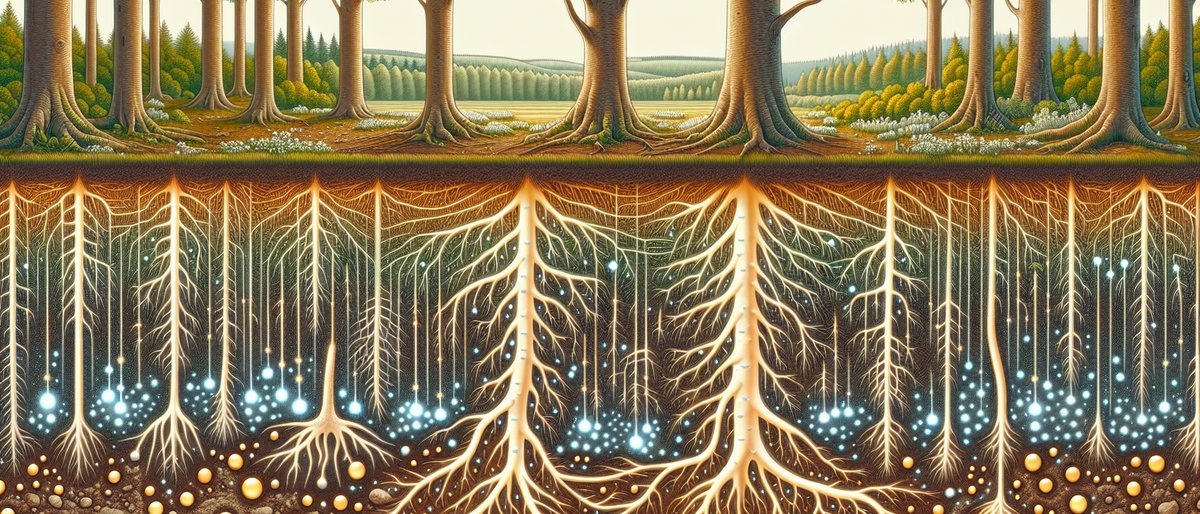
Over 90% of land plants are connected through underground fungal networks called mycorrhizae, which allow trees to share nutrients, water, and chemical signals with each other—a system scientists call the 'Wood Wide Web.'
Trees Share Resources Through a Vast Underground 'Wood Wide Web'
Beneath every forest floor lies an invisible internet. A vast network of fungal threads connects the roots of trees, shrubs, and plants, allowing them to exchange resources and chemical signals in ways scientists are only beginning to understand.
The Discovery That Changed Forest Science
In 1997, forest ecologist Suzanne Simard at the University of British Columbia made a groundbreaking discovery. Using radioactive carbon isotopes, she proved that trees were sharing nutrients through underground fungal networks. The finding challenged the long-held view that trees compete as isolated individuals.
The fungi form a symbiosis called mycorrhiza—from the Greek words for "fungus" and "root." The fungal threads, called hyphae, grow into and around tree roots, extending far beyond what roots alone could reach. According to research published in Nature Plants, more than 90% of all land plants depend on these fungal partnerships.
What Trees Actually Share
Through these networks, trees can transfer:
- Nutrients like nitrogen and phosphorus
- Carbon from photosynthesis
- Water during droughts
- Chemical warning signals about insect attacks
Perhaps most remarkably, older "mother trees" appear to recognize their own seedlings and preferentially send them resources. When a tree is dying, it may dump its remaining nutrients into the network for neighbors to use.
The Scientific Debate
Not all scientists agree on how much trees actually "communicate." A 2023 review in Scientific American noted that in well-controlled experiments, seedlings connected to fungal networks didn't always perform better than disconnected ones. The romantic notion of trees "talking" may overstate the evidence.
What's undisputed is that these networks exist and matter. In 2025, the Society for the Protection of Underground Networks released the first global map of mycorrhizal biodiversity, revealing just how extensive these underground connections are.
Why It Matters
Understanding the Wood Wide Web has practical implications. Clear-cutting forests doesn't just remove trees—it destroys the fungal networks that took decades to develop. Some foresters now advocate leaving "hub trees" during logging to preserve network connectivity.
The next time you walk through a forest, remember: beneath your feet, an ancient internet is humming with activity, connecting every tree in a web of mutual aid that predates human civilization by hundreds of millions of years.
Enjoyed this? Get a new fact every morning.
A fascinating fact in your inbox every morning. Free. Unsubscribe anytime.
Frequently Asked Questions
How do trees communicate with each other?
What is the Wood Wide Web?
Who discovered the Wood Wide Web?
Do all trees use fungal networks?
Can trees really help each other survive?
Verified Fact
This fact has been reviewed and verified against original sources.
Source: Mycorrhizal network - WikipediaShow verification details
The claim is accurate. Mycorrhizal networks are well-established in scientific literature. The 90% figure comes from research showing the vast majority of land plants form mycorrhizal associations.