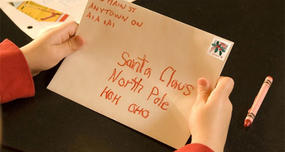
US scientists calculated that Santa would have to visit 822 homes a second to deliver all the world's presents on Christmas Eve, travelling at 650 miles a second.
Santa's Impossible Speed: 822 Homes Per Second
Every December, children around the world believe in the magic of Santa Claus delivering presents to every good boy and girl in a single night. But what would it actually take to pull off this impossible feat? Scientists have done the math, and the numbers are absolutely mind-boggling.
The Santa Physics Problem
Assuming there are approximately 238 million households with children celebrating Christmas, and Santa has 31 hours to work with (thanks to time zones and traveling east to west), the jolly old elf would need to visit 822.6 homes per second. That's not a typo—per second.
This means Santa has roughly 1/1000th of a second at each house to park his sleigh, slide down the chimney, fill stockings, arrange presents under the tree, eat the cookies and milk, climb back up the chimney, and jet off to the next house.
Faster Than a Speeding Bullet (Way Faster)
To maintain this delivery schedule, Santa's sleigh would need to travel at 650 miles per second—that's 3,000 times the speed of sound, or about 2.3 million miles per hour. For perspective, the fastest human-made object, the Parker Solar Probe, only reaches about 120 miles per second.
University of Leicester physics students calculated this another way: Santa would be moving at 0.5% the speed of light, or roughly 5.4 million kilometers per hour.
The Reindeer Would Vaporize
Here's where things get grim. The payload of Santa's sleigh—filled with presents for 238 million homes—would weigh approximately 353,000 tons. Moving that mass at 650 miles per second creates enormous air resistance.
The lead reindeer (poor Rudolph and Dasher) would absorb 14.3 quintillion joules of energy per second. That's the same heating effect that spacecraft experience during atmospheric reentry, except thousands of times worse.
- The reindeer would burst into flames almost instantly
- The sonic boom would be heard worldwide continuously throughout the night
- Santa and his entire team would be subjected to g-forces 17,500 times greater than gravity
- A 250-pound Santa would be pinned to the back of the sleigh with 4.3 million pounds of force
The Tongue-in-Cheek Conclusion
This hilarious analysis, which has circulated online since at least 1993, concludes with mock solemnity: "If Santa ever DID deliver presents on Christmas Eve, he's dead now."
Of course, scientists have proposed equally playful solutions to the Santa problem. Some invoke Einstein's theory of relativity—at such extreme speeds, time dilation would give Santa more subjective time. Others cite Heisenberg's uncertainty principle, suggesting Santa is "smeared out" across Earth's surface, allowing him to be everywhere at once.
The real lesson? Some things are better left to magic and childhood wonder. The physics of Santa Claus proves that if he exists, he's definitely not operating under conventional laws of nature—which, when you think about it, makes Christmas morning all the more miraculous.
Frequently Asked Questions
How fast would Santa have to travel to deliver all presents?
How many houses does Santa visit per second?
Is the Santa physics calculation real?
What would happen to Santa's reindeer at that speed?
How much time does Santa spend at each house?
Verified Fact
This fact has been reviewed and verified against original sources.
Show verification details
This is a famous tongue-in-cheek physics calculation that has circulated widely since at least 1993.
Related Topics
More from Science & Space
View all Science & Space →