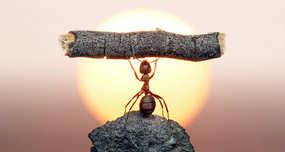
Ants can survive in a microwave because they're small enough to dodge the electromagnetic waves, which create hot and cold spots about 12cm apart.
Why Ants Can Survive Inside Your Microwave
Drop an ant in a running microwave and it'll likely stroll out unscathed. It sounds like a glitch in the matrix, but it's actually a fascinating quirk of physics.
Here's the thing: microwaves don't heat evenly. The electromagnetic waves inside your microwave create a pattern of hot spots and cold spots, spaced roughly 12 centimeters apart. That's why your burrito has molten lava edges and an ice-cold center.
Size Matters (A Lot)
An ant is typically 1-5 millimeters long. The wavelength of microwave radiation? About 12 centimeters. This mismatch is crucial.
For a microwave to efficiently heat something, that something needs to be large enough to absorb the electromagnetic energy. Ants are so small they can exist in the gaps between the waves—like walking between raindrops, except it actually works.
The Cold Spot Theory
There's a popular claim that ants deliberately seek out cold spots and wait there. While microwaves do have cooler zones, the truth is simpler: ants don't need to find safe spots because they're basically invisible to the radiation.
Their tiny bodies simply don't absorb enough energy to heat up significantly. Even if an ant wandered directly through a hot spot, it would pass through before absorbing lethal amounts of energy.
What About the Turntable?
Modern microwaves have rotating plates specifically to combat uneven heating. The movement helps distribute energy more evenly across your food. But for an ant? Still not a problem. Their small size remains their superpower regardless of rotation.
Scientists have actually tested this. In controlled experiments, ants placed in microwaves showed no significant temperature increase even after extended exposure. They just kept doing ant things—walking around, seemingly unbothered by the invisible energy storm surrounding them.
Don't Try This at Home
Before you start conducting ant experiments, consider:
- It's unnecessary cruelty to test on living creatures
- Your microwave will smell weird
- The ants have better things to do
The science is already settled. Ants survive microwaves not through some remarkable danger-sensing ability, but through the simple luck of being tiny in a world built for bigger things.
It's a reminder that size determines everything in physics. The same electromagnetic waves that can boil water in seconds pass harmlessly around creatures small enough to slip through the cracks. Nature's smallest survivors don't need to be clever—they just need to be small.
Frequently Asked Questions
Can ants survive in a microwave?
Why don't microwaves kill ants?
Do ants know where the cold spots are in a microwave?
What animals can survive in a microwave?
Verified Fact
This fact has been reviewed and verified against original sources.
Show verification details
Clarified the mechanism - ants survive due to their small size relative to microwave wavelengths, not because they 'find the coolest spot'
Related Topics
More from Animals
View all Animals →