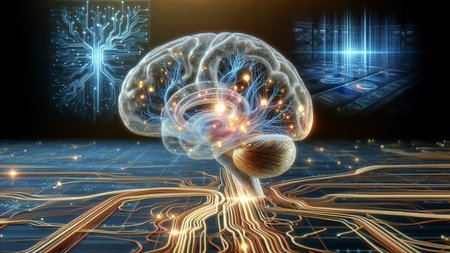
An ant brain has about 250,000 neurons. A human brain has around 86 billion—roughly 344,000 times more. Yet scientists study ant colonies as 'superorganisms' where collective behavior emerges from simple individual interactions, similar to how consciousness emerges from billions of neurons in our brains.
Ant Colonies Function Like Brains With Millions of Neurons
When you see a trail of ants marching in perfect formation toward a crumb on your kitchen counter, you're watching something remarkable: a distributed intelligence that works surprisingly like your own brain.
An individual ant brain contains approximately 250,000 neurons—impressive for an insect, but a fraction of the 86 billion neurons packed into a human brain. Yet neuroscientists and entomologists have discovered that ant colonies operate as what they call "superorganisms"—living systems where collective behavior emerges from millions of simple individual interactions.
The Colony as a Brain
The comparison isn't just poetic. In your brain, no single neuron "knows" what you're thinking. Your consciousness, memories, and decisions emerge from billions of relatively simple cells firing electrical signals and communicating through chemical messengers. Similarly, in an ant colony, no individual ant understands the "big picture." Colony-level intelligence—finding food, building intricate nests, waging coordinated warfare—emerges from ants following simple local rules and communicating through pheromones and antennal contact.
A typical ant colony contains anywhere from a few thousand to several million individuals. A colony of 344,000 ants would collectively possess roughly the same number of neurons as a human brain, though this doesn't make them equivalent in intelligence. What's fascinating is the structural similarity: both systems create sophisticated behavior from decentralized networks with no central controller.
Emergent Intelligence in Action
Research has revealed some stunning examples of colony-level problem-solving:
- Ants outperformed humans in cooperative puzzle-solving experiments, demonstrating what researchers called "emergent collective memory"
- Colonies optimize foraging routes using algorithms similar to those developed by computer scientists—ants discovered these solutions through evolution
- When part of a nest is destroyed, thousands of ants coordinate repairs without any individual directing the effort
No Boss Required
Despite popular belief, the queen ant doesn't rule the colony. She's essentially an egg-laying machine. There's no command center, no executive making decisions. Worker ants respond to local information—pheromone trails, encounters with nestmates, environmental cues—and from these simple interactions, colony-wide intelligence emerges.
This is strikingly similar to how your brain works. There's no "command neuron" directing your thoughts. Your sense of unified consciousness emerges from decentralized neural activity.
Stanford researchers studying ant colonies have found that understanding how ants collectively solve problems could provide insights into brain function, computer networks, and even how to design better human organizations. The ant colony and the human brain represent two different solutions to the same problem: how to create intelligence from many simple parts working together.
So the next time you watch ants at work, remember: you're observing a collective intelligence that's been refined over 140 million years of evolution, using principles remarkably similar to the three-pound supercomputer inside your skull.
Frequently Asked Questions
How many brain cells does an ant have?
How does an ant colony work like a brain?
How many ants would equal a human brain?
Do ant colonies have a leader?
Are ant colonies smarter than humans?
Verified Fact
This fact has been reviewed and verified against original sources.
Show verification details
Corrected human brain neuron count (86 billion, not 10 billion) and adjusted colony size accordingly.