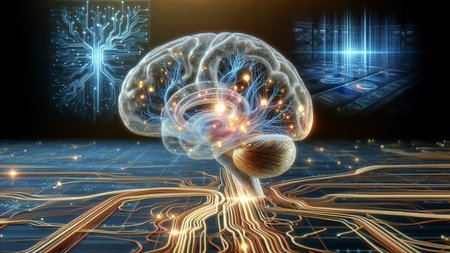
When someone looks at a new love, the neural circuits that are usually associated with social judgment are suppressed.
Love Literally Turns Off Your Brain's Judgment Center
There's scientific truth behind the saying "love is blind." When you gaze at someone you're falling for, your brain literally shuts down its judgment machinery.
Brain imaging studies have revealed that romantic love deactivates a common set of regions associated with negative emotions and social judgment—specifically the medial prefrontal cortex and posterior cingulate cortex. These are the exact brain areas normally responsible for critically assessing other people's intentions, flaws, and behaviors.
The Push-Pull Mechanism
This isn't a design flaw—it's a feature. Researchers describe it as a "push-pull mechanism" that helps overcome social distance. While your critical thinking circuits power down, your brain's reward circuitry lights up like a Christmas tree, flooding you with feel-good chemicals.
The same neural pathway that generates negative emotions like fear and social criticism—connecting the nucleus accumbens to the amygdala—gets temporarily suppressed. Meanwhile, dopamine and oxytocin take over, creating those butterflies-in-your-stomach feelings.
Why Evolution Made Us Blind
From an evolutionary perspective, this neural "blindness" serves a crucial purpose: bonding. If we spent the early stages of romance critically analyzing our partner's every flaw, we'd never form the deep attachments necessary for long-term partnership and child-rearing.
Interestingly, this same deactivation pattern appears in maternal love too. When mothers look at their babies, the same judgment-suppressing neural changes occur, explaining why parents often see their children through rose-colored glasses.
The phenomenon affects more than just how we see our partners. Studies show people in love process all emotional stimuli differently—they're generally more positive, less fearful, and less critical across the board.
When the Fog Lifts
The catch? This neural suppression is temporary. As relationships mature past the intense early stages, those judgment circuits gradually come back online. That's when couples either develop genuine compatibility or realize they've been dating someone whose flaws they'd conveniently ignored.
So the next time a friend makes questionable decisions over a new romance, remember: their brain's literally not firing on all cylinders. Love isn't just an emotion—it's a neurological takeover.
Frequently Asked Questions
Why does love make you overlook someone's flaws?
What part of the brain turns off when you fall in love?
Is love is blind scientifically true?
How long does the love is blind phase last?
Does maternal love affect the brain the same way as romantic love?
Verified Fact
This fact has been reviewed and verified against original sources.