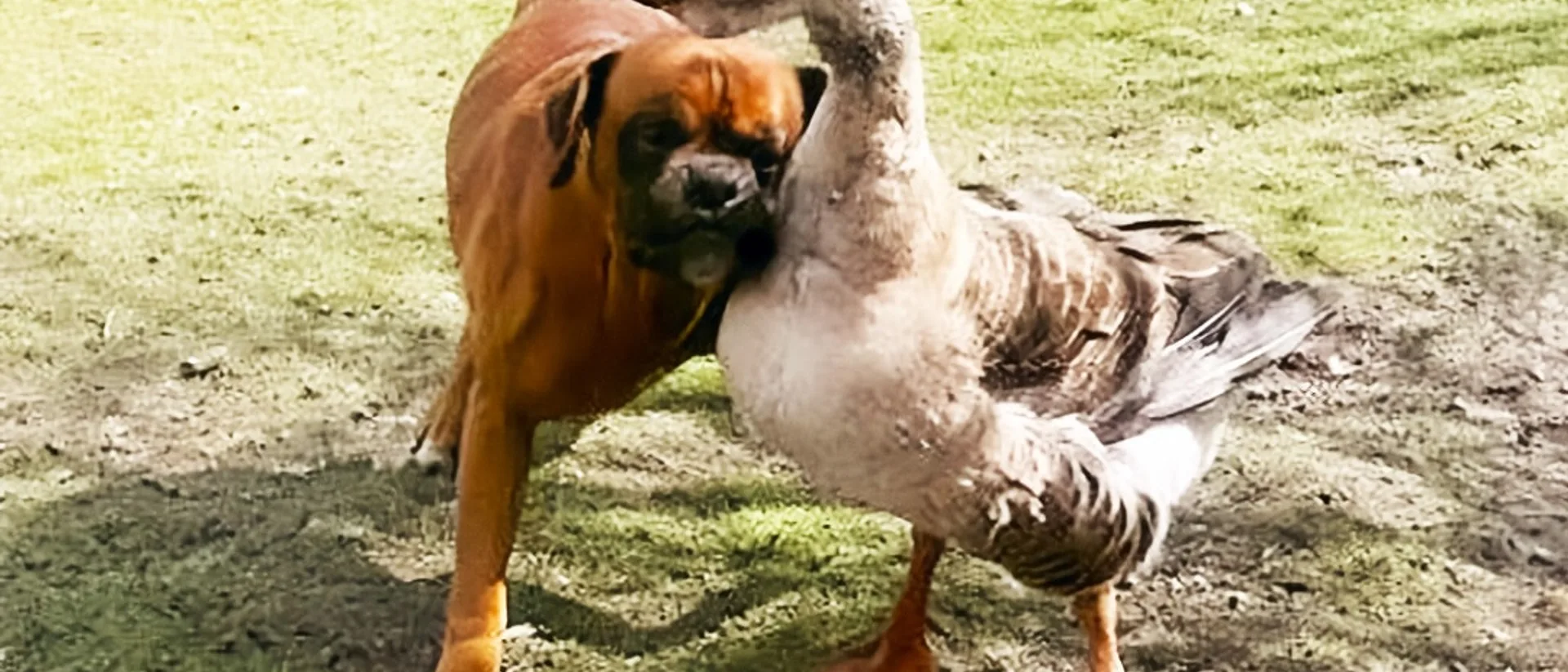
Baks the blind boxer had a seeing-eye goose named Buttons; a four-year-old goose who lead the pup around everywhere either by hanging onto him with her neck, or by honking to tell him which way to go.
Baks the Blind Boxer Had a Seeing Eye Goose Named Buttons
When you think of service animals, dogs immediately come to mind. Maybe miniature horses if you're well-versed in accessibility options. But a goose as a guide animal? That's exactly what happened with Baks, a blind boxer who found an unlikely guardian in Buttons, a domestic goose who appointed herself as his personal navigator.
Baks lost his vision due to an unknown illness, leaving him disoriented and struggling to navigate his world. Enter Buttons, a four-year-old goose who seemed to understand that her canine companion needed help. She developed a remarkable system for guiding him: she'd either drape her long neck around him to steer him in the right direction, or honk insistent instructions when he veered off course.
An Unbreakable Bond
The relationship between Baks and Buttons wasn't trained or orchestrated by humans. It developed organically, with Buttons seemingly recognizing Baks's disability and adapting her behavior accordingly. Geese are highly intelligent birds with strong social bonds, but this level of interspecies caretaking is exceptionally rare.
The duo became inseparable. Buttons would walk alongside Baks during his daily routines, honking warnings about obstacles and using physical contact to guide him. If Baks started wandering toward something dangerous, Buttons would intensify her honking and position herself to block his path.
Why Geese Make Unlikely Guides
Geese aren't exactly known for their patience or gentle temperament. They're territorial, can be aggressive, and are more famous for chasing people than helping them. But Buttons defied every stereotype about her species.
What made this work? Several factors:
- Intelligence: Geese are surprisingly smart, capable of problem-solving and recognizing individual faces
- Social nature: They form strong bonds and are naturally protective of their flock
- Communication skills: Their honking isn't random—it's a sophisticated system of alerts and calls
- Size and strength: At four years old, Buttons was large enough to physically guide a boxer
The Science of Interspecies Friendships
While Baks and Buttons's relationship seems like pure Disney magic, there's actual science behind interspecies cooperation. Animals in close proximity often develop what researchers call "social referencing"—they learn to read each other's signals and respond to each other's needs.
In cases where one animal has a disability, other animals sometimes demonstrate what appears to be empathy-driven behavior. Whether this is true empathy or learned social patterns is still debated, but the practical result is the same: animals helping animals.
Buttons never received formal training as a guide animal. She simply observed Baks's struggles and invented solutions. This kind of spontaneous caregiving behavior has been documented in various species—elephants supporting injured herd members, dolphins helping injured swimmers, cats alerting humans to medical emergencies—but it's always remarkable when it happens.
A Story That Resonates
The story of Baks and Buttons reminds us that compassion and adaptation aren't uniquely human traits. Sometimes the most unexpected friendships create the most beautiful solutions to life's challenges. A blind dog and a bossy goose proved that family isn't about species—it's about showing up for each other, one honk at a time.
Frequently Asked Questions
Was Baks the blind boxer really guided by a goose?
How did Buttons the goose guide Baks?
Can geese be trained as service animals?
Why did Baks the boxer go blind?
Do animals really help other animals with disabilities?
Verified Fact
This fact has been reviewed and verified against original sources.
Show verification details
Baks (sometimes spelled 'Bakz') was a real blind boxer who was guided by Buttons, a domestic goose. This heartwarming story was documented in the early 2010s in California.