Bear was an Australian koolie nobody wanted. His family gave him up - he ate through the walls of their apartment. Researchers saw his obsession as a skill. They trained him to sniff out koalas in burned forests, up to 20 times faster than any human search team. During Australia's 2019-20 fires, he found over 100 koalas. He retired in 2026 after ten years of service. The drive that no family could live with saved hundreds of koalas.
Bear: The Dog Nobody Wanted Who Saved Koalas
The call from IFAW was looking for a particular kind of dog. Not obedient. Not calm. Not good with people. They needed one that could not stop thinking about something, even when every signal said it was time to quit. Bear, a koolie from a Gold Coast apartment, was about to answer that call.
A Dog Nobody Could Live With
Bear's family had tried. He was anxious, skittish, hyper-focused, and entirely uninterested in other dogs or humans. He ate through the walls of their apartment. When they saw an IFAW notice recruiting wildlife detection dogs, they surrendered him to the program.
At the University of the Sunshine Coast's Detection Dogs for Conservation (DDC) program, researchers found a different word for what Bear had. Not a problem. A talent. Bear was obsessed with a ball to a degree most dogs can't match - and that obsession became his training lever. Researchers trained him on koala fur, an experimental method: when he caught the live scent of a koala, he would drop flat and wait. His team followed.
Into the Black Summer Fires
In late 2019, Australia's Black Summer bushfires tore through New South Wales and Victoria. Koalas - slow-moving, tree-dependent, easy to miss from the ground - were among the most exposed animals. Human teams struggled to cover the scale of burned terrain. Infrared drones helped narrow the area. Then it was Bear's turn.
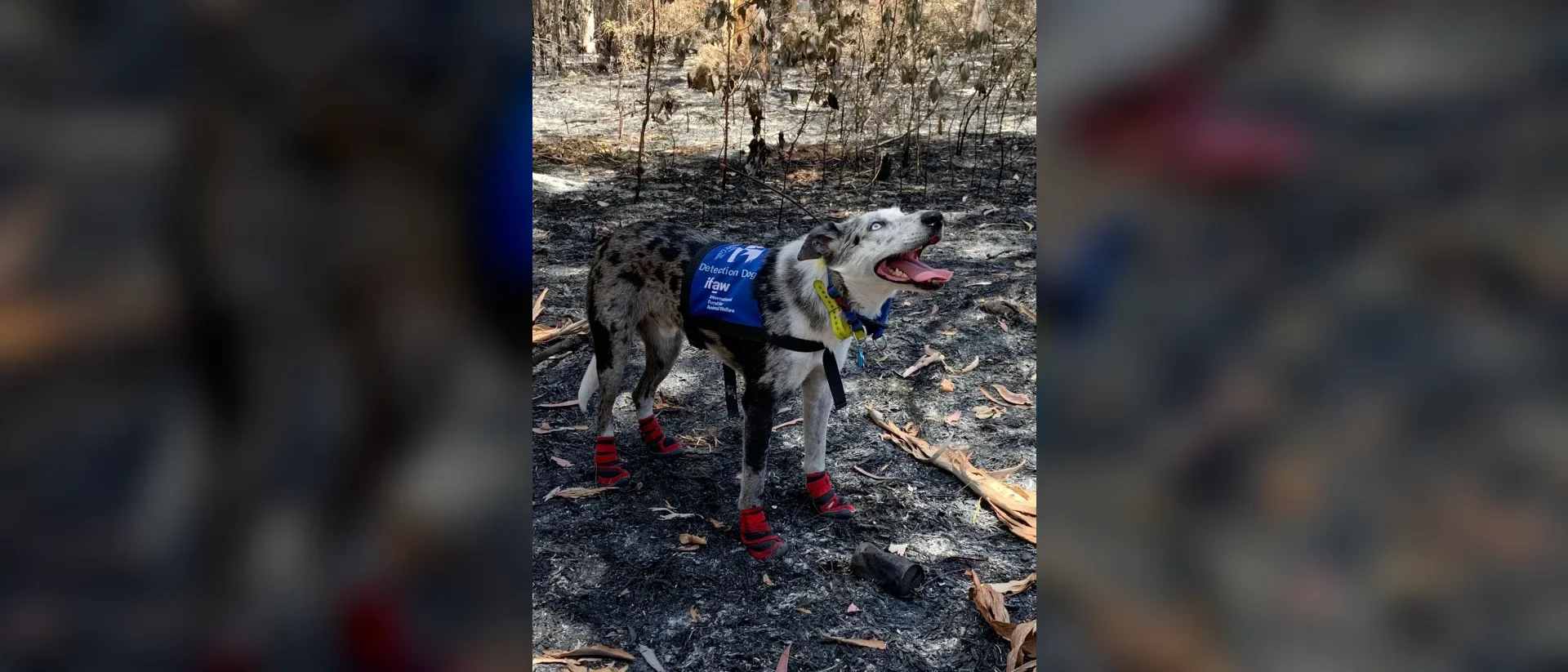
Wearing his red protective booties to shield his paws from scorched earth, Bear worked the fire-damaged forest line by line. From November 2019 to April 2020, he located more than 100 koalas - animals that were injured, sick, dehydrated, or starving, in places no human searcher could have reached.
Ten Years, Hundreds of Koalas
The Black Summer fires brought Bear international attention. IFAW named him Animal of the Year. A PBS documentary followed. He gained celebrity admirers and a social media following. But the fires were one chapter in a longer career.
Over his decade with the DDC program, Bear saved many hundreds of koalas. Detection dogs can locate koalas up to 20 times faster than human search teams - speed that turns a guess about where an animal might be into a confirmed rescue, in terrain that might otherwise take days to cover on foot.
Retirement
In 2026, at the age of eleven, Bear retired. He lives on the Sunshine Coast with one of his former handlers, doing morning beach walks and playing fetch with a ball - the same reward that trained him to save hundreds of lives.
The trait that made him unmanageable as a pet turned out to be exactly what the koalas needed.
Frequently Asked Questions
What breed is Bear the koala detection dog?
How did Bear find koalas in bushfire areas?
How many koalas did Bear save in the Black Summer fires?
Why did Bear wear red booties?
When did Bear the koala detection dog retire?
Verified Fact
Verified Jun 28, 2026 · 6 sources checked
Source: International Fund for Animal Welfare (IFAW)Show verification details
Claims checked
- Bear was an Australian koolie nobody wanted
- He was given up after eating through apartment walls
- Trained to find koalas, 20 times faster than human teams
- Found 100+ koalas during 2019-20 fires
- Retired in 2026 after ten years of service
Sources: International Fund for Animal Welfare, PBS Nature, Good Good Good, Scoop Upworthy