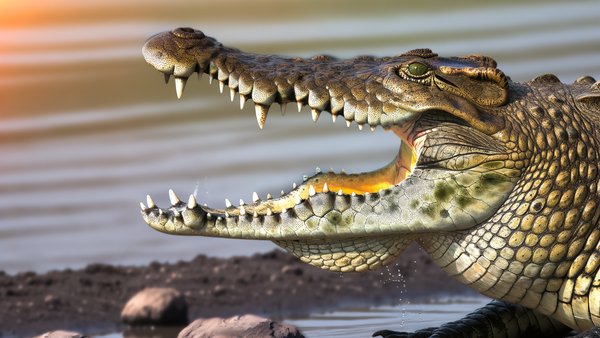
A crocodile always grows new teeth to replace the old teeth!
Crocodiles Replace Their Teeth Up to 50 Times in a Lifetime
While you're stuck with your adult teeth for life (barring dental work), crocodiles have a biological superpower: an endless supply of replacements. These apex predators can replace each tooth in their jaw up to 50 times over their lifetime, ensuring they're never caught with a toothless smile.
Crocodiles belong to a group called polyphyodonts—animals that continuously replace their teeth. While most mammals (including humans) are diphyodonts with just two sets of teeth, crocodiles share this regenerative ability with sharks, most fish, and many reptiles. It's the ancestral vertebrate condition that we mammals mostly lost.
The Tooth Factory Beneath Your Smile
Each tooth in a crocodile's mouth is part of a "tooth family" unit. Directly beneath every functional tooth sits a developing replacement, waiting in the wings like an understudy ready to take the stage. The magic happens in the dental lamina—a band of tissue packed with stem cells that acts as a biological tooth factory.
These stem cells continuously produce new teeth throughout the crocodile's life. When a tooth is lost to wear, damage, or the struggles of grabbing prey, the replacement beneath it migrates upward and takes its place. The process is so efficient that a new tooth can emerge every few months, though on average each position gets refreshed about once per year.
Built for a Rough Life
This constant regeneration isn't just convenient—it's essential. Crocodiles don't chew their food; they grip, tear, and swallow chunks whole. Their teeth endure tremendous force from thrashing prey, biting through bone, and the occasional rock or hard object. Without the ability to replace damaged teeth, a crocodile would eventually lose its hunting effectiveness.
Younger crocodiles replace teeth more rapidly than older individuals, which makes sense given their smaller teeth and more active growth phase. Over a typical 70-year lifespan (some species live even longer), that's potentially 3,000+ teeth grown and replaced in a single mouth.
Scientists have used microCT imaging on living alligators to watch this process in real-time, revealing the intricate timing and positioning of replacement teeth. Research published in recent years has mapped the molecular circuits regulating this development, hoping to unlock insights that might one day help humans regenerate lost teeth.
Why Can't We Do That?
Mammals evolved to prioritize precision over replacement. Our complex occlusion—the way our upper and lower teeth fit together for efficient chewing—requires stable, long-lasting teeth. The trade-off for our sophisticated chewing ability was losing continuous replacement.
But crocodiles remind us that nature solved the tooth problem differently millions of years ago, and it's worked brilliantly ever since.
Frequently Asked Questions
How many times can a crocodile replace its teeth?
How fast do crocodile teeth grow back?
What are polyphyodont animals?
Why do crocodiles need to replace their teeth so often?
Can humans regrow teeth like crocodiles?
Verified Fact
This fact has been reviewed and verified against original sources.
Show verification details
Factually accurate. Crocodiles are polyphyodonts—they continuously replace their teeth throughout their lifetime, with each tooth replaced up to 50 times. New teeth grow from stem cells in the dental lamina beneath existing teeth.