A crocodile cannot stick out its tongue.
Why Crocodiles Can't Stick Out Their Tongues
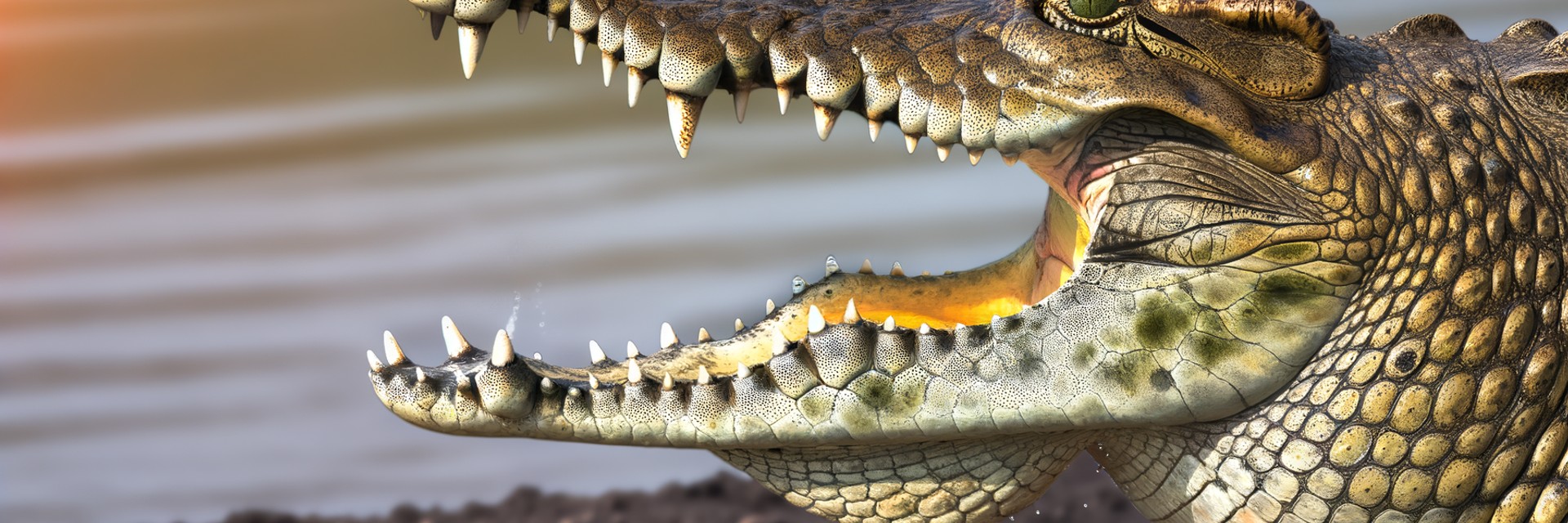
If you've ever watched a crocodile yawn or roar with its massive jaws wide open, you might have noticed something unusual: no tongue wagging. That's because crocodiles are physically incapable of sticking out their tongues, and this bizarre limitation is actually one of nature's cleverest designs.
Unlike humans, dogs, or most other animals that can move their tongues freely, a crocodile's tongue is essentially glued in place. A thick membrane called the lingual frenulum runs along the entire length of the tongue, anchoring it firmly to the floor of the mouth. The tongue itself is relatively flat and immobile, more like a textured carpet than a flexible muscle.
The Underwater Advantage
This might sound like a disadvantage, but it's actually a brilliant evolutionary adaptation. Crocodiles spend much of their lives submerged, waiting to ambush prey. When they open their mouths underwater—whether to catch fish or drag larger animals beneath the surface—they face a serious problem: how do you open your jaws without drowning?
The answer lies in the palatal valve, a sophisticated two-part seal system. The immobile tongue forms the lower portion of this valve, while a flap of tissue at the back of the throat (the gular fold) creates the upper portion. When these two parts press together, they form a watertight barrier that completely separates the mouth from the throat and airway.
This means a crocodile can open its mouth wide underwater, bite down on prey, and even perform the infamous "death roll" without water rushing into its lungs. It's essentially like having a built-in snorkel valve that automatically prevents drowning.
Protection from Self-Injury
There's another major benefit to having an immobile tongue: safety. Crocodiles possess one of the most powerful bite forces in the animal kingdom—up to 3,700 pounds per square inch in saltwater crocodiles. When those jaws slam shut on prey, anything caught between the teeth is in serious trouble.
If a crocodile had a mobile tongue like ours, it would be at constant risk of biting itself during feeding frenzies. The fixed tongue stays safely out of the way, pressed against the floor of the mouth where it can't accidentally become caught between those razor-sharp teeth.
Shared Across All Crocodilians
This trait isn't unique to just crocodiles. The entire crocodilian family shares this adaptation:
- Alligators have the same tongue-anchoring membrane
- Caimans also cannot stick out their tongues
- Gharials, with their distinctive long snouts, have immobile tongues too
Recent research has revealed even more complexity to this system. A 2024 study published in The Anatomical Record discovered a structure called the "velar fossa"—a shallow depression in the roof of the mouth that accommodates the gular fold when it rises to form the seal. It's a testament to just how refined this watertight mechanism has become over millions of years of evolution.
So the next time you stick your tongue out (something you can do, but a crocodile never will), remember: that immobile tongue isn't a limitation. For a predator that hunts between two worlds—air and water—it's the perfect tool for the job.
Frequently Asked Questions
Can crocodiles stick out their tongues?
Why can't crocodiles move their tongues?
Do alligators have the same tongue as crocodiles?
How do crocodiles eat without moving their tongues?
What is the palatal valve in crocodiles?
Verified Fact
This fact has been reviewed and verified against original sources.
Source: View sourceShow verification details
Confirmed through multiple scientific sources. Crocodiles have a membrane (lingual frenulum) that attaches their tongue to the floor of the mouth along its entire length, making it immobile.