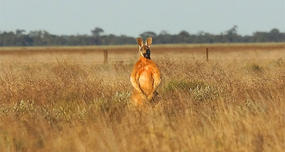
Emus and kangaroos cannot walk backwards.
Why Emus and Kangaroos Can't Walk Backwards
If you've ever wondered why the emu and kangaroo grace Australia's coat of arms, here's your answer: neither animal can walk backwards. This peculiar limitation made them perfect symbols of a nation that only moves forward. But this isn't just patriotic poetry—it's biology.
The Kangaroo's Five-Legged Problem
When a kangaroo moves slowly, it doesn't just use its legs. That massive muscular tail acts as a fifth limb, creating a tripod stance with the front legs and tail supporting the body while the hind legs swing forward. Research published in Biology Letters found that the tail generates as much propulsive force as the front and hind limbs combined during this "pentapedal" locomotion.
This five-point movement system is brilliant for moving forward but creates an unstable geometry for reversing. The tail can't exactly moonwalk.
Built for Bounding, Not Backing Up
The kangaroo's hind legs tell an even clearer story. These powerhouses are designed for one thing: explosive forward momentum. The joints at the knees and ankles are optimized to absorb impact and generate forward thrust, with a stiffness that severely restricts the range of motion needed for backward steps.
Add to this the fact that kangaroos move both hind legs together when hopping—rather than independently—and you've got an animal that's essentially a biological pogo stick. A rigid pelvis and spine provide stability for efficient hopping but eliminate the flexibility backward locomotion would require.
Can they ever move backward? Technically, yes—a kangaroo might shuffle back a few inches during a fight or when maneuvering in tight quarters. But sustained, purposeful backward walking? Anatomically impossible.
What About Emus?
The emu's backward limitation is equally real but less thoroughly documented. Unlike ostriches (which can walk backwards), emus are stuck in forward gear. Scientists suspect their knee joints prevent the movement, though the exact mechanism hasn't been studied as extensively as the kangaroo's.
An emu might occasionally shuffle backward very slightly in a cramped space, but watch one try, and you'll see an awkward, reluctant movement that clearly goes against the bird's design.
Evolution's Trade-Off
Here's the thing: this isn't a design flaw. It's an evolutionary optimization. Both animals inhabit Australia's vast open landscapes where speed and endurance matter far more than reversibility. Kangaroos can reach speeds of 35 mph and cover 25 feet in a single bound. Emus can sprint at 30 mph for extended distances.
Why waste biological resources on backward mobility when forward momentum is what keeps you alive? In the kangaroo's case, that powerful tail and those spring-loaded legs are perfectly adapted for covering ground efficiently in the Australian outback. Going backwards would be about as useful as a reverse gear on a rocket.
So next time you see Australia's coat of arms, remember: those animals aren't just national symbols. They're anatomical proof that sometimes, the best way forward is the only way forward.
Frequently Asked Questions
Can kangaroos walk backwards?
Why can't emus walk backwards?
Why are kangaroos and emus on Australia's coat of arms?
What animals cannot walk backwards?
Do kangaroos ever move backwards at all?
Verified Fact
This fact has been reviewed and verified against original sources.
Show verification details
Scientifically accurate. Kangaroos cannot walk backwards due to their tail acting as a fifth limb, powerful hind legs designed for forward hopping, and joint mechanics optimized for forward momentum.