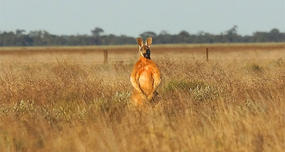
A kangaroo cannot jump if its tail is off the ground.
Kangaroos Can't Jump Without Their Tail Touching Ground
Here's something that sounds made up but is absolutely real: if you somehow lifted a kangaroo's tail off the ground, it wouldn't be able to hop. Not because it's being stubborn—it physically can't do it.
Scientists discovered this wasn't just internet folklore when they studied red kangaroos walking across force-sensitive plates in 2014. The results were surprising: a kangaroo's tail exerts as much propulsive force as its front and hind limbs combined during slow movement. It's not just a balance aid—it's literally a fifth leg.
The Physics of Hopping
A red kangaroo's tail contains more than 20 vertebrae wrapped in muscles comparable in thickness to a human thigh. When kangaroos hop at high speeds, the tail acts as a counterbalance, swinging in the opposite direction of their body to maintain stability. Remove that counterweight, and the physics fall apart.
Think of it like trying to run while someone holds your arms pinned to your sides. Your body relies on arm movement to balance the rotation of your legs. For kangaroos, the tail does even more—it provides the actual thrust needed to move forward when they're grazing or walking slowly.
What Happens When You Lift It
Without the tail touching the ground, kangaroos become confused and unstable. They can't coordinate their limbs properly. Even a slight lift disrupts their entire locomotion system.
This isn't theoretical—it's been observed both in lab settings and in the wild. Injured kangaroos with tail damage struggle significantly with movement until they heal.
Walking Like a Pentapod
When kangaroos aren't hopping at speed, they use what scientists call pentapedal locomotion—literally, five-legged walking. Here's how it works:
- They plant their forelimbs on the ground
- They push with their powerful hind legs
- They use the tail to thrust the body forward
- The tail supports their weight while the hind legs swing forward
This "walking" gait is actually their default mode when grazing. The iconic hopping only happens when they need to cover ground quickly or escape predators.
Evolution's Clever Solution
Kangaroos evolved this system because hopping is incredibly energy-efficient at high speeds. Their ankle tendons store and return elastic energy like springs, allowing them to travel faster without burning more calories. A 2025 study showed they can increase speed without increasing energy expenditure by changing their posture and maximizing tendon efficiency.
But at slow speeds, hopping is wasteful. So evolution gave them a muscular tail that transforms their body into a stable five-pointed platform for grazing and slow movement. It's biomechanical brilliance.
So yes, the internet fact is true: lift a kangaroo's tail, and you've disabled Australia's most iconic hopper. Their tail isn't decorative—it's mission-critical hardware.
Frequently Asked Questions
Why can't kangaroos jump without their tail?
What happens if you lift a kangaroo's tail off the ground?
Do kangaroos use their tail as a leg?
How strong is a kangaroo's tail?
Can kangaroos hop without using their tail?
Verified Fact
This fact has been reviewed and verified against original sources.
Show verification details
Scientific studies, particularly a 2014 Royal Society study, confirm that kangaroos use their tail as a 'fifth leg' for balance and propulsion.