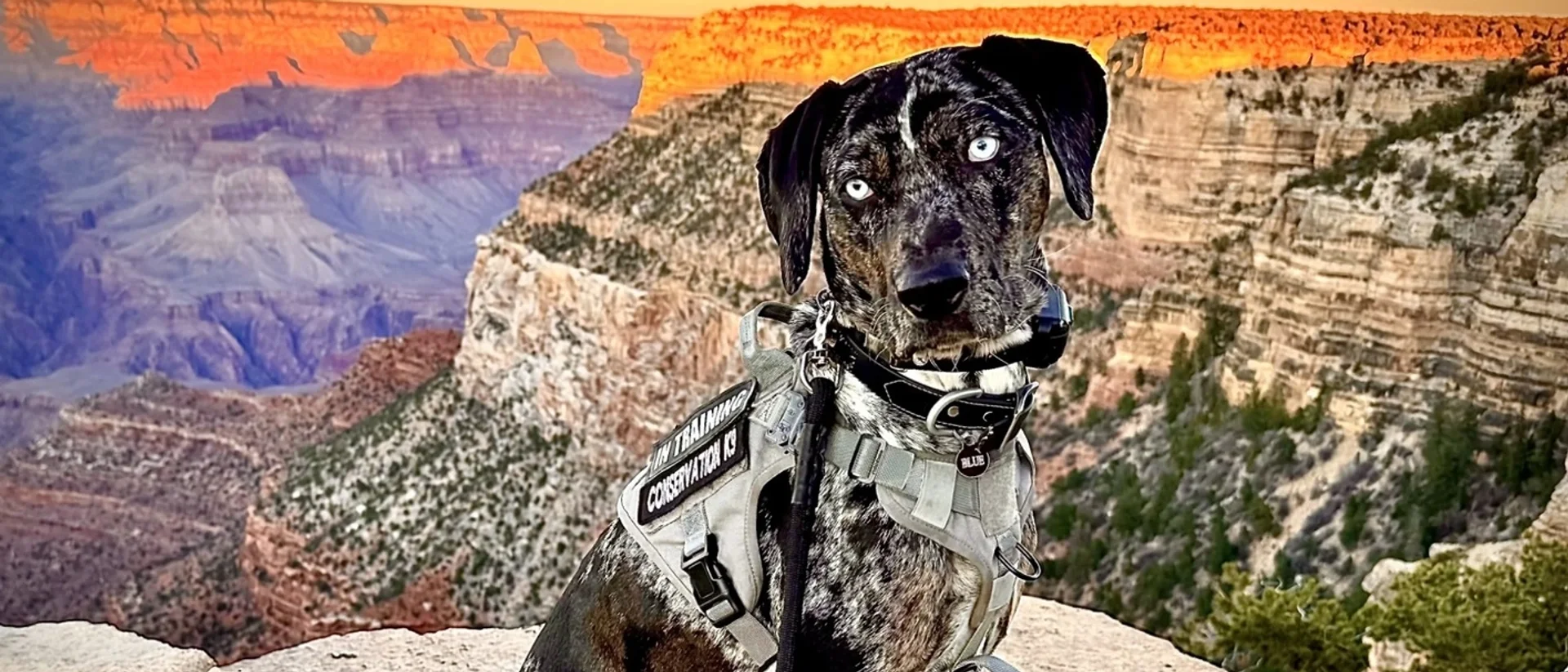
Elk at the Grand Canyon taught themselves to work the water fountains, lifting the spring-loaded levers with their noses. They guarded the spouts from hikers, and the park rebuilt the fountains elk-proof. The herds crowd the lodges anyway, to dodge cougars, so park biologists brought in a dog. Blue works on a leash and barks them back out.
The Grand Canyon Put a Dog on the Elk Problem
Somewhere on the Grand Canyon's South Rim, an elk worked out that the metal box by the trailhead gives water to anything that lifts the lever with its nose. Enough of the herd learned the trick that the park eventually lost control of its drinking fountains.
The Elk Learned the Levers
Grand Canyon National Park installed water refill stations in 2011 and stopped selling disposable plastic water bottles the following year. The bottles had been a fifth of the park's waste.
The elk noticed. They began lifting the spring-loaded levers with their noses and drinking straight from the spouts, and they were not inclined to share.
"They got a little aggressive about it," chief resource manager Martha Hahn told the Associated Press. "They were pretty protective of that water and wanting to get it first."
The favorite was the station at the South Kaibab Trailhead, because an elk could duck straight back into the woods afterwards.
A Flagstaff hiker named Ian Tong described walking up on one there in 2012. The elk made clicking sounds with her mouth and shadowed his group from either side of the filling station. "It definitely was a 'go away' kind of thing," he said. "She wasn't wanting to share."
For a while the park switched that station to winter mode, which runs off a button instead of a lever. The elk had not solved the button.
Fountains That an Elk Cannot Open
The stations were eventually closed outright. Too many people and too many elk were meeting at the same tap.
In August 2023, crews installed replacements at the Bright Angel and South Kaibab trailheads with wildlife-resistant enclosures around the works, paid for by Grand Canyon Conservancy through a grant from the National Park Foundation and Tupperware.
The new fountains give water to hikers and nothing to elk. About a dozen filling stations are scattered across the park, and the retrofit covered the two trailhead stations the elk had made their own.
Why the Herds Moved Into Town
The fountains were a symptom. Over the years, elk and bighorn sheep on the South Rim have settled on the busiest parts of Grand Canyon Village as the safest place to be, because cougars and coyotes do not hunt in a parking lot.
Studies between 2018 and 2021 found elk using developed areas as core habitat: bedding down beside the lodges, crossing visitor pathways, lingering near the roads.
Emergency wildlife callouts climbed with them. Visitors stopped traffic to take photographs and gathered in too close, and an elk guarding a calf or deep in the rut does not always give way.
The old tools were blunt. Wildlife biologist Brandon Holton told the Associated Press that staff had tried staring the herds down and firing paintball and water guns at them.
"Some move, some don't," Holton said. "Sometimes when you shoot them with water guns, they open their mouth."
Enter Blue
In May 2026, the park sent a dog out instead.
Blue is a trained and certified Catahoula Leopard Hound, picked for her herding instinct, her stamina and her calm temperament. Her handler is wildlife biologist Brady Dunne, who leads the park's new Conservation K-9 Pilot Project.
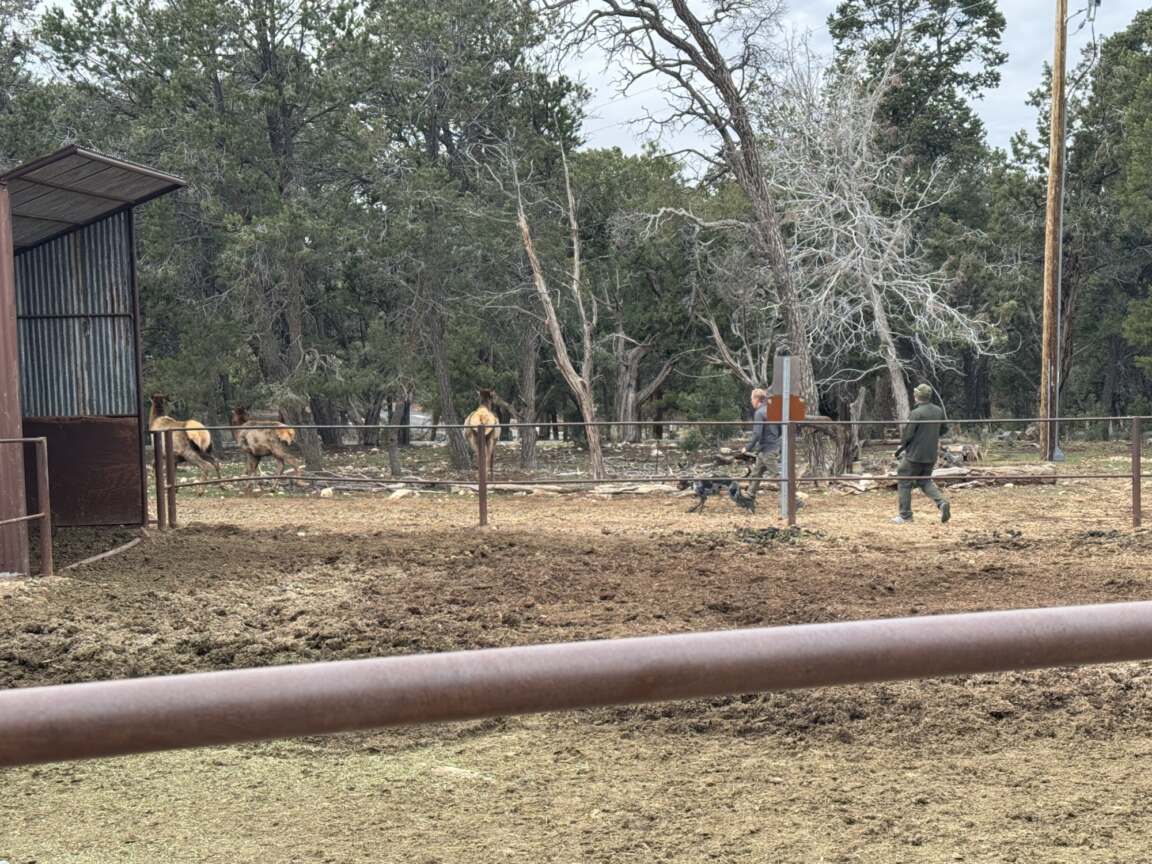
She works the exclusion zones in Grand Canyon Village where the trouble has always clustered, among them the El Tovar complex, the visitor center, Maswik Lodge, the Mather Campground services area and the Grand Canyon School. When elk or bighorn sheep drift in, staff may briefly hold up foot or vehicle traffic while Blue goes to work.
The work is barking and herding pressure and nothing else. She stays on the leash and never makes physical contact with an animal.
The park calls it a natural predator cue. The herds came into the village to get away from a predator, so the park walked one back in on a lead.
Most of her shifts fall in spring calving season and the late-summer rut, when the animals are at their touchiest.
Three Years to Find Out
Blue is in year one of a three-year pilot, funded largely by Grand Canyon Conservancy and modeled in part on a wildlife shepherding program at Glacier National Park.
In fall 2025, wildlife staff fitted radio collars on nine habituated elk and five habituated bighorn sheep, so the movements can be measured against more than fifteen years of monitoring records rather than guessed at.
Success looks like fewer animals in the exclusion zones, fewer emergency callouts and, in time, elk that go back to grazing and bedding somewhere other than the lawn outside a hotel.
The park is also drying up what drew them in, fixing water leaks, tightening waste handling and changing the landscaping. The two trailhead fountains, at least, are already elk-proof.
Source:National Park Service
Enjoyed this fact?
Be the first to love this
Get a new fact every morning.
A fascinating fact in your inbox every morning. Free. Unsubscribe anytime.
Frequently Asked Questions
Can elk really use water fountains?
Why are there so many elk in Grand Canyon Village?
What is a conservation K-9?
What breed is Blue, the Grand Canyon's conservation dog?
Is it safe to approach elk at the Grand Canyon?
Verified Fact
Verified Sep 18, 2026 · 4 sources checked
Source: National Park ServiceShow verification details
Claims checked
- Elk at the Grand Canyon learned to open the trailhead water stations by lifting the spring-loaded levers with their noses
- The elk guarded the stations and did not always back down when hikers approached
- The stations were closed, then rebuilt with wildlife-resistant enclosures at two trailheads in August 2023
- Start of the park's conservation dog project corrected to May 2026 (was May 18, 2026)
- The park names five exclusion zones the dog works; the copy no longer states it as a park-wide total
Sources: Associated Press, National Park Service, Grand Canyon Conservancy
Related Topics
More from Animals
View all Animals →