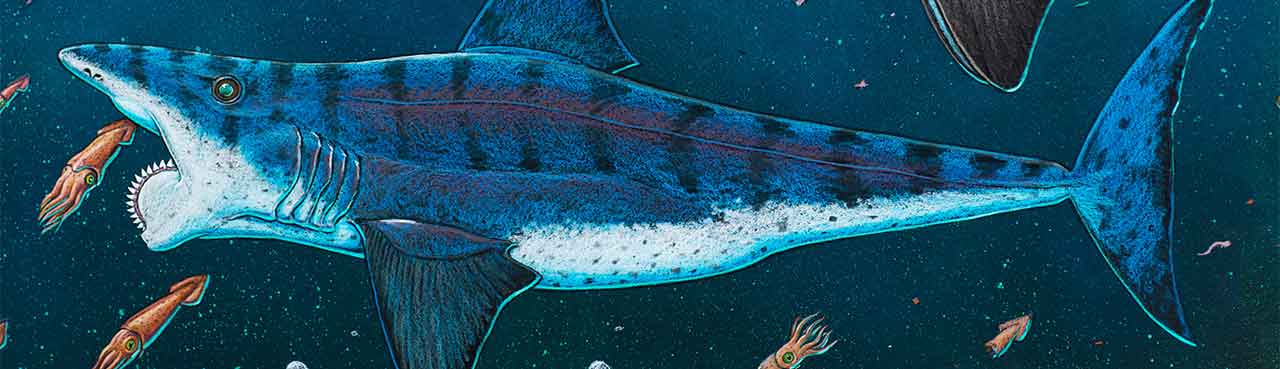
Helicoprion was a shark-like fish that lived 270 million years ago. It grew up to 4-8 meters long and had a bizarre spiral whorl of teeth on its lower jaw, unlike anything seen in modern animals.
The Prehistoric Fish With a Buzzsaw for a Mouth
Imagine a creature with a circular saw blade embedded in its jaw. That's essentially what Helicoprion looked like—a prehistoric fish so bizarre that scientists spent over 100 years arguing about where its teeth actually went.
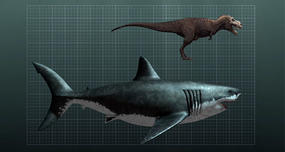
This wasn't your typical ancient predator. Helicoprion swam the oceans during the Permian period, roughly 270 million years ago, long before dinosaurs dominated the land. It survived one of Earth's most catastrophic events and grew to impressive sizes of 4-8 meters (13-26 feet) in length.
The Tooth Whorl That Stumped Science
When the first Helicoprion fossil was discovered in 1899, paleontologists were baffled. They found a spiral of teeth—a tooth whorl—that looked like a coiled spring or a circular saw blade. But where did it go on the animal?
Scientists proposed wild theories:
- A defensive tail weapon
- A dorsal fin modification
- A curled-up nose appendage
- Some kind of external saw protruding from the jaw
The guessing continued for over a century. Without a complete skull fossil, everyone was essentially solving a puzzle with most pieces missing.
The 2013 Breakthrough
It wasn't until 2013 that CT scans of a well-preserved specimen finally revealed the truth. The tooth whorl sat entirely inside the lower jaw, functioning somewhat like a circular saw within the mouth. As new teeth grew at the back of the whorl, older teeth rotated forward and inward, creating that distinctive spiral pattern.
Unlike modern sharks that constantly shed teeth, Helicoprion never lost a single tooth. Every tooth it ever grew remained in that whorl, creating a permanent dental record of the animal's entire life.
Not Actually a Shark
Despite often being called the "buzzsaw shark," Helicoprion wasn't technically a shark at all. It belonged to a group called eugeneodontids—cartilaginous fish related to sharks and rays but on a different evolutionary branch. Think of it as a cousin rather than a direct ancestor.
The creature likely used its tooth whorl to slice through soft-bodied prey like squid and small fish. The spiral arrangement would have worked like a serrated blade, efficiently cutting through flesh as the jaw closed.
A Survivor Against the Odds
Helicoprion wasn't just weird—it was remarkably successful. The genus survived for approximately 35 million years and lived through the Permian-Triassic extinction event, which wiped out roughly 96% of all marine species. That's the most devastating mass extinction in Earth's history, and this buzzsaw-mouthed oddball made it through.
Eventually, the eugeneodontids did die out, leaving no direct descendants. But for millions of years, Helicoprion and its relatives were apex predators with one of the most unusual feeding mechanisms evolution has ever produced.
Sometimes nature's experiments look like something from a fever dream—and Helicoprion is proof that reality can be stranger than any creature we could imagine.
Frequently Asked Questions
Was Helicoprion a shark?
How did Helicoprion's tooth whorl work?
How big was Helicoprion?
When did Helicoprion live?
What did Helicoprion eat?
Verified Fact
This fact has been reviewed and verified against original sources.
Show verification details
Corrected length from 7.5m to 4-8m range (more accurate based on fossil evidence). Also clarified the tooth structure - it's a whorl, not technically 'chainsaw-like' teeth.
Related Topics
More from Animals
View all Animals →