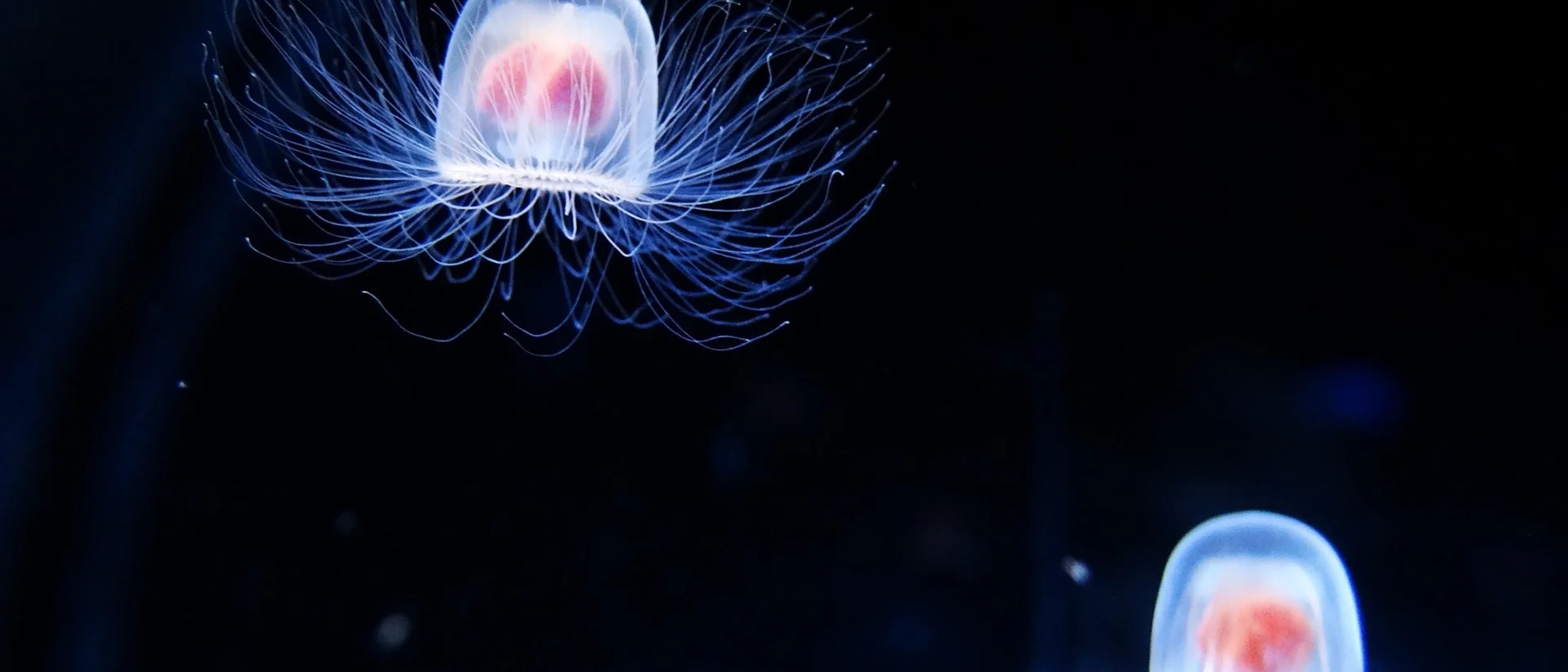
A jellyfish no wider than a fingernail cannot die of old age. When Turritopsis dohrnii gets old, starving, or injured, its adult cells transform and it shrinks back into a polyp - the larval stage it grew from years earlier. Then it grows up all over again, and can repeat the loop indefinitely. That makes it biologically immortal. Scientists only noticed in the 1990s, when aging adults kept reverting in their tanks instead of dying.
The Jellyfish That Can Live Forever
Almost every living thing ages in one direction. Cells wear out, tissues break down, and the body eventually stops. One animal does not follow this rule. Turritopsis dohrnii, a jellyfish no wider than a fingernail, can run its life cycle in reverse.
A Discovery Nobody Expected
Scientists first collected the species in the Mediterranean Sea in 1883. For over a century it was treated as an ordinary small jellyfish. Then in the 1990s, researchers noticed something strange: stressed or aging adults were sinking to the bottom of their tanks and transforming. Instead of dying, they were shrinking back into polyps, the larval stage they had come from years earlier.
How It Works
The process is called transdifferentiation. When the jellyfish is old, starving, or badly injured, its mature adult cells change type. They reorganise into the cells of a much earlier life stage, forming a new polyp colony on the seabed. That polyp then buds and releases new medusae, genetically identical to the original adult. The whole cycle starts again.
Think of it like a butterfly turning back into a caterpillar, then hatching again as if nothing happened. No other animal is known to do this on demand as a survival reflex.
The Scientist Who Keeps Watching It Die and Undying
Shin Kubota, a biologist at Kyoto University's Seto Marine Biological Laboratory, has kept captive colonies of T. dohrnii for decades. He observed one colony reverse itself 10 times over a two-year period, in intervals as brief as one month. Kubota believes the jellyfish holds clues to understanding aging in all animals, including humans, and has described it as potentially pointing toward treatments for age-related disease.
A Silent World Invasion
Originally found only in the Mediterranean, the species has now spread to oceans worldwide. Ships discharge ballast water that carries jellyfish larvae, and T. dohrnii has quietly colonised temperate and tropical seas across the globe. Scientists call it "a worldwide silent invasion."
Still Mortal in Practice
The jellyfish can avoid death from aging, but it can still be eaten, infected by parasites, or killed by sudden physical damage it never triggers a reversion from. In the wild, most individuals meet one of those fates before the reversal mechanism is needed. The immortality is biological, not absolute.
Even so, the ability to reprogram differentiated cells is of enormous interest to stem cell researchers and oncologists. Understanding how T. dohrnii switches cell identity could one day point toward new ways to repair human tissue damaged by disease.
Frequently Asked Questions
What is the immortal jellyfish?
How does Turritopsis dohrnii become immortal?
Can the immortal jellyfish actually never die?
Where does the immortal jellyfish live?
Why does the immortal jellyfish matter to science?
Verified Fact
Verified Jun 15, 2026 · 4 sources checked
Source: View sourceShow verification details
Verified 2026-06-15. 4 sources checked. Primary: Kubota 2011 Biogeography 13:101-103 (via Wikipedia + secondary reports). Claims checked: core immortality claim CONFIRMED; transdifferentiation CONFIRMED; size 4.5mm CONFIRMED; 1883 Mediterranean origin CONFIRMED; Kubota/Kyoto/Seto Lab CONFIRMED; ballast water spread CONFIRMED; wild mortality CONFIRMED. CORRECTED: article said 10 times in a single month but Kubota 2011 says 10 times over a two-year period in intervals as brief as one month - the article had merged the total count with the shortest interval. Worldwide silent invasion quote paraphrase acceptable (attributed to Maria Miglietta, Smithsonian). No social fields affected.
Related Topics
More from Animals
View all Animals →